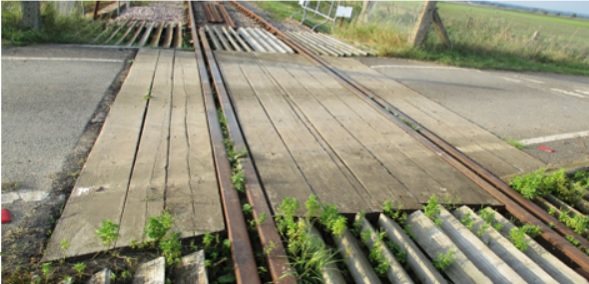
There are approximately 6,000 level crossings in Britain, of which 2,059 are User-Worked Crossings (UWCs), meaning that they are manually operated by drivers and pedestrians with no signalman or crossing keeper involved. These UWCs crossings include ‘occupation’ crossings, typically for vehicles, plus footpath crossings.
UWCs are usually found on private roads or small country roads. Such private crossings were installed by the railways when they were built, for the benefit of farmers and individuals whose land or access to homes was divided by the railway. Over the course of time these crossings have presented railway operators with several challenges.
The first and most obvious challenge relates to safety. Around nine people are killed in level crossing accidents each year, mainly pedestrians and vehicle users. Incidents on UWCs are more frequent than on other types of crossing, when taking account of the relative frequency of usage. Some major contributing factors to this increased risk include greater potential for user error, lack of awareness, and potential for misuse.
The second major challenge posed by these crossings is maintenance. While some crossings traditionally featured gravel or tarmac surfaces, and others steel-framed concrete (Bomac) panels, a high percentage are of timber construction. With some parts of Britain averaging over 4,000mm of rainfall annually, our damp climate can promote rotting and deterioration of woodwork. Coupled with regular usage by heavy farm vehicles, this may result in crossing surfaces becoming damaged or unsafe and requiring regular maintenance or replacement. Moreover, since creosote was banned due to its toxicity, timber crossing surfaces can no longer be treated to extend their lifespan.

A solution
These were challenges that Network Rail’s Ross Briddon was seeking a solution for. Ross is the route engineer for Network Rail’s busy Sussex and Kent routes in the south of England (Southern Region). Since 2014, Ross has experimented with the use of Network Rail-approved Sekisui Fibre-reinforced Foamed Urethane (FFU) sleepers and longitudinal bearers on bridges on this route. These were installed as part of a programme of replacing life-expired timber assets and the outcome had been most impressive. FFU looks and behaves similarly to hardwood, yet is non-porous, doesn’t rot or need treating, and has a lifespan greater than 50 years.
Ross was made aware that Sekisui had also produced FFU level crossing surfaces in Japan for many years, and in more recent years had trialled them successfully in Europe at a rural location in Austria. Working with his contacts at Sekisui in the UK and his colleagues from Network Rail Technical Authority, Ross opted to become a sponsor to enable the FFU level crossing surface to undergo trials in Britain. The locations selected for the trials, starting in 2022, were Forge Farm Level Crossing in Sussex and Snargate Level Crossing in Kent.
The material to be used was FFU74, the same as already used on Sekisui’s sleepers and bearers on more than 150 Network Rail bridges. Baker Hicks Consulting was employed by Sekisui to assist with the development and design of the trial. FFU74 has a density of 740 kg/m³ (similar to hardwood), a Young modulus E value of 6,000 MPa, a bending modulus of 810 kN/cm², and an impact bending resistance of 41 J/cm².
A proposal was evaluated against Network Rail level crossing and UK highways standards. The report aimed to determine a figure for ‘HB Loading’ for FFU74. HB Loading simulates the impact of heavy loads on bridge structures and is modelled as a four-axle vehicle with four wheels on each axle. The number of HB units indicates the load intensity and varies based on road type. Each HB unit represents 10kN (kilonewtons) per axle. Motorways and trunk roads require 45 HB units, principal roads require 37.5 HB units, and other public roads require 30 HB units. Modelling determined that FFU74 was suitable for 30 units of HB loading (‘other public roads’) which was in line with the aspiration to supply an FFU replacement alternative for Network Rail’s hardwood on lower category level crossings.
Prior to the two trial sites being installed, bending stresses and deflection were also evaluated using modelling by Baker Hicks. Finally, as part of the development and design of the trial, a skid resistance evaluation was carried out by Tiflex in Cornwall. The FFU74 was etched to a depth of 5mm with an anti-slip textured surface using multiple squares arranged in a grid pattern – this was found to be the most effective design type for skid prevention. When measured using a portable skid resistance tester (as described in the Department of Transport’s Road Note 27) this gave a skid resistance value of 84 for Dry Skid Resistance and 70 for Wet Skid Resistance. These results were much higher than the minimum required skid resistance value of ≥58 (or 52 following a 15-year service life).
In summary, the feasibility study managed to convincingly demonstrate that 75mm-thick FFU74 is an adequate material for timber level crossing replacements, whether in combination with timber or concrete sleepers beneath the crossing surface.

Resounding success
Following three years of trials on Kent and Sussex routes, the FFU level crossing surface system, by now dubbed ‘RBX1’, had proved to be a resounding success. Despite extensive and heavy use by both road and rail traffic, and with exposure to varying extremes of weather and temperature, the boards demonstrated almost no sign of wear and tear or degradation, looking as good as they did when new.
The day eventually came in June 2025 when Ross Briddon received the good news which he had been waiting so long to hear. Jamie Wilkes, principal engineer for Composites at Network Rail Technical Authority in Milton Keynes, would be issuing full product acceptance for RBX1. It would now be available for use across Britain’s rail network.
RBX1 boards will be made at Sekisui’s Netherlands factory. Bottomley Site Services Ltd (BSSL), Sekisui’s Network Rail-approved fabrication partner, will add the etched anti-slip surfacing and carry out painting and fabrication according to clients’ requirements.
RBX1 will be available to customers in kit form, and they will only need to order the quantities of each component required for the project.
To allow prices to remain as low as possible, and due to the finishing of the product being carried out by BSSL, orders will be placed directly with them. BSSL also offers design and construction services should this be required by the client.
In summary, Sekisui’s RBX1 Level Crossing Surface System provides many benefits. It has a 50+ year lifespan, is non-porous, and does not rot or need treating. The product offers thermal resistance from -65 to +50°C, oil and chemical resistance, UV (light) resistance, and is fully recyclable.
And most importantly, RBX1 can be installed and maintained without the need for heavy lifting equipment, resulting in reduced maintenance costs for inspection of the rail foot, and also for rail replacement and tamping.
Image credit: Sekisui