As modern railway technology evolved 200 years ago, some might think that it is old fashioned. Yet, for significant passenger and freight flows it remains, and most probably always will be, the most efficient way of transporting large traffic volumes. It is also the only form of transport that offers net-zero carbon, high-speed, high-volume transportation. In this year of Railway 200, it is important to understand why the science and engineering of a railway gives it so many inherent advantages.
Resistance to motion
For a given load, a steel wheel on a steel rail typically has a tenth of the rolling resistance of an inflated rubber tyre which deforms slightly as it rotates and so requires additional energy.
Some forms of transport do not need wheels and so are not subject to rolling resistance, though these have other disadvantages. The water displaced by ships as they move creates a drag which is proportional to speed squared. Hence at low speed this is not significant. At walking pace, a horse could pull a 30-tonne canal boat, an 8-tonne rail wagon or, depending on road surface and gradient, a cart of up to two-tonnes.

Planes are subject to air resistance at high-speed and need to be lifted 10km into the air. As a result, on a London to Glasgow journey they consume around ten times more energy per seat than a train.
Wheel-less Maglev vehicles have been promoted as a future form of transport. However, the energy they consume to lift them above the track is greater than the friction losses saved from having no wheels. Furthermore, at very high speeds almost all the resistance to motion is from air resistance.
Hyperloop has also been promoted as the transport system of the future. It proposes very high-speed pods in vacuum tubes which would have almost no resistance to motion. Yet the provision of a costly network of large vacuum tubes, hundreds of kilometres long presents significant unresolved issues. Even if this was feasible, its capacity would be significantly less than a high-speed rail line.
Spreading the load
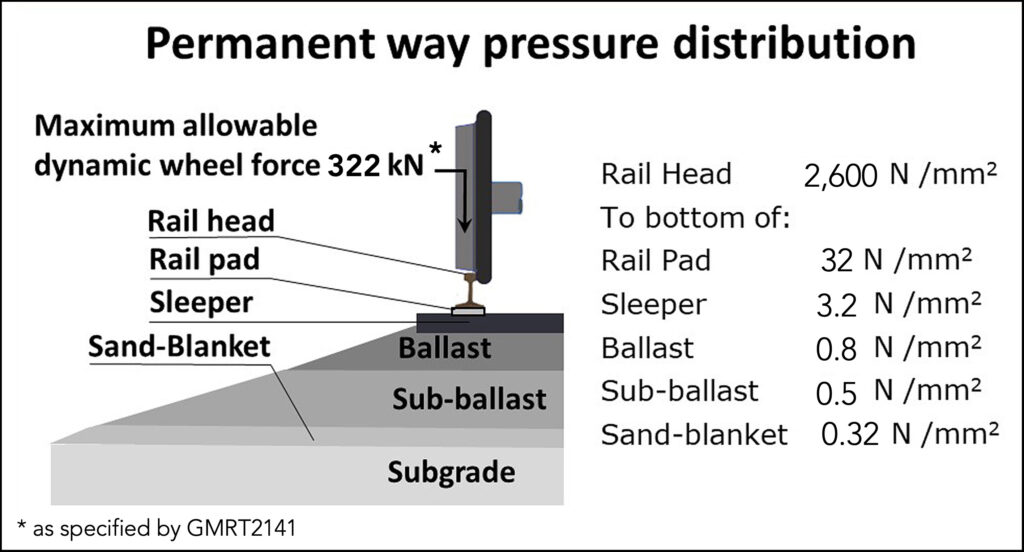
The static weight on a rail wheel of a passenger vehicle is typically six tonnes. On a freight wagon it could be up to 12 tonnes. Dynamic loading on the wheel is much more than this. This load is supported by a contact patch the size of a 20p piece which subjects the rail to a very high pressure. This is then spread through rail pads, ballast, sand blanket, and subgrade so that it can be supported by the ground. This means that a railway with a relatively narrow footprint can carry 100 tonne freight vehicles. In contrast, roads which carry 40 tonne heavy goods vehicles need to be wider and built to support such vehicles over their entire width.
Coupled vehicles
As trains are guided by rails it is safe for trains to safely pass each other at speeds of 100mph and more than a few feet apart in a way that is not possible with manually steered vehicles. This also reduces land take as tracks can be placed close together.
With rails guiding the train, it is possible to have long trains of coupled vehicles. Hence passenger trains can carry large numbers of passengers. For example, a 12-coach Thameslink train 700/1 has 666 seats and can carry a further 1,000 standing passengers. Through its central core, Thameslink has 24 trains an hour which gives it a maximum capacity of 16,000 seated, or 40,000 crush-loaded, passengers per hour. A two-lane urban road can carry typically 4,000 people per hour.
Long passenger trains are also energy efficient as much of the air resistance is from the front of the train, reducing the air resistance per vehicle.
Rails also enable one or more locomotives to haul a long freight train. For example, a 3,300-horsepower locomotive can haul a 1,500-tonne train (1.8 hp per tonne). A 40-tonne HGV with a 500-horsepower engine requires 12.5 hp/tonne and so, per tonne, requires seven times the power of a train.
Using electricity as it is generated
A further benefit of rail guided transport is that overhead cables or third rails can be used to provide a moving train with an electricity supply. This can be generated from renewable sources and so offers net zero traction. As a result, electric trains are the only vehicles that do not need to carry their energy supply and, in the case of diesel-powered trains, they do not need to carry a heavy engine which limits the power of the train.

At 125mph a train’s pantograph can collect a maximum of 300 amps from a 25,000 volt AC overhead line to provide the train with 7.5 megawatts of power or 10,000 horse power. When braking, electric trains can also generate electricity and feed it back into the national grid thus increasing their efficiency.
While battery-powered cars offer net zero traction, battery technology is not yet suitable for high powered applications. For example, a 30-tonne battery would be required to replace the energy in a typical HGV 500 litre fuel tank.
When the Stockton and Darlington railway opened 200 years ago, its five-horsepower Locomotion No 1 was able to haul 120-ton coal trains. It was only able to do so because iron wheels on iron rails were such an efficient form of transport. Since then, this technology has been developed to carry trains at very high speeds and also to carry heavy loads. For the above reasons, there’s no reason to doubt that steel wheels on steel rails will still be carrying passengers and freight in 200 years’ time, especially as decarbonisation requires a reduction in energy consumption which necessitates the use of the most efficient form of transport possible.
Image credit: David Shirres