Railway 200 celebrates the dawn of the ‘Railway Age’, inspired by the opening of the Stockton and Darlington Railway on 27 September 1825. Looking back through the history of various rail developments, it is clear that this should be recognised as a momentous date, because, for the first time, all those developments coalesced to create the first railway as we have understood them ever since, both nationally and globally. The arrival of the railways was possibly the most significant feature of the early part of the industrial revolution, leading as it did to rapid and profound changes in society, business and cultural life.
The coming of the railway was transformative in many ways. It almost annihilated the effects of distance for the traveller, and enabled and encouraged people to explore further afield and to seek employment far from home. It gave manufacturers advantages by reducing the cost and the duration of transport of goods. New markets became readily accessible. In conjunction with the telegraph and newspapers, it would convey opinions as well as people and goods and thereby have effects on political life. It had political effects in linking distant regions (levelling up, anybody?!), while at the same time strengthening central authority.

A ‘proper’ railway
What is the definition of a ‘proper’ railway? It needs to fulfil the following criteria: specialised track; accommodation of public traffic; conveyance of passengers; mechanical traction; and some measure of public control. ‘Specialised track’ means both the provision of a specially formed track with parallel rails to guide vehicles with appropriate wheels and the sole and complete occupation of land on which that track is laid. ‘Accommodation of public traffic’ distinguishes a railway from a tracked system as part of a private enterprise, for example a mine, a factory, or docklands.
From this definition it can be seen why the opening of the Stockton to Darlington Railway in 1825 is widely celebrated as the first commercial passenger carrying railway. While there had been several examples of ‘tramways’ taking passengers in horse-drawn, rail-borne coaches, it was the first passenger carrying railway powered by mechanical means and not by horse.
Interestingly, after the initial enthusiasm for steam-powered traction, the Stockton and Darlington Railway found that reverting to horse power for much of the journeys over the next few years was more efficient and economical! This remained the case until further development of locomotive design proved it to be the better option. During this period of gaining confidence from improved locomotives, passenger coaches continued to be largely hauled by horse, with freight traffic using the steam power available. Horsepower was not relinquished from the line until 1833.
The Stockton and Darlington Railway
The Stockton and Darlington Railway almost started life as a canal. The coal mines in Durham had a very healthy market for their output in London. The easiest part of the conveyance of the coal was by sea from Stockton-on-Tees. The difficult part was getting it from the coalfields to the port at Stockton. At first, it was proposed that a canal would be built from a point where the coal could be brought by wagon on tramroads from the mines down to a suitable level and then conveyed for the remainder of the journey to Stockton by water transport. In fact, three canals were proposed, the last one being objected to by the residents over whose land it would cross. However, these same residents took the initiative to propose a tramroad as an alternative.
Once again, the proposed route was objected to, this time by a fox-hunting lord. After a further change in route and the replacement of the original surveyor by the appointment of George Stephenson, the proposed railway was authorised by Act of Parliament in 1823. Stephenson advocated the use of steam locomotives on the railway. Originally the track had been planned as a plateway, but locomotives required the track to be built using edge rails instead. Also, as Stephenson had begun experimenting with wrought iron, this material was specified in place of cast iron which, as described later, frequently broke under the weight of steam locomotives. As first built, the railway used the fairly usual system at that time of short rails laid on stone blocks. What differentiated the Stockton and Darlington from previous enterprises, and was almost certainly fundamental to its success, was that it seems to have been the first instance of the large-scale use of wrought iron for the permanent way.
Precursors
By 1825, the various features necessary to create a new form of transport were all there, including:
Track in many forms, from short wooden or iron rails, usually simply supported on stone blocks, or even from stone ‘rails’, had been used in tramroads in many places over a long period. While canals were important carriers of heavy goods such as coal or stone, tramroads or mineral lines provided an efficient adjunct to bring the goods down to the canal level. These were the canal feeder lines and there were many such lines, particularly in the mining areas of north-east of England and, in Wales, in the Forest of Dean and in the Neath and Swansea valleys.
A suitable locomotive had been developed by Stephenson after Richard Trevithick had demonstrated in 1804 the practicality of a steam locomotive as opposed to stationary engines.
Passenger transport by rail had been trialled at Oystermouth on the Swansea and Mumbles Railway in 1807, showing that tracked conveyance need not be restricted to freight.

The powers given to the Stockton and Darlington allowed users other than the owners to offer carriage of goods and people, being the beginning of a public, rather than a fully private, railway as was the case for mineral and dock railways. In fact, the carriage of passengers on the railway was carried out entirely by external contractors, and not by the proprietors of the line.
Evolution of track types
But what about development of the track? It might be imagined that the permanent way being specified for this first mechanically-powered, passenger-carrying railway had evolved from the earlier forms of track used on the various ‘tramroads’ and mineral lines. This is not entirely the case. The majority of the older tramways used the L-section plateways rather than the ‘edge’ rail. This was to allow the load carrying vehicles, fitted with flangeless wheels to be used on roads as well as on a guided rail system.
Additionally, the preferred method for achieving the correct gauge was to fix the plates to stone blocks rather than using sleepers or any other form of cross-ties. The stone blocks were drilled to allow oak plugs to be installed to receive the fastenings. The absence of any cross-ties avoided any obstruction for the horses walking between the plates. Incidentally, the commonly used term ‘platelayer’ for a permanent way lengthman has its derivation from the days of these plateways.
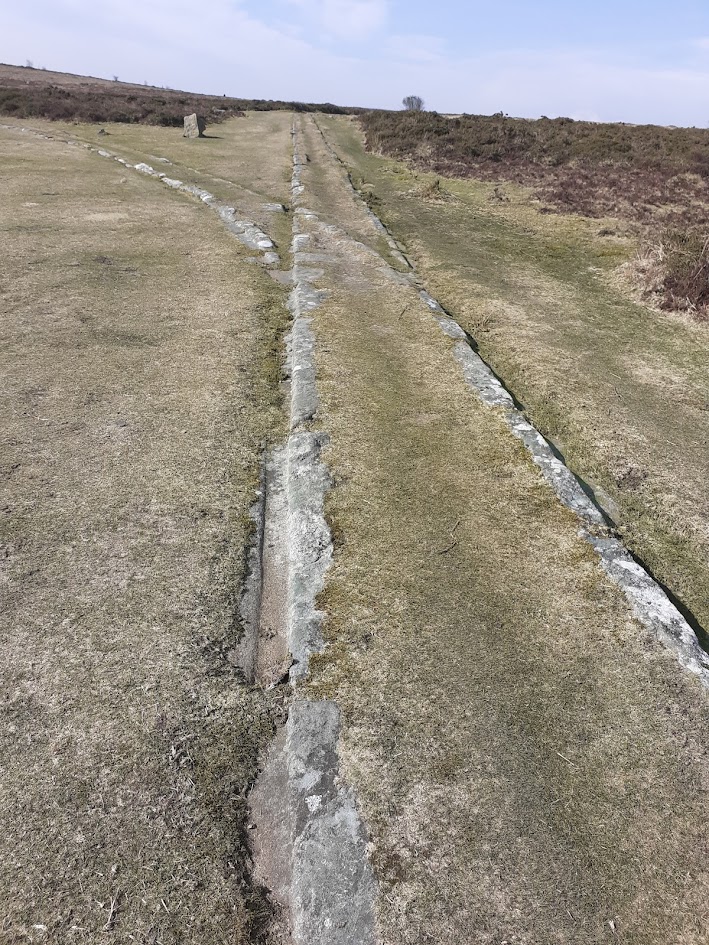
Going a little further back in time, what was the gestation of the metal plateways, with the concept of the flange on the track, rather than the wheel? It may have evolved from trackways using only stone as the construction material. A good example of this is the track system used to carry granite from the Haytor Quarries on the edge of Dartmoor down to the Stover Canal for sea transfer from the Teign estuary. This was used to build such structures as London Bridge and the British Museum. This particular track system, built in 1820, was actually contemporaneous with the metal plateways in common use by that date, but the use of stone was evidently still favoured.
The granite available on the spot was used to build the track, which is formed simply from blocks between 4-8 feet long and about 1 foot square, beautifully crafted into an L-shaped cross-section. The workmanship and labour involved in producing these must have been enormous, but the finished product was very robust, hard wearing, and long lasting. So much so, that large extents of the Haytor trackways are still very evident and in good condition to this day. In terms of maintenance and repair, they are a striking contrast to the early days of the alternative track forms in use. Once locomotives started to be used on metal rails, whether supported by stone blocks or timber sleepers, much experimentation with the rail profiles, weight, and material was necessary before some degree of reliability became established.
Cast iron rails had been adequate for horse-drawn traffic, but when Richard Trevithick demonstrated his first steam locomotive at Penderryn Colliery in 1804 it quickly became apparent from the number of breaks that occurred that wrought iron would be needed for the increased loading. Similarly, while the first true railways continued for a while to use stone blocks for support, once speeds and loading increased they became inadequate to prevent gauge spread and sleepers became the norm.
So, it is not really true to say that the track form for modern railways evolved from the original tramroads, because after those modern railways came into being the tramroads continued for several decades with their own established system. In fact, both railways and tramroads continued to independently evolve and develop their own systems suitable for their respective uses. They each had a pair of parallel metals in common, but from 1825 onwards they had to fulfil different purposes.

The Liverpool and Manchester Railway
At the start of the nineteenth century, Liverpool and Manchester were respectively dependent on the Bridgwater Canal for the import of raw materials, cotton, coal, grain and livestock, and the export of cloth and other finished goods. From 1800 onwards, businesses in both great cities were looking for a more efficient means of conveyance. In 1822, William James carried out a survey for a possible railway route. A young Robert Stephenson was also in the surveying party. This work was later taken over by the latter’s father, George Stephenson, around the same time as the opening of the Stockton and Darlington. Five years later, there was another historic day, 15 September 1830, when the Liverpool and Manchester Railway was opened.
The works had been a major civil engineering project with many large structures, designed with easy gradients apart from a section requiring cable haulage at the Liverpool terminus. The line is particularly famous for Stephenson’s determination in overcoming the problems presented by Chat Moss, a four-mile-wide-swamp. He cut drains and laid floating beds of brushwood and heather for month after month until a bottom was touched 25 feet down and a stable embankment rose 5 feet above the surface of the bog. The track for most of the 31-mile route was of short, fish-bellied rails, quite light at only 35lb/yd and supported on stone blocks. The exception to this was over Chat Moss and one or two other short sections, where Stephenson specified timber sleepers to reduce the static load. The gauge, now becoming established practice, was set at 4 foot, 8.5 inches.
Rail materials and design
By 1832 it was becoming obvious that the Liverpool and Manchester Railway was having track problems. The directors asked George Stephenson to investigate and report on stronger rails. Also at this time, the directors of the Newcastle and Carlisle Railway were using the Walker Foundry to carry out a series of tests on elliptical (fish-bellied) and parallel rails to decide on the best design. However, consultation with a number of engineers only resulted in a lack of agreement. The results were passed to George Stephenson but is not known whether he used these in his report to the board. Apparently, Robert Stephenson also used the results to support a report he gave to the directors of the London and Birmingham Railway in 1834.
The tests were carried out on 15-foot elliptical and parallel rails which were each nominally 50lb/yd. Trials were made with various distances between supports with progressively increasing loads being applied and the deflections measured. Deflections were lower in the case of the elliptical rails, and this led to a belief in their better strength. Consequently, the Newcastle and Carlisle was laid with these. It was not until a few years later that it was realised that the wrong conclusions had been drawn from the tests. The tests had actually been of ultimate strength, as the rails had been loaded to beyond the elastic limit. The loads applied to achieve this deformation were far in excess of the axle loads to be carried. Soon after this realisation both the Newcastle and Carlisle and the Liverpool and Manchester were re-laid with parallel rails.
Various rail profiles were being trialled throughout these early days of railway development, including the T-section, the inverted and flanged U-section, and the H-rail or I-rail, known as double-headed, which evolved to a stabilised design as the bullhead rail. This rail section became the established stalwart for most railway construction right through until the 1930s, when some experimentation with the more modern flat bottom rail commenced.
Meanwhile, over on the Great Western Railway, Brunel decided in 1833 not only to adopt a broad gauge of 7 foot. ¼ inch, confident that this would give better comfort at higher speeds, but also to use a completely different form of track construction, being inverted U section rail (pictured below inset) directly fastened to longitudinal baulk timbers. These timbers were joined at intervals by transverse members or transoms. This system enabled, at least initially, a comparatively light rail section of 43lb/yd.
Permanent way components
Apart from the rails themselves and their fairly quickly accepted best means of support being timber sleepers, there were, of course, many other components and associated aspects of permanent way design to be developed. How to ensure continuity of the rail head across joints, how to fasten rails to sleepers and how to provide the ability to switch rail vehicles between routes were three of the most significant needs.

Originally, joints between rails were simply a case of butting one up to the next on a common support, with both rails then being clamped to that support, whether it be a stone block or a sleeper. Quite soon, a degree of sophistication was introduced by having the two rail ends fabricated such as to overlap each other on the common support. It seems that fishplates, which themselves evolved through various designs, were not generally introduced until 1847.
Various methods of fastening the rails to blocks or sleepers were trialled, ranging from direct fixing of the rail foot to the support or with the use of some kind of ‘baseplate’. Eventually, the bullhead rail system was to prove its superiority by the ease with which the rails could be secured by oak keys to cast iron chairs screwed to the sleepers. It could also be easily removed and replaced.
The subject of the design of switches and crossings is too vast to go into detail about here. Suffice to say that even such a simple trackway as that at Haytor Quarries needed junctions to facilitate the access of wagons to several loading areas. A photograph of such a ‘switch and crossing’ makes it look as though there were no moving parts, but, in fact, the wheels were guided by ‘point tongues’, made of either oak or iron, provided to choose one route or the other at the crossing ‘nose’.
A place in history
To many railway historians, the Liverpool and Manchester Railway should have the honour of being the first example of a ‘proper’ railway, in that it fulfilled all the attributes as defined earlier in this article. Unlike the Stockton and Darlington Railway, it never even contemplated the use of haulage by horse, championing steam haulage. Also, for the first time, the owners of the line provided the locomotives and rolling stock and ran all the services.
However, the Stockton and Darlington Railway deserves its own place in history, as being the enterprise which really initiated the beginning of the creation of a completely new form of transportation, available to all. It would go on to very quickly bring radical changes to people’s way of life, bring national and global opportunities, and would form a new culture and heritage loved and appreciated to this day.
Image credit: iStockphoto.com/ZU-09