
Image: IonQ
US quantum computing company IonQ and the Oak Ridge National Laboratory report having demonstrated how the power of quantum can support grid operators to meet emerging challenges.
The demonstration involved the application of a hybrid quantum-classical approach to address the ‘unit commitment problem’, which is becoming increasingly complex in an expanding decentralised system with bidirectional flows.
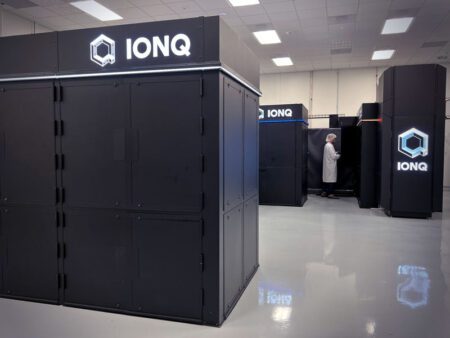
To approach this optimisation problem, which is focused on optimising generation scheduling to meet demand at the lowest cost, IonQ and ORNL developed a hybrid approach that combines IonQ’s 36-qubit Forte Enterprise quantum computing with classical computing.
Using this hybrid approach, varied solutions are reported to have been found for power generation scheduling across 24 time periods and 26 generators.
Have you read?
Quantum optimisation for power grids project launched
Why quantum innovation will be a key enabler for decarbonising energy systems
“This demonstration marks a significant milestone in applying quantum computing to real-world energy challenges. We are proud to be partnering on this ground-breaking work with ORNL and the DOE,” said Niccolo de Masi, CEO of IonQ.
“As our systems scale to thousands and millions of qubits, we expect to solve grid optimisation challenges at a scale that classic computing methods cannot match.”
The unit commitment problem, which is also under investigation by other quantum computing groups, is one of a number of optimisation and simulation tasks of interest to the energy sector.
In a release, IonQ quotes the US Energy Information Administration finding that more than 60% of energy used in electricity generation is currently lost, stating this as pointing to a significant opportunity for waste reduction through improved planning and computational methods.
This research is part of the DOE’s GRID-Q (Grid Research, Integration and Deployment for Quantum) project, which was launched in January 2024, bringing together national laboratories, academic partners and private sector companies to identify and better understand specific use cases for quantum computing, communication and sensing on the power grid.
ORNL leads the three-year project, with IonQ as one of the two quantum industry partners – the other being Denver, Colorado-based Resilient Entanglement
Suman Debnath, power electronics/power grid integration and electromagnetic transient simulation research leader at ORNL, who led the lab’s contributions to the project, said it has demonstrated the feasibility of using an ion-trapped quantum computing device to solve the unit commitment problem.
“As the quantum device scales, concurrent research is intended to test how the application performance can gain a quantum advantage.”
IonQ anticipates that quantum systems with 100 to 200 high-fidelity qubits, which are expected as early as 2026, will be capable of solving unit commitment problems at grid scale.