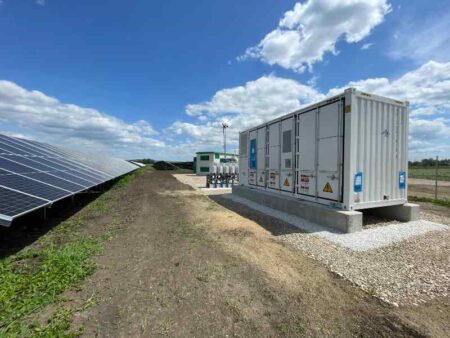

Nehrybka Solar. Image © R.Power
Photon Energy Trading PL Sp. z o. o. has signed an agreement with renewable developer R.Power Renewables for the optimisation of a hybrid solar+storage asset in Nehrybka, Poland.
According to Photon Energy, this project marks one of the first hybrid assets in the county, and will aid in increasing the flexibility of the national power system.
Under the agreement, Photon Energy will optimise the energy flows within R.Power’s asset in Nehrybka and between the asset and the grid, aiming to maximise revenue generation through applying a multi-market optimisation approach, with participation in both spot and ancillary service markets.
Have you read?
Battery project at former nuclear facility to stabilise German grid
Google partners with Energy Dome for CO2 battery technology
Depending on market conditions, the BESS can be charged either from the PV installation or directly from the grid. Both the PV and BESS capacities can be used to provide ancillary services, or to trade on the Day-Ahead Market (DAM) and Intraday Market (IDM).
Optimising these energy flows in real time requires precise forecasting of spot and balancing market conditions, as well as careful consideration of the technical constraints of the system every 15 minutes.
Photon Energy explains in a release that the challenge lies in determining the most profitable strategy for each part of the hybrid asset.
This level of optimisation is only possible through automation and seamless integration of all key components of the system, including the LFC node, SCADA and PLC systems, and machine learning-based forecasting and bidding tools.
More about Poland’s energy transition
Georg Hotar, CEO of Photon Energy Group, commented in a statement: “Photon Energy is excited to offer our expertise to maximise revenue from hybrid assets, co-located projects, and cable pooling energy objects. We believe that these optimisation services benefit not only asset owners, but also the grid and the energy system as a whole.
“During peak generation periods, energy can be stored in batteries and then discharged back into the grid when generation drops. And because these storage systems are charged with renewable energy sources, they actively support the acceleration of the sustainable transition to low-emission energy sources,” concluded Hotar.
Katarzyna Suchcicka, vice president of the Management Board of R.Power, added: “The integration of PV with storage is not only a response to changing market needs – it is the foundation of our strategy across Europe.”
Originally published on Power Engineering International.