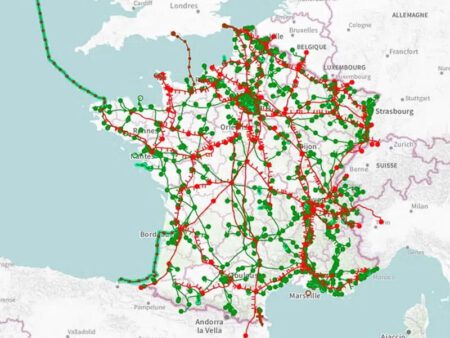

RTE’s transmission grid – 400kV level in red, 225kV level in green. 150, 90 and 63kV substations are not displayed but are included in the dataset. Image: Centre for Net Zero
Data on the French transmission grid is the first to be incorporated in the OpenSynth open data community beyond smart meter demand data.
This first candidate for non-demand data inclusion is the RTE7000 dataset, representing the 7,000 nodes of the French transmission grid and containing a series of snapshots in node breaker topology with a temporal granularity of five minutes covering the three-year period from 2021 to 2023.
RTE7000 combines a mixture of non-synthetic data on the grid topology, all network components and synthetic data and is the first major contribution in the D-GITT (detailed grid inner topology timeseries) centralised open dataset hub.
OpenSynth, which was originated by the Centre for Net Zero and open sourced under LF Energy, is designed to democratise access to AI generated synthetic data and thereby accelerate the decarbonisation of global energy systems.
Have you read?
The how, why and benefits of synthetic smart meter data
How data spaces can guide innovation in Europe
Initially, OpenSynth was focused on synthetic smart meter demand data, with the aim to empower holders of raw smart meter data to generate and share synthetic data and for community members to generate, improve and share algorithms.
As OpenSynth has grown, the Centre for Net Zero reports being approached with offers of other forms of synthetic and real energy adjacent data from different international markets for potential inclusion.
With data that is accurate at all levels of the grid hierarchy necessary to build sophisticated models of the energy system, it was decided to expand the scope of OpenSynth to maximise its value for users.
The D-GITT & RTE7000 data is now available on the Hugging Face platform. This was made possible by the non-profit association CRESYM, which fosters R&D collaboration to deliver open source energy system simulation tools and is supporting RTE with this work.
CRESYM, with the help of eRoots, is offering technical support and tutorials around the dataset and will shortly be organising a challenge on a specific use case.
This RTE dataset is intended to be the first of many transmission grid topologies made available via OpenSynth.
The vision is for the community to become the place for both AI generated synthetic datasets for energy research and modelling and real or synthetic system data to train advanced AI models.