
Image credit: Elevion Group
The Zwölferhorn cable car project sets a pioneering example in terms of sustainability and environmental protection in cable car operation, providing proof of energy self-sufficiency and contributing to the reduction of CO2.
Elevion Group in Austria was commissioned with the planning and construction of a ground-mounted PV system and the installation of a battery storage system to make the Zwölferhorn cable car in the Austrian Alps the world’s first energy self-sufficient cable car.
The Zwölferhorn mountain is located an hour’s drive east of Salzburg and rises to a height of more than 1,500 m. The mountain is located above St Gilgen and Lake Wolfgangsee in the Salzkammergut region. The Zwölferhorn cable car runs from St Gilgen to the summit.
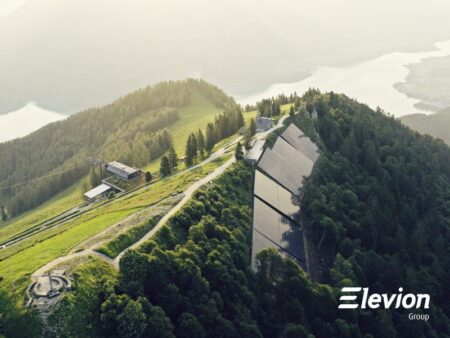
The original cable car was put into operation in 1957 and remained in service until 2019. The following year, it was replaced by an energy self-sufficient cable car powered by solar energy. The view of the mountain is impressive, as is the integration of the solar power plant into the mountain terrain. The structure, which is located on a steep slope and surrounded by trees, consists of a total of 50,000 individual panels.
Elevion Group, was commissioned to build the free-standing facilities and battery storage system. To minimise the impact on nature, the solar panels were not mounted on concrete foundations as usual, but on steel pillars anchored 2.5 m deep in the ground. The entire power plant has an output of 804kW and was built on the southern slope of the mountain station. This presented enormous challenges.
Steel piles instead of concrete
On the one hand, mounting the modules on six solar tables on the 35° steep slope required a sure footing, a certain amount of alpine experience, and creative solutions. On the other hand, the fitters on the mountain had to constantly contend with difficult weather conditions such as snowfall, strong winds and thick fog.
Limited space on the slope
The location on the slope presented several challenges: A wooden platform was built for temporary storage and installation of the modules, and a special rail system was developed on the solar tables to facilitate the transport of the modules. This saved material and also prevented accidents and the strenuous task of carrying the modules up the steep slope.
In addition, there was only limited space available for installation on the mountain slope. The components were therefore delivered to the construction site as needed by a local logistics partner.
Key facts
The project utilises a total of 1,848 bifacial glass-glass modules from Trina Solar, carefully installed on a steep slope at an altitude of over 1,500 m.
With an installed capacity of 804kWp, the solar power plant generates approximately 835,900kWh of clean energy annually, significantly contributing to the self-sufficient operation of the Zwölferhorn cable car without the need for external energy sources.
This level of production also results in annual CO₂ savings of 190 t, making the project a valuable contribution not only to climate protection but also to the sustainable development of the Salzkammergut region.
You might be interested in:
How to decarbonise while remaining competitive and profitable
Extra benefit
On top of that the municipality of St. Gilgen is benefiting from an overproduction of electricity. The establishment of the local energy community has enabled a high level of sustainability. As a result, public facilities within the municipality are now being supplied with solar power generated through this collaborative initiative.
About Elevion Group
Elevion Group (www.eleviongroup.com) is Europe’s leading provider of end-to-end solutions for decarbonisation and energy efficiency. Thanks to its unique structure and pioneering spirit, its capabilities can be easily scaled within projects of various sizes and with a range of different skills required. Elevion Group operates in over 13 European markets (including the Netherlands, Germany, Austria, Italy, Poland, Spain) through more than 80 highly specialised independent companies, but with the financial strength of an international group. For more news and information about the Elevion Group, please visit www.eleviongroup.com/newsroom.