Since 2012, the Railway Division of the Institute of Mechanical Engineers, supported by the Friends of the Stapleford Miniature Railway (FSMR) which operates the railway, have run 13 Railway Challenges. These require teams of young engineers to design and build a 1/5th scale miniature locomotive. The teams and their locomotives are then judged against up to 15 locomotive performance and team presentation challenges.
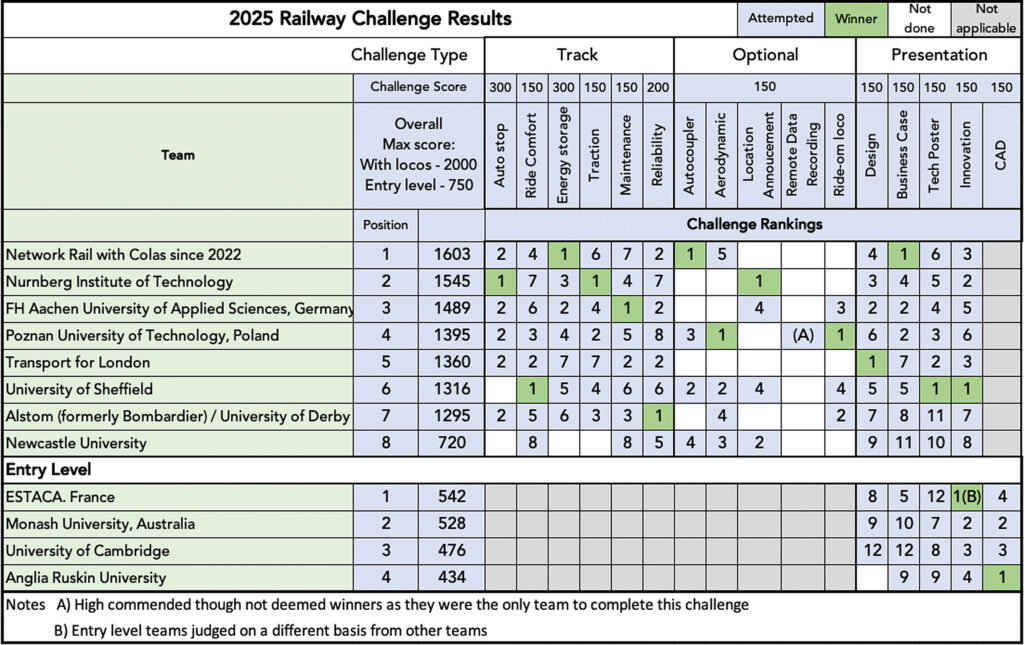
The overall winners of this year’s event were a combined team from Network Rail and Colas Rail who first entered the competition in 2019. They also won the energy storage, autocoupler, and business case challenges.
Second was the team from the Nürnberg Institute of Technology who won the traction, autostop and location announcement challenges. Third place went to Aachen University of Applied Sciences who won the maintainability challenge. Poznan University of Technology from Poland were given a special award for the traction challenge for which they were only 0.24 seconds behind the winners.
In total, eight teams entered locomotives while there were four entry level teams who were judged on presentation challenges such as design and business case. The list of entrants and prizes are shown below. The prizes awarded to the Nürnberg, Aachen, and Poznan teams show the international nature of the competition which also had a locomotive from Poznan in Poland and entry level teams from France and Australia.
To provide fresh challenges, each year there are changes to the rules. New for this year was an optional challenge of building a locomotive to accommodate the driver, rather than the locomotive being operated from the coach behind it.

Also new this year was a turntable which was ceremonially opened at the event by Stapleford Estate owner Lord Gretton, Railway Challenge Organising Committee Chair Simon Iwnicki, and IMechE Chief Executive Alice Bunn. It was designed by FSMR personnel and built over a two-year period by volunteers from FSMR, Network Rail, AtkinsRéalis, Alstom, HS2, and the Universities of Huddersfield and Sheffield.
The turntable has 21 spurs which significantly increases the space available for teams to work on their locomotives. It also provides the operational flexibility to change the running order in the event of a failure. The turntable is one of various proposals to increase the capacity of the railway which currently limits Railway Challenge locomotive entries to 14 teams.
While the Railway Challenge locomotives may be small, they present big challenges and so provide their teams with a valuable learning experience. To date, around 1,500 young engineers have benefited from their participation in the Railway Challenge. The IMechE’s Railway Division provides a valuable service to the industry by developing future railway engineers in this way.
A detailed account of the 2025 Railway Challenge will appear in the next issue.
Image credit: David Shirres