
Image courtesy Joby
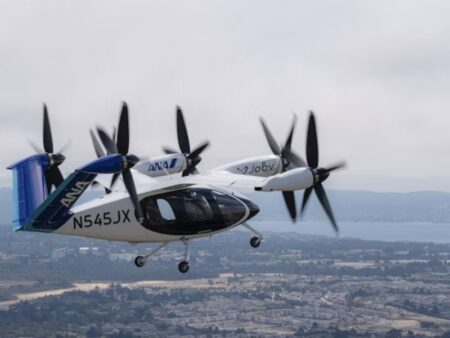
Japanese aviation company NA Holdings (ANA HD) and Joby Aviation are expanding their partnership to establish a joint venture and deploy more than 100 Joby electric aircraft within a new air taxi ecosystem across Japan.
Joby, a company developing electric air taxis for commercial passenger services, announced the joint venture with Tokyo as the starting destination. ANA HD and Joby are targeting a phased rollout in the coming years.
The companies say they also plan to accelerate the development of an ecosystem for the air taxi service, including a network of vertiports, pilot training programmes, and aircraft maintenance support, by strengthening collaboration with national and local governments, as well as private sector companies. One such partner is Toyota Motor Corporation, a key collaborator and investor in Joby.
Joby’s electric vertical takeoff and landing (eVTOL) aircraft lifts off like a helicopter but then transitions to fly forward like a plane, says the company in a release.
The aircraft is designed to carry a pilot and up to four passengers at speeds of up to 200mph (320km/h), reducing travel times and alleviating urban congestion, while also reducing noise and air pollution.
Commenting in a release was Koji Shibata, president and CEO of ANA HD: “Our expanded partnership with Joby, a company with exceptional technology and vision, represents a pivotal step forward.
“Air taxi service will directly contribute to addressing Japan’s urban transportation difficulties, ultimately enhancing regional exchange and providing a new, efficient means of travel.”
The initial joint venture between California’s Joby and Japan’s NA Holdings was announced back in 2022 to bring aerial ridesharing services to Japan.
At the time, the partners said they would collaborate on all aspects, including the development of infrastructure, pilot training, flight operations, air traffic management, public acceptance, and the regulatory requirements to operate.
Have you read:
How etrucks are driving decarbonisation of mining in China
Spain’s Wallbox launches virtual power plants in New York and California
Takeoff in Japan
The joint venture is the latest development in Japan’s eVTOL segment developments this year.
SkyDrive – an eVTOL aircraft manufacturer based in Japan – announced in July that it secured ¥8.3 billion ($56.3 million) in pre-series D funding from Suzuki as well as railway companies JR East, JR Kyushu, and others to improve the readiness of its technology.
Other investors in Skydrive’s tech include Univance Corporation, Itochu Technology Ventures, Obayashi Corporation, the Kansai Electric Power Company, SuMi TRUST Innovation Investment, Toyoda Iron Works, NHK Spring and MUFG Bank.
eVTOL infrastructure challenges
Following Joby’s announcement in Japan, in the US the company more recently successfully operated with other aircraft in Federal Aviation Administration (FAA)-controlled airspace by completing its first flight between two US airports, Marina (OAR) and Monterey (MRY), California.
The achievement, says Joby, is a major step as part of their commercial market readiness and marks the first time a piloted eVTOL air taxi has flown from one public airport to another.
Said Didier Papadopoulos, president of Aircraft OEM at Joby: “Successfully flying from Marina to Monterey showcased operations of our aircraft integrated in the broader transportation network and further validated its performance to ensure we’re prepared for service on day one.”
These critical flight tests, says Joby, also provided developmental data related to the human factors of operating the aircraft at a controlled airport and in the enroute national airspace.
In particular, Joby’s ability to integrate into controlled airspace was demonstrated when its aircraft successfully sequenced with other aircraft at Monterey Airport, including a holding pattern to accommodate another arriving airliner.
Sequencing, however, is not the only challenge to overcome for eVTOL’s to be a success.
According to a March 2024 study by NREL in the US, a first important consideration for eVTOL’s and their flying batteries is where they will charge and whether the existing power grid infrastructure can accommodate this demand.
“We found that potential eVTOL charging demand could impact grid infrastructure and operating parameters considerably,” said NREL researcher Bharat Solanki. “We have shown that this significant increase in demand consumption can be optimised with on-site generation and storage solutions, using microgrids to improve operability and integration.”

The lab stated that utilities will need to be involved early in planning because vertiports are not an everyday load.
They would increase site demand by six to seven times in most cases, and utilities would need to upgrade transformers, lines, voltage regulators, protection equipment, and possibly electricity bills and demand charges.
Early on, utilities would also need a reasonable idea of the vehicles’ charge schedules to understand get an idea of their daily load.