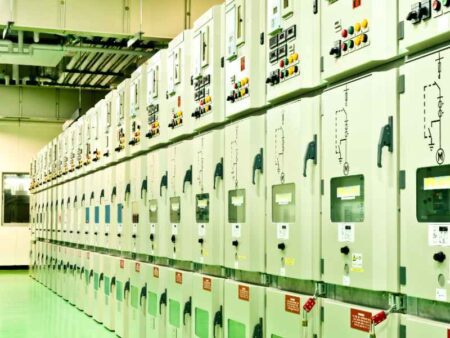

Substation in a power plant. Image courtesy 123rf
In this week’s Power Playbook, Yusuf Latief examines the global switchgear market. While the sector is poised for strong growth, it still faces headwinds from supply chain disruptions and impending regulatory changes.
In September 2023, I covered a report from data analytics company GlobalData, which projected that the global high-voltage switchgear market would reach $30.3 billion by 2027.
Two years later, new research from Research and Markets estimates that the market will grow from $101.71 billion in 2025 to a staggering $136.65 billion by 2030, a CAGR of 5.7%.
Of course, the former data set is focused on high-voltage switchgear, whereas Research and Markets includes high-, medium- and low-voltage; to an extent explaining the surge in numbers between then and now.
According to Research and Markets, the medium voltage (2-36kV) segment is the fastest-growing during the forecasted period due to its critical role in power distribution.
By current, the AC segment holds the largest share because it is the dominant form of electricity used in power generation, transmission, and distribution systems worldwide. Most national grids operate on AC due to its efficiency in transmitting power over long distances and ease of voltage transformation using transformers.
As a result, most of the electrical infrastructure – ranging from utilities and industrial plants to commercial and residential buildings – is designed around AC systems. Additionally, the expansion of renewable energy sources like wind and hydro, which predominantly generate AC power, further reinforces the global market dominance of AC switchgear.
So, within this market, what kind of deals are being made?
Let’s dig in.
More from the Power Playbook:
Is the UK’s BESS market entering its next phase?
How the Iberia blackout has accelerated resilience financing
Investments and expansions
According to Research and Markets, the sector’s growth is driven primarily by rising electricity demand, rapid urbanisation, expansion of renewable energy, and ongoing grid modernisation efforts.
Indeed, just this month, tech company Schneider Electric announced a long-term agreement with Germany’s E.ON to accelerate the deployment of SF6-free MV switchgear across its network. Although the exact amount being paid for the tech is not disclosed, what we do know is that it is being funnelled from the same procurement contracts announced back in July, which comes to a whopping €6 billion ($7 billion). The funds, when announced, were designated for core components to expand and modernise E.ONs grid infrastructure.
In April, Czech industrial group CONTEG acquired two leading manufacturers of electrical switchgear: Spálovský and Global Business. According to Deloitte, both companies will become part of CONTEG’s newly established energy division, Conteg TSE, bringing it to five businesses raking in expected revenues of CZK1.3 billion ($61.2 million). Further, CONTEG expects the acquisitions to increase their production capacity, integrate knowledge, and strengthen competitiveness in foreign markets.
And, if we go back a bit further in time to 2024, Siemens too has been doubling down on its switchgear supply chain. In September 2024, the company acquired California-based Trayer Engineering Corporation, which designs and manufactures medium voltage secondary distribution switchgear for outdoor and below ground applications. In June 2024, Siemens also spent €100 million ($100 million at the time) to expand its switchgear manufacturing plant in Frankfurt, Germany.
Additionally, in August of that same year, the UK’s Aurora Utilities Limited was acquired by I Squared, an independent global infrastructure investment manager. Through the acquisition, I Squared owns and operates several electrical connections, including switchgear, transformers, circuit breakers and power cables.
More on SF6 and switchgear:
Why the energy transition cannot compromise on SF6
A forward-thinking SF6-free approach to the energy transition
HV switchgear in the digital age: Advancements and opportunities
Market barriers
The business case for the tech is clear. And this, of course, isn’t limited to Europe or the US.
In fact, says Research and Markets in their report, Asia Pacific is projected to be the largest and fastest-growing segment in the global switchgear market due to rapid urbanisation, industrial expansion, and significant investments in power infrastructure across emerging economies such as China, India, Australia, and Japan.
Additionally, strong manufacturing bases and supportive policy frameworks, such as India’s Revamped Distribution Sector Scheme (RDSS) and China’s Five-Year Plans, are further fuelling demand for both high-voltage and medium-voltage switchgear in utility and industrial applications.
However, the market for the tech still has significant constraints.
Specifically, says Research and Markets, current restraints include high initial installation costs, supply chain disruptions, and environmental concerns related to SF6 gas used in some switchgear types.
Indeed, the issues of supply chain and SF6 are incredibly pertinent.
According to a survey released in May 2025 by the EU DSO Entity, responses from 19 DSOs identified three categories of critical and hard-to-procure components: transformers (90%), cables (68%) and, you guessed it, switching equipment (58%), which includes switchgear, especially SF6-free.
A prime trigger for this concern stems from new sustainability requirements in the EU, such as the ban of SF6-switchgear, which restrains the availability of materials during the adaptation time needed at production level.
And this is the case not only in the EU, but also in the US.
Wood Mackenzie stated in an October 2024 blog post that supply chains in the US have not been able to keep up with demand, especially for critical transmission and distribution electrical equipment where giant spikes in lead times and prices have already been delaying energy transition plans.
And the direct result of this growing disparity between supply and demand is that the price of key equipment, including transformers, circuit breakers and switchgear, is soaring.
While it’s clear that the switchgear market is on a rapid growth trajectory, the road ahead isn’t without its challenges. The industry must grapple with significant hurdles like supply chain disruptions, soaring equipment costs, and the complex shift away from SF6 gas.
This is the case in the EU, especially, where under the F-gas regulation, SF6 and other F-gases in new medium voltage switchgear up to 24kV are banned from 1 January 2026.
The long-term health of this market will depend on how successfully these issues are navigated. Can manufacturers and suppliers meet escalating demand without compromising on quality or sustainability?
Will innovative solutions emerge to alleviate supply chain bottlenecks and bring down costs? And as the industry transitions to SF6-free technology, will it be able to do so at the pace and scale required to support the energy transition?
What do you think? Reach out and let me know so that I can feature your thoughts in the Power Playbook.
Cheers,
Yusuf Latief
Content Producer
Smart Energy International

Follow me on LinkedIn