The Institution of Mechanical Engineers Railway Division recently held a railway gauging seminar, attended by 60 delegates. A similar event was previously reported on in Issue 202 (May-June 2023).
Freight keynote
Paul Long, Freightliner’s head of traction and rolling stock and chair of the industry Vehicle/Structure System Interface Committee, gave the freight keynote. He said that bulk/heavy haul using L1 gauge locomotives and W6A gauge wagons are relatively straightforward from a loading gauge perspective. Axle loads are another matter (as discussed later).
Paul gave examples of new opportunities such as hydrogen/ammonia transport for fuel and carbon dioxide for storage. Intermodal (container) traffic also presents opportunities but there are challenges.

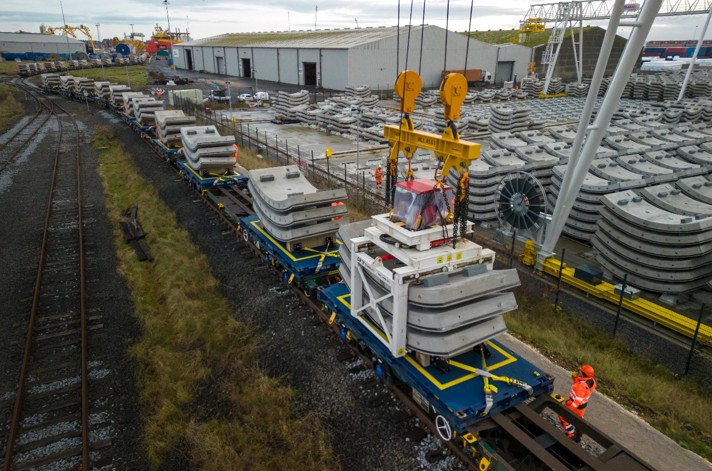
While containers are generally standardised, all sorts of container loads present interesting challenges. He gave examples of carrying HS2 tunnel sections strapped to container cradles, carrying batteries in containers that are heavier than usual requiring a particular wagon type, and curtain sided containers that present new risks. Furthermore, containers are not necessarily 20 feet or 40 feet long as some users have developed 50-foot containers.
As an example, many of these bio-fuel plants are located where the line has never been gauged for the wagons proposed for the service. A route might have sections cleared for the proposed train, sections that have never been assessed, and sections not clear. That said, Paul thought that progress is being made with the objective of:
- Changes to existing profiles and definitions to reflect, for example, that not all container wagons are high deck and 60 feet long.
- Using modern gauging simulations.
- Applying all gauges everywhere.
RSSB’s completed research project T1327 explored revised W10 and W12 gauges to increase freight access to the GB rail network which offered small gains that Paul said would lead to big opportunities. He concluded with a plea for an easy tool for planning freight routes. The current process of working out what train can run where, and when, involves assessing timetables, wagons and locomotive gauges, weight, and J tables which RSSB defines as: “a set of tables that set out the acceptable combinations of load units and vehicles for freight gauges W6a, W7, W7a, W8, W8a, W9, W9a, W9plus, W10, W10a, and W12”.
Paul likened the process to wartime decryption at Bletchley Park. The task can take 10 person-days over two months that may require modelling and Network Rail inspections.
As Paul said: “If it takes two months to say ’maybe’, the load will probably go by road.” Hence his desire for an easy tool to plan freight routes.
Passenger keynote
Steve White, Southeastern’s managing director gave the passenger keynote. He welcomed the creation of Great British Railways but observed that Southeastern and Network Rail Kent Route are ahead of the game having formed an integrated South East Alliance. This is expected to deliver benefits from whole system thinking, optimising service and access, making better use of trainborne technology, and ensuring new rolling stock is ‘best fit’.
This approach will benefit the new metro trains which Southeastern is procuring to replace the1990s Networker units which brought a step change in safety, customer facilities, and comfort. Southeastern wants its next metro fleet to take a similar step forward with the following features:

- Improved accessibility to maximise unassisted boarding.
- Brighter and more spacious interiors.
- Air conditioning (which Networkers lacked).
- Improved customer information.
- More reliable trains with improved acceleration and braking.
- Equipped with batteries to keep trains running in the event of power supply failure as well as enhancing safety in stations, depots and sidings.
The Alliance approach is particularly important for the power supply (improved acceleration and air conditioning) and for accessibility which involves changes to trains and infrastructure as well as to culture and processes.
A key, though challenging objective is delivering unassisted boarding. The Southeastern metro fleet will number over 200 units and serve 236 platforms. Most of the platforms date back to the19th century and heights vary considerably from station to station, platform to platform, and even along the same platform.
Although the standard height is 915mm, the lowest point measured was 500mm and the highest 1500mm. Public funding is scarce, Steve said, and by working together to optimise train and infrastructure, maximum compatibility will be achieved at a lower cost than the current process where a TOC has to demonstrate that its new trains will fit the infrastructure that is in place. By fully understanding what the network looks like, the Alliance can seek the optimum solution be it train and/or infrastructure changes.
Understanding the railway
At the heart of this is gauging. A different Steve White (Steve W), Southeastern’s head of major contracts and Rebeka Sellick, Cordel’s business development director, presented Cordel’s work to help Southeastern understand its railway. Steve W said that Southeastern’s challenge is to maximise unassisted boarding and alighting, adding that specifying ‘rebuild all the platforms’ or a train floor height of 915mm above rail is easy. Yet the first would incur huge cost and the latter is not simple, considering the complexities of tolerance stacking as well as mechanical gap fillers. He referred to the National Technical Specification Notice for People with Reduced Mobility that includes a specification of ‘level access’ (<75mm gap, +/- 50mm step) and considers boarding aids such as ramps or lifts.
However, there is no industry definition of ‘unassisted boarding and alighting’. One might think that, by now, the heights and offsets of platforms would be well understood, but this is far from the truth.
Rebeka took up the story. As reported at the last seminar, Cordel won Network Rail’s contract to develop the Railway Gauging Data Solution (RGDS) as the source of the truth for NR’s National Gauging Database (NGD). After the 18-month development and testing phase, the RGDS went live on schedule on 31 July 2023.

The RGDS takes inputs from many sources – from Network Rail staff filling in spreadsheets manually to automated links from third party vendors and key feeds from NR’s Infrastructure Network Model. It adds gauging domain knowledge quality assurance checks to facilitate Network Rail decision-making. At the end of the process, RGDS provides greater transparency of the currency, accuracy and completeness, and delivers the NGD, Network Rail’s four-weekly statement of the infrastructure gauge.
Separately, Cordel has gained Network Rail standards approvals but had not delivered gauging data in the UK. The South East Alliance identified the lack of up-to-date gauging data for its platforms, and contracted Cordel to address this. Cordel installed its train mounted sensors – LiDAR and video – to survey the network. It then processed this data using AI tools to feed into the RGDS, and through to publication in the NGD.
Going beyond the Network Rail standards of a measurement every five or 10 metres, Cordel is producing granular measurements along the line. For the South East Alliance’s platform exam question, the system allows the height and offset to be obtained automatically at one metre intervals, and for platform furniture details to be measured down to centimetre accuracy.
The granular detail enables rolling stock to be procured with a better understanding of the platforms, avoiding issues like ramps deploying onto platforms with insufficient usable width. Furthermore, other useful information such as platform cross fall can be obtained.
With this material, engineers can make decisions balancing all the risks and benefits. For example, resource could be targeted to raise the lowest platforms with the worst adverse crossfall by installing Harrington humps where the usable width is adequate.
Clearance calculation
Mark Ward, principal engineer, track in Network Rail Technical Authority discussed improving clearance calculation on which much time is spent, yet collisions with structures are extremely rare. One factor is that clearances are calculated assuming all dynamic movements/tolerances are at extreme limits at the same time.

Two key developments are probabilistic gauging (discussed later) and better defined track fixity. GIRT7073 requires that effective track position (EFT) is considered when undertaking gauging calculations. EFT is defined as: “a position that the track could credibly occupy in relation to structures or an adjacent track at some point within its maintenance cycle, giving the smallest clearances.” EFT’s constituents are lateral alignment, vertical alignment, cross level error, and side wear. The first three items relate to track fixity with tolerances shown in Table 2 (left).
These figures do not allow for asymmetric values e.g., where track is strutted against a platform. All this is defined in RIS-7773-INS, and Mark suggested that there is scope to improve track fixity data requirements. This matters because when clearance is tight, accurate assessment of track fixity can affect whether there is a predicted foul or not. For example, the track fixity might be recorded as low despite the track having high fixity from being fixed to a structure.
Probabilistic gauging
Dr David Johnson, technical director and Ian Johnston, head of engineering at D/Gauge, presented the path to probabilistic gauging. As Ian advised, all gauging, whether modelled or by old traditional methods using expanded polystyrene applied to the target vehicle, is risk based. Probabilistic gauging is no exception.
The essential difference between traditional absolute gauging processes and probabilistic gauging is how the various variables are used. The former uses fixed allowances, such as those described above in track fixity, and tends to assess the sum of those allowances to estimate the worst case. In contrast, the latter uses statistical distributions based on real variability. This technique is already routinely used to assess electrification clearances and to enable reduced clearances and so avoid many bridge reconstructions.

David explained that the process technique is in everyday use in other engineering industries having been developed for the US space programme and was first proposed for the railway in 2004 where it has taken a long time to become accepted. But now RSSB is intending in 2025 to publish standard RIS-2774-RST ‘Probabilistic Gauging’.
It sets out a methodology and a standard set of parameters so that the vehicle/structure interface is modelled in the same way by everyone involved with a new train introduction/modification. David estimated that probabilistic gauging alone would allow roughly half the current number of substandard/foul clearances to be listed as clear. David also, slightly tongue in cheek, estimated that the risk of an infrastructure strike is some 1,000 times lower that the estimated probability of the world ending today!
An integrated approach
Scotland’s railway has had a deep alliance between operators and infrastructure manager for many years. Network Rail’s Andrew Blakeley is a systems engineer for Capital Delivery in Scotland’s Railway and recently undertook a maternity cover secondment to work as senior gauging engineer. He outlined an integrated approach to gauging. His entertaining talk included the non-engineer view on gauging which essentially is “gauging is a nightmare”.There were many nods in the audience at this point.
He explained that Scotland takes the issue of gauging very seriously. The Scottish Government’s 20-page High Level Output Statement included three pages of gauging requirements. As a result, there is a Scottish Gauge strategy document which outlines the approach, although Andrew dispelled the thought that trains might need to shape shift as they cross the border from England.
This has led a three-step gauging approach for renewals and enhancements:
Step 1 – Avoid: recommends that infrastructure is not placed close enough to the track to trigger a requirement for gauging calculations.
If that is not possible, then Step 2 – Comply: requires that projects comply with existing infrastructure gauges. This means that projects can be sure their design will comply and be signed off. Platform faces are examples.

Step 3 – Managing non-compliance: this is clearly non-preferred as it brings uncertainties and risk for the infrastructure project as well as making it much harder to introduce new or cascaded rolling stock.
New vehicles
Zoe Boreham, Alstom’s WCE senior expert – gauge, highlighted the importance of a gauging strategy when a new vehicle is being produced. Many people/organisations are involved with gauging a new vehicle. One body – often the train manufacturer – might be in the lead, but customers, sub-suppliers, infrastructure managers, and various approval/certification bodies might all be involved. A good gauging strategy needs to cover all the information that these organisations might need to play their part in the gauging process and a typical contents list is shown in Table 3 (right).
Edward Garner, team lead – dynamics, gauging & testing at AtkinsRéalis Rail & Transit, assesses gauging compatibility and compliance for new and existing vehicles. He presented the consultant’s view of the challenges and aspirations within the gauging industry. It should simply take infrastructure gauging data, apply vehicle models, and deliver the result to the customer in the required timescales. However, often challenges with the first two lead to late delivery. Survey data can have errors such as vegetation taken as structures, incorrect curve radii or cant, transition curve data and platform measurements, as well as lack of confidence in six-foot data. Moreover, data is often out of date with, for example, 87% of structure data over three years old. He then went on to discuss aspirations relating to data quality improvements and making newer data readily available.
Vehicle models can be an issue too, sometimes far too complicated or too simplistic, causing slow or overly conservative assessments respectively. Where comparative gauging is preferred, the comparator vehicle model might be unavailable due to IPR issues. Guidance notes in tandem with updated railway group standards could vastly improve the quality of the gauging models, reducing the time taken to assess them and improving the usefulness of the results.
Tony Ellis, RSSB’s professional head of passenger operation said that there has been a lot of focus on accessible boarding and alighting at platforms but risk also has to be considered. These include, steps/gaps, boarding ramps, adverse crossfall, lack of tactile paving, unattended pushchairs, boarding ramps, trap & drag, passenger behaviour, and aerodynamics of passing trains. The overwhelming majority of the platform edge risk relates to falls from the platform when no train is present.
Rail Engineer suggests that plans to deliver unassisted boarding will help reduce this risk, although providing gap-free level boarding does not necessarily close the gap between train and platform away from doorways.
Platform train interface
The final presentation provided a case study that drew together many of the ambitions and processes described earlier in the seminar. Andrew Brice, head of profession for permanent way engineering and David Watkinson, senior engineering lead, both at Transport for London described how the platform train interface issue was managed when three fleets on London Underground’s District, Circle, Hammersmith and City, and Metropolitan lines were replaced by a single fleet designated as S stock.

The Underground sub surface platform height is 950mm and this value probably suffers less variability than is seen on the main line railway, although on some sections the trains share platforms with tube-size trains where the platform height is nominally 840mm. The legacy fleet floor height was a nominal 1100mm above rail. This was the height originally proposed for the new fleet until it was decided to lower the train floor to 980mm to deliver level access at most stations.
Andrew and David described the general challenges of gauging on the Underground where the objective is to maximise the train size, and the challenges brought about by level access. The aim was to achieve a design gap on level track of 64mm which, with tolerances, would be within the Rail Vehicle Accessibility Regulation requirement of <75mm. The challenge was on curves as shown in the adjacent diagram.
This was particularly difficult at Baker Street where platform 2 is on a tight concave curve as the Metropolitan line diverges from the Circle line. This has proved to be quite an intractable problem with various mitigations tested and/rejected. David described the proposed final solution outlined in the diagram which is expected to eliminate the issue of large gaps at this location.
Even for stations where smaller gaps were theoretically possible, tight control of platform edge nosing stones was required and, in places, adjustments to track as well. Finchley Road, for example, had a gap of 140mm at one end of the platform and a significant ‘foul’ at the other.
A process, described as ‘chasing millimetres’, was aimed at improving RVAR compliance (<75mm gap). Standard platform offsets were reduced from 711mm to 695mm, then to 690mm for designated RVAR locations. The risks (principally of platform strike) were considered ALARP, both because dynamic vehicle models were very conservative due to the build-up of tolerances and via observational evidence of known tight spots during initial S Stock runs.
London Underground worked with D/Gauge to consider geometric transitions more accurately, along with probabilistic techniques to demonstrate risk. During the resulting PTI improvement works on curved platforms, both approaches were used separately in trials – ‘Transitional’ at Monument and ‘Probabilistic’ at Finchley Road – to support not cutting nosing stones back at pinch points.

The end result was that 118 out of 249 platforms were made compliant with RVAR dimensions, 58% of platforms have a horizontal gap less than 150 mm at every doorway, although 8% have a horizontal gap of above 250mm at one S stock doorway at least.
Key messages
The seminar clearly showed the importance of collaboration, innovation, and planning in gauging. There were two key messages.
First, everyone wants to be able to contribute to and use a gauging database populated with up-to-date and validated information. Freight operators want to know quickly whether ‘this’ load on ‘that’ wagon can travel from ‘here’ to ‘there’ – a sort of Google Maps for the railway (without the risk of a high load meeting a low bridge). Passenger operators want certainty about the platform-train interface so they can deliver solutions that enable unassisted boarding and alighting.
Second, beyond knowing the art of the possible today, the overall strategy should be to continue to upgrade infrastructure built to a variety of shapes and sizes over a couple of centuries. The infrastructure gauge should be standardised for passenger and freight operators to be able to deliver the smoothest railway service to satisfy more customers.
With thanks to the presenters for their assistance with this article.
Image credit: Freightliner Ltd