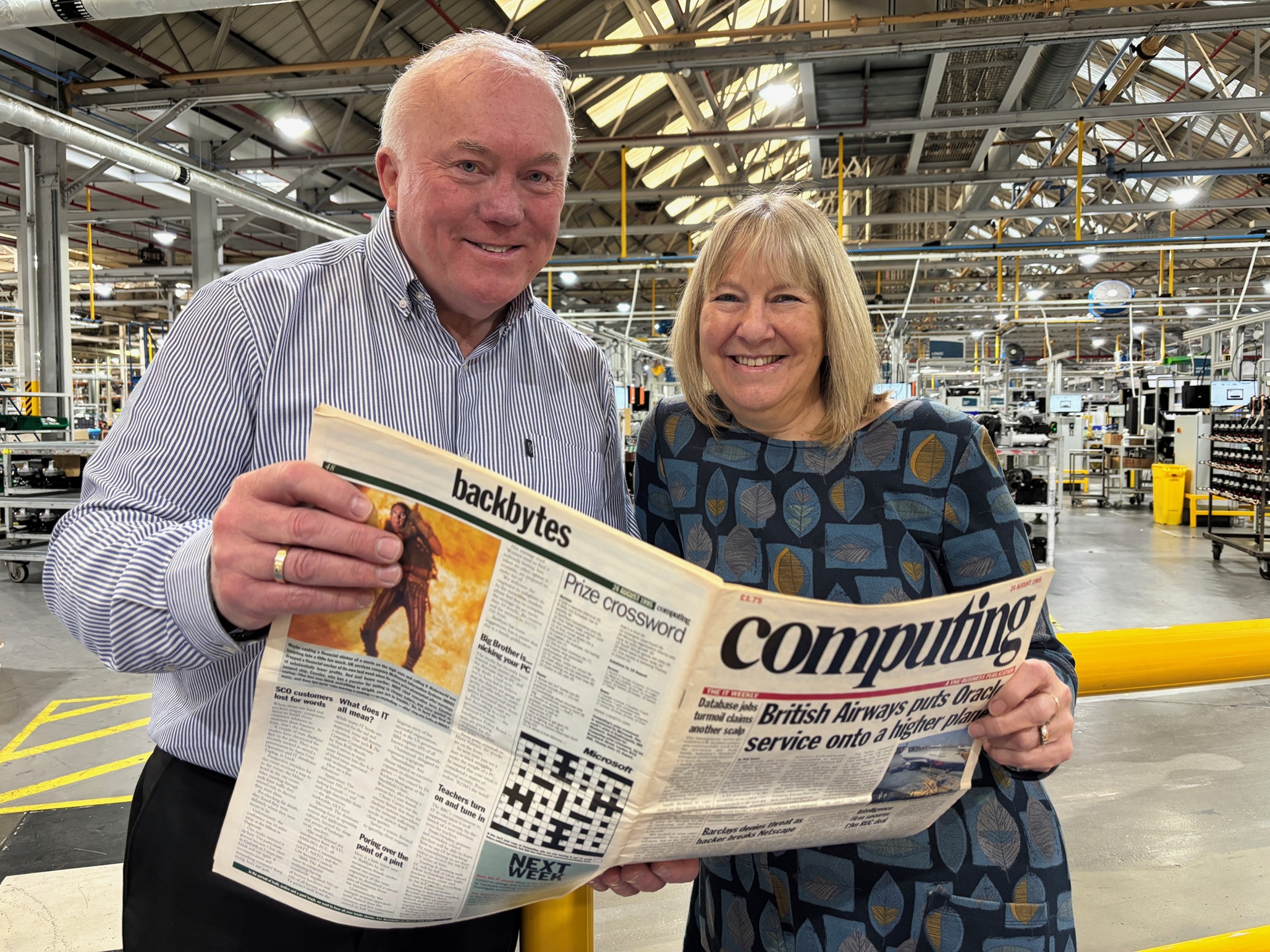
Ideal Heating has confirmed the retirement of two senior figures whose careers span some of the most transformative decades in the company’s history. Chief Information Officer John Glanville steps down after 48 years, while HR Director Debbie Skalli concludes 41 years at the business. Their departures underscore a generational shift inside the manufacturer as its digital and people strategies continue to expand under Groupe Atlantic ownership.
Glanville joined Ideal in 1977 as a Computer Operator before rising through a succession of leadership roles across the company and its former parent groups. His early responsibilities included introducing Microsoft Office across the Caradon Group in the mid-1990s, a rollout that predated mainstream enterprise adoption in many sectors. Subsequent milestones ranged from cloud migration to early AI deployment and technical leadership across sites in the UK, Belgium, France, India, and the US.
Reflecting on his career, Glanville noted that technology was only part of the story. He attributed his near five-decade tenure to the colleagues he worked alongside, describing the people at Ideal as the constant in an industry — and organisation — that has repeatedly reinvented itself. As CIO, his recent work focused on supporting a major IT programme for Groupe Atlantic’s Paris headquarters, a reminder of how far his remit had evolved from loading tapes in a computer room.
Skalli’s path through the organisation mirrors a similar arc of long-term evolution. Introduced to the company through her father, former Technical Director Terry Howells, she began in the Health and Safety team, later leading Learning and Development and eventually taking responsibility for HR, L&D, and H&S simultaneously. Her tenure covered the transition from a traditional boiler manufacturer with foundries and press operations to a diversified heating technology group with a modernised Hull site and a broader product portfolio across the Groupe Atlantic division.
A defining part of Skalli’s contribution has been workforce development. Her stewardship of the apprenticeship programme helped establish a pipeline of internal talent, many of whom now hold managerial positions. Her involvement in the company’s Queen’s Award win — and the subsequent visit to Buckingham Palace — stands out as a personal highlight, though she maintains that the enduring appeal of Ideal Heating has always been the people within it.
Both roles will be filled through internal succession. Barry Dixon becomes Chief Information Officer, while Miriam Moore steps into the position of HR Director. Ideal Heating presents the transitions as evidence of its commitment to developing leadership talent from within — a point consistent with both retirees’ decades-long focus on organisational capability-building.
As the company pushes further into smart systems, low-carbon heating technologies, and division-wide digital programmes, the departures of Glanville and Skalli close two unusually long chapters. What they leave behind is not simply institutional memory, but a reminder that longevity in manufacturing comes from the slow accumulation of practical judgement — something that cannot be replaced on day one by even the most capable successors.