HS2 celebrated another construction milestone on 9 May when the 1,600-tonne tunnel boring machine (TBM), Mary Ann, broke through at Washwood Heath, Birmingham, marking the end of her mission to excavate the first bore of what will soon become the longest railway tunnel in the West Midlands.
The 125-metre-long machine began constructing the 3.5-mile (5.8km) Bromford Tunnel, which starts at the Warwickshire village of Water Orton and extends to the northeast Birmingham suburb of Washwood Heath, in July 2023.
The result of years of meticulous planning, the undertaking required pinpoint precision, flawless preparation, and a highly committed team. Led by HS2’s West Midlands contractor Balfour Beatty VINCI, a 450-strong team worked around the clock for just under two years.
During the 22-month-long mission, the team on board the machine spent 649 days and nights working at depths of up to 40 metres, navigating Mary Ann under the Park Hall Nature Reserve, the M6 motorway, and the River Tame – which crossed the tunnel four times, with a headspace as low as five metres.
It is fitting, then, that we celebrate the magnificent achievements of the individuals who’ve played a role in one of the most complex tunnelling operations on the entire HS2 network. Here we give some of those inspiring individuals a voice and cast a spotlight on their role in the project.
Leading the team
The team was led by Tunnelling Director Jules Arlaud (pictured right). Jules was mobilised to the West Midlands when BBV’s first giant tunnelling machine arrived from Germany. He already had a string of successful worldwide missions under his belt and his next challenge was to join – and eventually lead – the team responsible for constructing two of the five twin-bore tunnels on the HS2 network.
“It’s been a challenging drive beneath critical live infrastructure and through complex ground conditions,” says Jules. “I’m incredibly proud of our entire team, whose expertise, dedication and resilience have made this possible.

“This achievement follows years of design, planning and preparation from BBV, in close collaboration with HS2 and our partners. The team will now move onto the next phase of work inside and outside of the tunnel, while our second TBM, Elizabeth, has completed 60% of the second drive.”
At the coalface
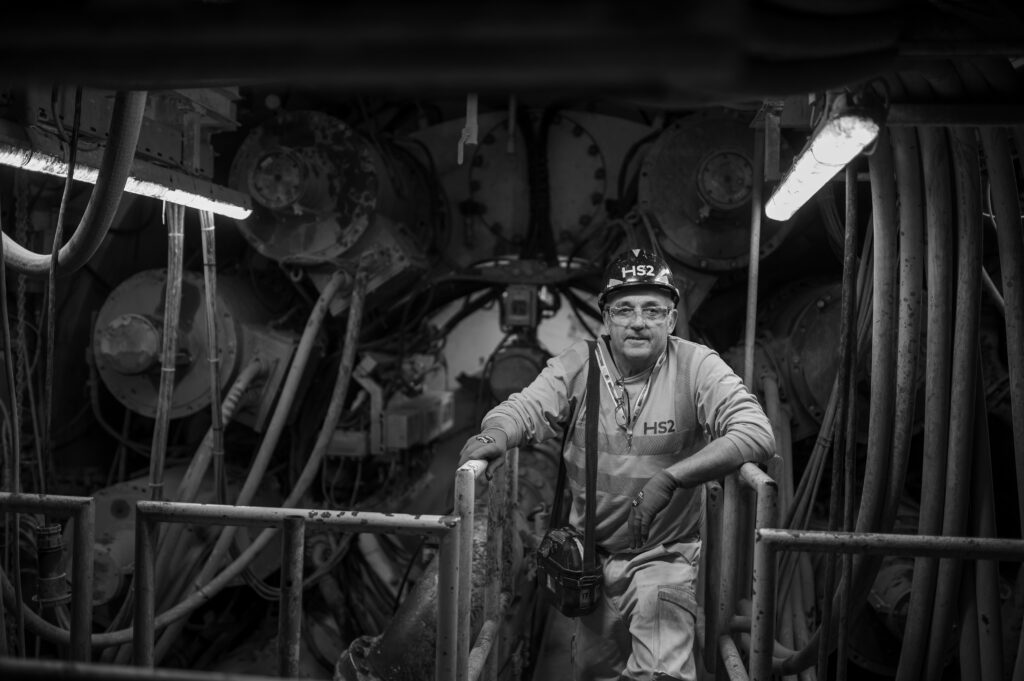
A team of 16 worked the TBM with 61-year-old Lead Miner Steve Rocke in charge. After 43 years on the job, this was his last assignment, after which he returned to his family in Hull, and his beekeeping hobby.
Pilot Harsh, from Kolkata, works in tandem with Steve. They share a tiny office space with three crew members who monitor the technical and mechanical side of the drive. If the cutterhead needed repairing or maintaining, one of the miners must enter the excavation chamber to fix it. “It can be like working inside a balloon,” says Steve. “So, we calculate to the second how long they’ve got.”
Air pressure levels inside the tunnel determine whether a hyperbaric intervention is required on the miner’s return and Tunnel Agent Josh Knight makes that decision. He assesses the miner’s safe working time and calculates how long he must spend in the decompression chamber afterwards. From a mini submarine-like space inside the TBM, the miner must inhale pure oxygen to avoid the painful decompression sickness, known as the bends.
“Hyperbaric interventions don’t happen often”, explains Josh. “Thankfully, we’ve only had to do it once so far on this mission.”
At the rear
Around one million tonnes of spoil were excavated during Mary Ann’s 3.5-mile drive, and those at the back of the operation are just as integral to the machine’s daily advance. As the cutterhead rotates, excavated material is extracted and mixed with slurry. The solids and liquid are then separated at an on-site slurry treatment plant.
The treatment plant is where most new starters learn the ropes and is where 21-year-old Dylan Kehoe works alongside his father, Greg. The duo (pictured above) from South Wales moved to nearby Minworth to work on HS2.
Dylan was recruited by Solihull-based Rorcon, as part of the drive to upskill a new generation of tunnellers. After an initial stint as a labourer, the company supported him to achieve his Level 3 Supervisor NVQ, enabling him to climb the ladder to treatment plant operative. The experience has left him hungry for more.
“If you work hard, the progression opportunities are there,” said Dylan. “I’ve worked my way up from being a labourer and hope to progress into mining next, so I can work on the tunnel boring machine.”
During his 40-year career, Dylan’s father Greg has worked on some of the UK’s biggest tunnelling projects, from Crossrail to the London super sewer, Tideway. He, Dylan, and Erdington-based new recruit Edward East worked in sync to keep pace with the TBM’s miners.

Every tonne of excavated earth is compressed to extract the groundwater. Recycled slurry is pumped to the front of the giant digging machine to maintain ground pressure, while the excavated material goes back to the treatment plant and through the slurry circuit. The trio monitors the vast network of machinery that controls the pressing, dilution, and pump process, and are in constant contact with the TBM team underground. The miners need to know the water’s coming and rely on Greg’s analysis of the ground conditions.
“The toughest bit is keeping pace with the mining,” explained Greg. “It’s a balancing act to keep the water tanks at the right level, so we’ve got the volume we need for the machine. Too much, or not enough is never a good thing.”
Subterranean support
There’s little glamour in tunnelling. Whether onboard the giant moving factory, or supporting the machine’s drive from the rear, the team works long, hard hours. Seven 12-hour shifts are rewarded with a three-day break, then it’s another stint of 7/12s before a long awaited four-days off.
The same is true for the ring builders and grouters who scurry along the metal stairwells and corridors. Excavating the ground is just one part of the job – Mary Ann must also build the tunnel. At peak production, the TBM advanced at around 30 metres per day, lining the tunnel with segments to form precision-placed concrete rings.
Gary Jones (pictured right) and his two-man team dictated the installation of 20,000 of these precision-designed segments, manufactured at Balfour Beatty VINCI’s pre-cast factory at Avonmouth near Bristol.
Crane operators lifted and loaded the huge concrete segments onto an electric vehicle (EV) which was driven into the tunnel. Gavin Davis from Doncaster was at the wheel. Years of experience have earned him the accolade of being the only driver that can manoeuvre the 16-wheel EV in a three-point turn. When he arrived with another haul of segments, Gary and his crew lifted, shifted, and locked them into place.
“On a good shift, we’ll build five or six complete rings,” explains Gary. That 2,971 rings were required in total gives a sense of the scale of the task.
The grout which seals the segments into place is made at the onsite batching plant. Tunnelcraft Apprentice Jevon Lynch, recruited at an HS2 careers fair, was rewarded with a permanent job running the grout batching plant after passing his Tunnelling NVQ.
“I’ve done a bit of everything in my two-year apprenticeship,” says Jevon,” from helping to build the TBM to working with the crew onboard. Getting a permanent job sets me up for a career in the industry, which is exactly what I need with a baby on the way.”

End in sight?
Despite its most recent success, it’s not the end of the project for our tunnelling heroes. TBM Elizabeth is already hard at work on the second drive of the Bromford Tunnel and her breakthrough is expected later this year. Once complete, Bromford Tunnel will be the longest railway tunnel in the West Midlands and, in the not-too-distant future, will be used by millions of passengers travelling to Birmingham’s new terminus station – Curzon Street – just two miles away.
The Washwood Heath site, where Mary Ann broke through, and covered by Malcolm Dobell in Issue 208 (May-June 2024), will become the nerve centre for HS2’s operations. Next to the tunnel portal, HS2’s Depot and Network Integrated Control Centre will be built. From this site, trains will be serviced and stored, and the real time operation of the railway will be controlled.
Rail Engineer celebrates the efforts of all involved and salutes their continued grit and determination under some very difficult conditions. Here’s looking toward the second breakthrough at this critical site.
Image credit: HS2