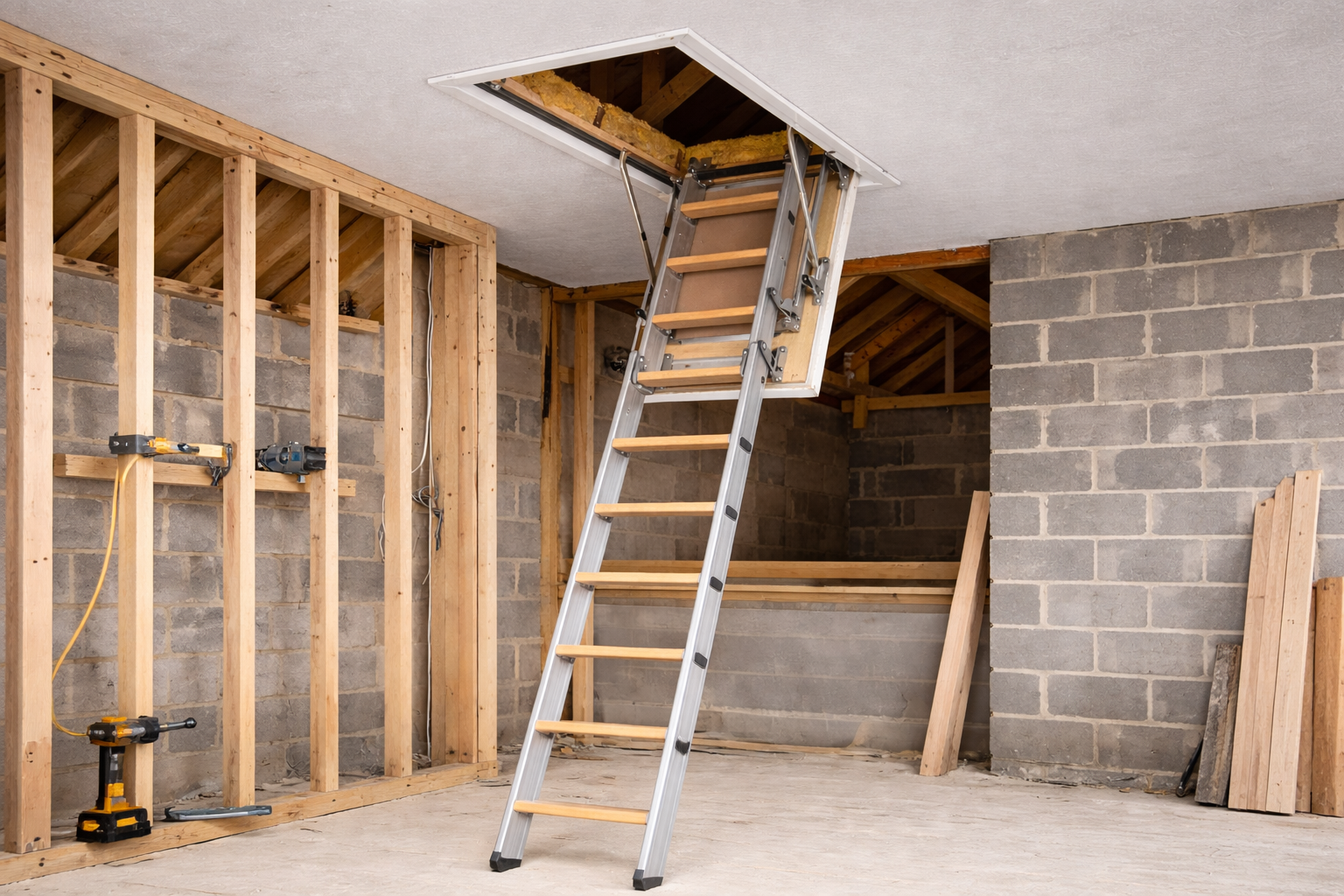
Planning attic access often looks straightforward until you start balancing safety, regulation, and long-term usability. As a construction professional, you make decisions that affect not only Building Control approval but also how safely occupants will use the space for decades.
Poorly planned access leads to increased risk of falls and costly remedial work. When you approach this with a clear understanding of the requirements and a practical installation process, you protect your client, your reputation, and the building itself.
Understanding UK requirements for attic access
You must start by aligning your design with the Building Regulations, particularly Parts K, B and L. Part K sets expectations for safe access, headroom, and fall prevention, which directly influence ladder angle and landing space.
Part B affects whether the access point sits within a protected escape route, while Part L governs insulation continuity and air tightness around the hatch.
You reduce approval delays by reviewing local authority guidance early and checking whether the attic qualifies as a storage space or a habitable area, as this distinction alters load and access expectations.
Choosing the correct access equipment
The access solution needs to match how occupants will realistically use the attic, not how you hope they will use it.
Lightweight storage areas benefit from proprietary loft ladders and loft hatches that combine tested load ratings with insulated trapdoors, while more frequent access demands robust timber or aluminium systems with secure handrails.
You should assess ceiling height, available floor space, and user demographics before selecting equipment. Choose products with UKCA marking and manufacturer installation instructions that align with Building Control expectations.
Ensuring safe placement and structural support
Poor placement undermines even the best access equipment. You should position the hatch where users can climb and descend without twisting or stepping onto uneven surfaces.
Joists around the opening need trimming and doubling to maintain structural integrity, particularly in older properties with irregular spacing. You achieve safer outcomes by confirming load paths and fixing points before cutting any structural timber.
Meeting fire safety and insulation standards
Attic access can compromise compartmentation if you ignore fire performance. Where the hatch opens onto a protected stair or escape route, the assembly must provide appropriate fire resistance.
Insulation also requires careful detailing to prevent thermal bridging and air leakage. You maintain compliance by specifying insulated hatches with effective draught seals and by reinstating insulation around the opening to the same standard as the surrounding ceiling.
Installation, inspection and ongoing maintenance
Compliance does not end when the ladder unfolds smoothly on handover day. You should inspect fixings, seals, and clearances once installation finishes, then record product details for future reference.
Advise your client to include attic access in routine property checks so hinges, springs, and seals continue to perform as intended. This approach reduces liability and keeps the access safe throughout the building’s life.