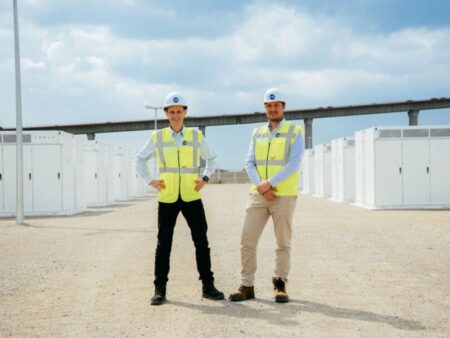

Image courtesy Harmony Energy
Harmony Energy, a European developer of battery energy storage systems (BESS), has successfully energised the 100MW/200MWh Cheviré battery project, which they says is now the largest of its kind in France.
Located in the port of Nantes Saint-Nazaire Harbour, Harmony says the facility is the country’s first large-scale, two-hour duration battery storage system.
The project is built on the site of the former Cheviré fossil fuel power plant, which consumed coal, gas and oil from 1954 to 1986, and is situated adjacent to the grid operator’s substation.
Using Tesla’s Megapack and Autobidder technologies, the Cheviré energy storage system will provide essential balancing services to the national grid, helping to replace fossil fuel peaking plants with renewables.
With the ability to power approximately 170,000 homes for two hours, more than the entire population of Nantes, the site will play a pivotal role in boosting grid resilience, cutting carbon emissions, reducing energy costs and volatility, and accelerating France’s energy transition.
Commenting in a release was Andy Symonds, CEO of Harmony Energy France: “The Cheviré battery project is a landmark achievement for the wider energy transition in France.
“It shows how disused industrial sites can be repurposed to enable a more sustainable electrification of our power systems. This project strengthens energy security, supports affordability, and helps pave the way for a cleaner, energy system which is less reliant on burning fossil fuels.
“We began construction on site in summer 2024 and have just achieved energisation, one year later, showcasing how expertise, skill and productive collaboration between teams working on a shared goal can accelerate the transition to net zero.”
Have you read:
UK sees slew of grid-balancing BESS project announcements
BW ESS and Ibersun to develop 2.2GW BESS portfolio across Spain
France’s BESS market
According to a study from Aurora Energy Research released in April 2025, France’s battery market is expected to expand rapidly by 2030, but faces saturation risks.
According to Aurora’s analysis, by 2030, France will reach a 179% ratio of installed battery capacity to procured capacity in the ancillary service market that helps balance the grid, indicating a high risk of market saturation, similar to trends in other European countries.
The French electricity mix continues to be dominated by nuclear, gas, and hydro, but as ageing nuclear assets retire, Aurora sees batteries playing a critical role in balancing the system. In response, says Aurora, developers should consider ancillary service market saturation risk in investment decisions.
In figures, Aurora says France’s installed battery capacity surpassed 1GW in 2024, a tenfold increase since 2020, fuelled by expanding revenue streams from ancillary services, declining CAPEX costs, and a 70% increase in intermittent renewable capacity.
Additionally, says their study, this growth increases market competition, applying downwards pressure on prices as more conventional technologies are pushed out of merit.
France’s shift to a pay-as-clear model for automatic Frequency Restoration Reserve (aFRR) in June 2024 is one example of evolving market dynamics that incentivise battery deployment. Yet, Aurora warns that the limited depth of the aFRR market leaves it particularly vulnerable to oversupply.
Commenting in a release was Christina Rentell, research lead for Iberia and France at Aurora Energy Research: “The battery storage market in France is expanding rapidly, but with deployment dominated by the development of large batteries, markets are at a higher risk of saturation.
“Effectively hedging against downside scenarios, such as saturation risk, will be key to facilitating continued large scale battery deployment, while ensuring emissions from ancillary services remain low as nuclear capacity declines.”
Across scenarios, Aurora estimates a near tenfold increase in battery capacity in France, from approximately 1GW in 2024 to 9GW by 2030.