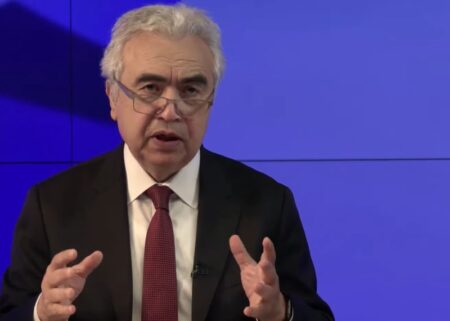

IEA executive director Fatih Birol.
This year will see 750GW of new renewable energy capacity installed globally – but 1700GW remains “in the queue, waiting to be connected to the grid”.
And that, according to Fatih Birol, executive director of the International Energy Agency, is one of the biggest barriers to the world tripling renewable capacity by 2030 as agreed at COP28 in Dubai.
Birol was speaking at a press conference to launch the IEA’s annual report into renewables.
The report found that under present conditions, by 2030 renewables will see a 2.6‑times increase from 2022 – shy of the three-times ambition.
But Birol said the target could be hit if several bottlenecks were removed, and the biggest one is grid integration.
Fatih Birol says grid limbo of renewables is ‘economically criminal’
Electrification will cause system collapse without flexibility
He said “curtailment is on the rise” and stressed that was still a big and unacceptable difference between investment in power plants and the grid: the IEA estimates that for every dollar spent on power, half a dollar is spent on grids.
The IEA report found that “the rapid rise of variable renewables is placing increasing pressure on electricity systems. Curtailment and negative price events are already appearing in more markets, signalling the need for urgent investment in grids, storage and flexible generation.”
While it conceded that several countries are responding with new capacity and storage auctions, it added that “much more will be needed to ensure that variable renewables are integrated in a cost-efficient and secure way”.
The IEA said that while some curtailment “is expected and inevitable, persistent or widespread curtailment often highlights gaps in planning, flexibility or infrastructure. Reducing curtailment thus requires a comprehensive strategy involving transmission, flexibility and co‑ordinated system planning.”
The report stresses that integrating variable renewables is highly dependent on each country’s unique situation, including its grid infrastructure and energy policies.
“Successful integration,” it states, “relies on the adaptation of strategies to local conditions to overcome challenges and optimise renewable energy use.”
It also notes that the rising grid integration challenges are renewing interest in pumped-storage hydropower: the IEA predicts growth in this sector to be almost 80% faster over the next five years compared with the previous five.
Birol explained that IEA data concludes that global renewable power capacity will increase by 4600GW by 2030 – roughly the equivalent of adding China, the European Union and Japan’s total power generation capacity combined.
“The growth in global renewable capacity in the coming years will be dominated by solar PV – but with wind, hydropower, bioenergy and geothermal all contributing, too,” he said.
“Solar PV is on course to account for some 80% of the increase in the world’s renewable capacity over the next five years. In addition to growth in established markets, solar is set to surge in economies such as Saudi Arabia, Pakistan and several Southeast Asian countries.
“As renewables’ role in electricity systems rises in many countries, policymakers need to play close attention to supply chain security and grid integration challenges.”