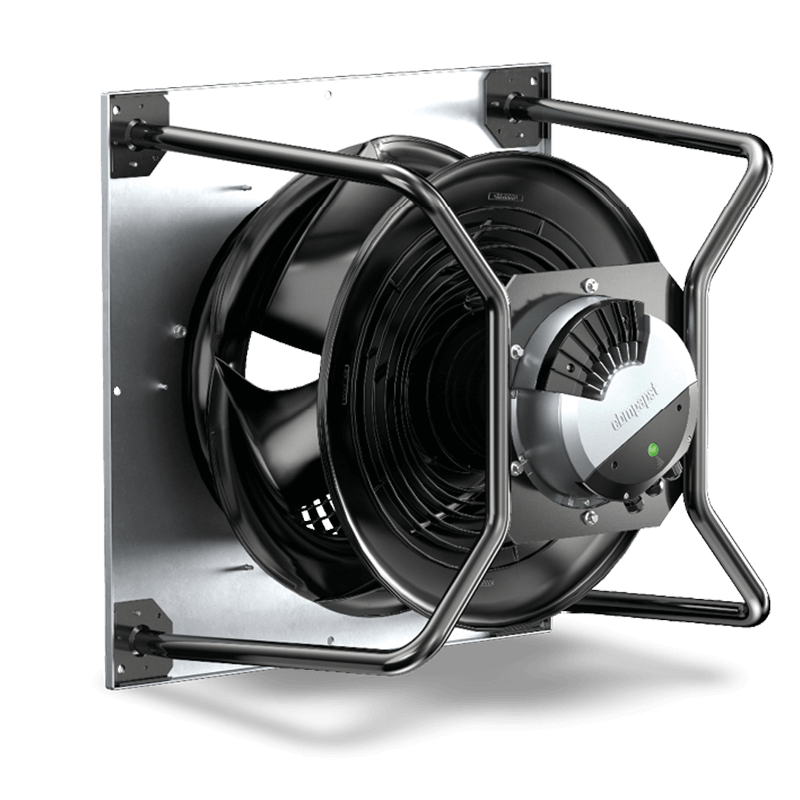
The Department for Energy Security and Net Zero has opened a consultation on proposed changes to ecodesign requirements for industrial fans sold in Great Britain. Covering electrically driven fans with input power between 125W and 500kW, the proposal addresses minimum energy performance, product definitions, information and resource efficiency. It would not apply automatically to Northern Ireland, where different EU-aligned rules operate under the Windsor Framework. The proposals remain subject to consultation and must not be described as enacted product rules.
Industrial fans are used throughout manufacturing facilities, building services, and process operations to move air through ventilation systems, production equipment, cooling arrangements, and pollution-control installations. Their cumulative electricity consumption makes efficiency requirements a significant technical issue, even when the performance improvement from changing one individual machine appears comparatively modest.
The government’s assessment forecasts cumulative electricity savings of approximately 5,990GWh between 2026 and 2050, 0.07 million tonnes of traded carbon dioxide equivalent savings, and a discounted net present value of £128.7 million from the proposed changes. Both figures are modelled outcomes rather than savings already measured in operating factories. The estimates depend on assumptions about product turnover, efficiency improvements, operating hours, and the electricity used by affected equipment.
Responses to the consultation are invited until 24 December 2026. That deadline concerns the opportunity to comment on the proposals, not a date when new requirements automatically become legally binding. Any subsequent regulation would need to follow the appropriate policy and legislative process.
Fans convert electrical and mechanical power into airflow and pressure. The useful work required depends on the volume of air moved and the pressure difference the fan must overcome. Energy losses occur in the motor, drive system, impeller, housing, and air passages, making efficiency a property of the assembled equipment and its operating condition.
A fan selected without regard to its duty point may consume more electricity than necessary even when its nominal efficiency rating appears satisfactory. Performance varies with airflow and pressure, and the installed system’s resistance determines where the fan operates on its characteristic curve. Changes to ducting, filters, dampers, or processing equipment can shift this operating point.
The government proposes aligning revised Great Britain standards with EU Regulation 2024/1834 as amended by Regulation 2025/2481, but that alignment has not been enacted. The existing relevant domestic requirements are based on Commission Regulation 327/2011. The proposed rules therefore require careful consideration of how products are defined and tested. An efficiency measurement made at a defined laboratory condition does not capture every configuration in which an industrial fan may be installed. Standardised test methods nevertheless provide a basis for comparing products and verifying that supplied equipment meets a declared minimum performance.
Electric motors and electronic drives contribute significantly to fan efficiency. Where variable speed control is available, the operator can adjust airflow to meet changing demand instead of relying entirely on restrictive dampers or other forms of throttling. Actual savings depend on the duty cycle and the way the controls are set up.
Many industrial applications operate at different loads during the day. Ventilation can be affected by occupancy or production activity, while fans serving process equipment must maintain the airflow required for temperature control, material transport, or extraction. Efficiency measures cannot be implemented at the expense of the minimum flow or pressure specified for safe operation.
Replacement programmes may introduce further constraints. Equipment must fit the installation, withstand its environmental conditions, and deliver the required process duty. High-efficiency products do not automatically provide a cost-effective substitution if they require extensive modification to foundations, ducts, wiring, or control systems.
In addition to energy performance, the consultation considers information and resource efficiency requirements intended to support a circular economy. The consultation may also affect manufacturers of fans and associated components. Product suppliers need sufficiently clear definitions, measurement methods, and conformity arrangements to determine whether particular models fall within the proposed rules. A change in minimum efficiency can require redesign, testing, revised technical documentation, and adjustment of stock and procurement plans.
The distribution of manufacturing costs and user benefits is not necessarily even. A more efficient motor or aerodynamic design may increase the initial purchase cost while reducing electricity use during operation. The financial outcome depends on electricity prices, hours of use, maintenance requirements, and the remaining life of the equipment.
Long-running fans can offer larger cumulative savings because a relatively small reduction in power demand is multiplied across many operating hours. Conversely, a fan used only intermittently may take longer to recover any increase in purchase or installation cost. Government impact modelling must account for differences in product use and replacement behaviour.
The way the proposed limits interact with existing requirements is another consideration for manufacturers. Equipment sold as part of an integrated machine may have different performance and conformity responsibilities from a fan marketed as a stand-alone unit. Unclear boundaries can create uncertainty about testing and documentation.
Monitoring can help operators identify whether a replacement is performing as expected. Measuring electricity consumption, operating hours, airflow, and pressure makes it possible to distinguish an efficiency gain from reduced production or changed ventilation demand. Without comparable operating conditions, lower energy consumption cannot automatically be attributed to better equipment.
Maintenance also influences performance. Filter fouling, debris accumulation, bearing condition, leakage, and damaged impellers may increase resistance or impair the fan’s ability to deliver its design duty. Efficient product selection and effective maintenance therefore address related but different sources of energy loss.
The government’s forecast benefits are based on an assessment of future product sales and the operating life of equipment rather than a single retrofit initiative. The consultation provides an opportunity to test the assumptions against practical experience from fan manufacturers, industrial users, and testing specialists.
Responses received by 24 December will inform the government’s next decision. Until any new rules are formally adopted, the efficiency thresholds remain proposals and the stated 2050 energy savings and £128.7 million net benefit remain forecasts, not achieved industrial performance.