As factories and logistics centres expand, so too do the challenges of keeping people and equipment safe. Ian Holland, Managing Director of DOLD Industries, explains how wireless systems with ranges of up to 800 metres are reshaping the way managers think about site-wide protection.
Imagine standing in the centre circle of Wembley Stadium. Now picture a safety signal that stretches far beyond the pitch, past the stands, over the car parks, and into the streets beyond. That’s the kind of distance modern wireless safety systems can now achieve – and it’s changing the way large industrial sites think about protection.


For plant, warehouse and safety managers, the challenge is clear: as facilities expand, production lines extend, and mobile equipment moves further afield, traditional wired safety systems can leave gaps. Adding cable isn’t always practical – and as layouts evolve, safety coverage must evolve just as quickly.
This is where advances in wireless technology are reshaping expectations. With systems now capable of ranges up to 800 metres, site-wide safety coverage becomes possible without the delays, costs, or constraints of physical wiring. In practice, which means uninterrupted protection across:
- Large factories and production floors
- Sprawling logistics centres
- Production sites where layouts are regularly changing, such as packaging lines or robotic cells
- Sites where installing cable is impractical or costly
Such scale removes the need to think in terms of boundaries. Instead, safety can be planned as a seamless, end-to-end layer of protection – one that adapts as operations grow.
How Point-to-Point Safety Protects Mobile Equipment
The real power of modern wireless safety systems lies not just in their range, but in how they can be configured to meet different operational needs. Whether you’re safeguarding a single piece of mobile equipment or coordinating safety across an entire fleet, flexible modes of operation make it possible to build protection around the realities of your site.
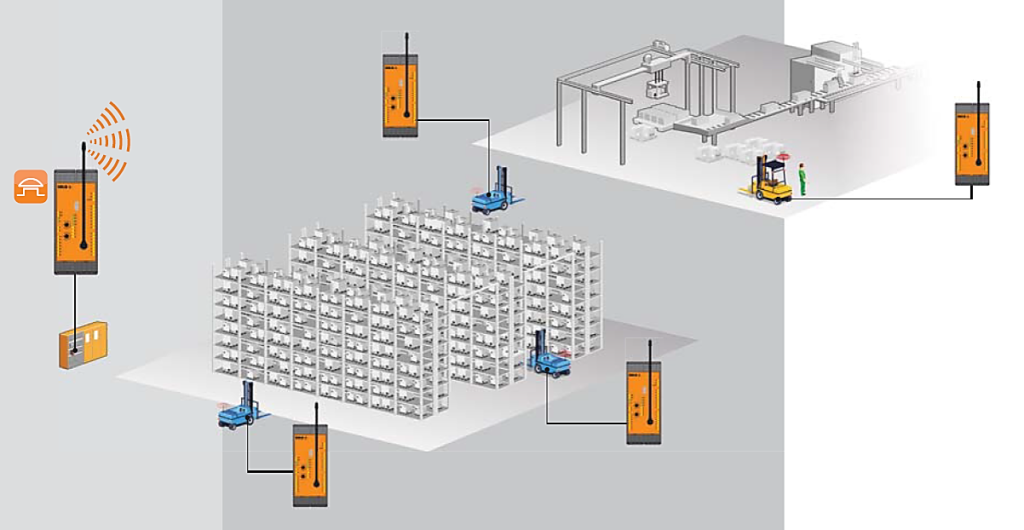
Point-to-point protection (often called Pair Mode) allows two devices to communicate directly via a certified bi-directional link – behaving as if they were hard-wired, but without a single cable in sight.
This is particularly valuable where mobility is key:
- AGVs with independent safety loops
- Cranes spanning long distances
- Floor-level conveyors needing stop functions between endpoints
- Mobile loaders that dock and undock from fixed stations
Why Group Control Matters in Large Sites
At the other end of the scale, some facilities require collective protection. Imagine a fleet of AGVs in a high-bay warehouse or a network of conveyors moving goods across multiple halls. Here, a single stop command must trigger an instant, site-wide response.
Group control makes this possible. Operating on a uni-directional basis, a central controller can manage hundreds of receivers at once, ensuring:
- Synchronised shutdown across distributed equipment
- No blind spots in safety coverage
- Assurance that no part of the operation continues running when it shouldn’t
By combining point-to-point flexibility with group-wide coordination, today’s wireless safety platforms give plant and warehouse managers the ability to design protection systems that are as agile as the operations they support – without compromising on compliance with the highest international safety standards.
Flexible Safety Architectures That Grow With You
For today’s factories and logistics hubs, change is constant. Layouts evolve, equipment is added or relocated, and production lines expand. In this context, safety systems can’t remain static – they need to be as adaptable as the operations they protect.
Modern wireless safety architectures are designed with this in mind. They separate control from shutdown, so that:
- Local receivers carry certified safety logic for redundancy and compliance, and perform all safety shutdowns.
- Central controllers manage coordination and monitoring
This ensures a single point of failure never compromises protection.
Equally important is usability. Wireless safety systems today are designed for ease as well as compliance, offering:
- Fast installation with standard mounting and connectors
- Straightforward set-up with DIN-rail mounting, rotary switches and configuration software
- Real-time diagnostics help operators monitor signal strength and connection health
- License-free frequencies (433/869 MHz EU, 915 MHz US), avoiding spectrum licensing complexity
- Built-in site survey tools ensure wireless traffic is directed to the clearest available frequency
Whether you’re managing a static production floor or a constantly shifting logistics centre, flexible architectures ensure that safety grows alongside your operations – rather than holding them back.
A Case in Point: 800 Metres of DOLD Coverage
One system that illustrates these advances is the DOLD SAFEMASTER W UH6900, a wireless safety platform certified to the highest international standards (PL e / Cat. 4 / SIL 3). Already deployed across a range of European sites, it combines long-range coverage, scalable architecture, and straightforward setup – showing what’s now possible when safety design embraces mobility and change across both manufacturing plants and central distribution centres.
For plant, warehouse and safety managers, the message is clear: as operations become more dynamic, safety systems must be ready to scale. And if you’re still picturing what 800 metres really means, just imagine Wembley Stadium – and then some!