
Image: NYK Line
Proposals to develop floating data centres open the way for data centres in coastal locations with limited space and power availability.
As the demand for data centres grows, sufficient land to site them and electricity to power them is becoming a growing issue and encouraging developers, following in the steps of renewables developers, to look to site facilities offshore.
The concept isn’t new. For example, since 2021, Nautilus Data Technologies has been operating its Stockton 1 data centre on a repurposed 90m freight barge on the San Joaquin river in California – the concept developed to take advantage of the river for water cooling.
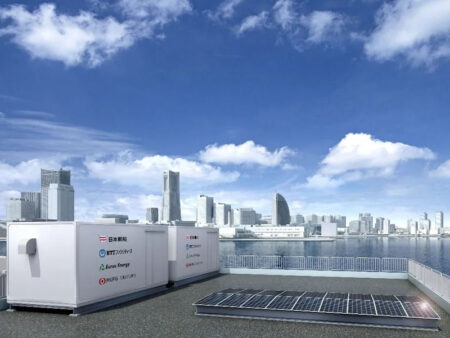
But interest is growing. Earlier in the year, a Japanese consortium led by the NYK shipping line announced plans to demonstrate a floating data centre at the Osanbashi pier in Yokohama as a step towards a full-scale facility offshore powered by offshore wind.
Have you read?
IEA launches observatory to monitor AI and data centre energy demand
How a university data centre delivers heat to the campus district heating network

The demonstration, which is planned to start in autumn 2025, is due to comprise a containerised data centre with solar power generation and battery energy storage on a mini-float approximately 80m long and 25m wide.
The project aims to operate the data centre entirely on renewable energy while assessing the equipment’s salt damage resistance and operational stability in an offshore environment.
According to the consortium, which also includes data centre developer NTT Facilities, renewables developer Eurus Energy Holdings Corporation, MUFG Bank and the city of Yokohama, the offshore floating green data centre operating on 100% renewable energy will become one of the new standards for future data centres and greatly contribute to the realisation of a carbon-neutral society.
Once realised, offshore floating green data centres should enable efficient utilisation of offshore wind power without relying on or being limited by onshore power grids.
Vessel retrofitting

Subsequently, a second floating data centre development to pilot in 2027 has been announced by Karpowership subsidiary Kinetics and Mitsui Lines.
In this case, the aim is to retrofit vessels as data centres, which will be supplied with uninterruptible power either from shore-based resources or Karpower’s powerships, depending on the project location and client’s requirements.
According to the companies, the floating platform will offer a scalable, mobile and rapidly deployable alternative to traditional land-based data centres.
The pilot is due to take place in a yet unnamed location on a 120m vessel with 20-70MW of data centre capacity powered from a powership from the Karadeniz fleet.
As an example of the potential of this approach, the companies point to a construction period of one year compared to the three years of a conventional data centre and that the floor area of a car carrier of approximately 54,000m2 is the equivalent to one of Japan’s largest land-based data centres.
Said Mehmet Katmer, CEO of Kinetics, of the project: “By pairing mobile power generation with floating data infrastructure, we are addressing critical market bottlenecks while enabling faster, cleaner and more flexible digital capacity expansion.”
Originally published on Power Engineering International.