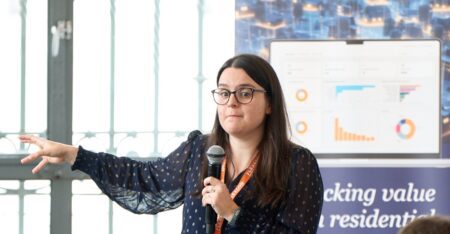

Lucinda Murley of LCP Delta. Photo: smartEn.
The widely-held belief that consumers will exploit smart meters to save money might be largely wishful thinking, according to new research.
More than 60% of domestic electricity customers in Great Britain have smart meters, but only 3% have smart tariffs that would allow them to choose the cheapest times to use electricity, finds the report by consultancy LCP Delta.
In 2025, 86% of customers in the study opted for a flat tariff, with 41% of those having a fixed-price tariff for the duration of the contract, according to the research.
However, consumers are stimulated by other incentives. “Flexibility is much bigger than a tariff,” said senior LCP Delta consultant Lucinda Murley at the Flexcon conference in Brussels organised by smart energy association SmartEn. “We are seeing a very rapid growth in specific propositions.”
She said retailers are increasingly finding that add-ons are just as important as tariffs. Examples of these add-ons include free electricity on Sundays or offers bundled with specific assets such as electric vehicles or brands of assets. LCP Delta found that in 2025 in Britain, 2.9 million consumers signed up to add-ons.
Flexibility benefits
The most advanced offers involve customers allowing third parties to control their assets, with the flexibility believed to benefit the customer, the energy retailer and the electricity system as a whole.
However, LCP Delta believes that the British regulator Ofgem may not have been considering the customer enough, and that some of the more than 50 actions in Ofgem’s clean flexibility plan published in July could act against each other.
Lillian Phillip, senior leader at supplier EDF Energy, told the conference that the company was not getting the consumer response to tariffs that it needed for flexibility. “They do not want to talk about pence per kilowatt hour.”
Electric vehicles, which are growing rapidly in number, are a focus for energy suppliers as electrified assets that can be used flexibility. Phillip said that EDF Energy tries to make it easy for consumers to understand how much they will pay to charge their EV: “The benefit is that they don’t need to think.”
Add-ons a plus
“It’s recognised that the focus has to change. All suppliers are on that journey,” said Stephen Davies, director of strategy at the energy supplier E.ON Next. “There are endless possibilities.”
However, he also thought that dynamic tariffs could be worthwhile, although the aim was to provide benefits rather than just price signals. “You don’t need to have a customer switching things on and off. That’s the role of the retailer.”
Davies identified a problem with the past initial enthusiasm in the industry for smart meters: “The value proposition for the consumer was not that strong.”
Now a supplier was likely to tell a customer that if they had an EV, they could save hundreds of pounds a year on charging it.
“We should be much more focused on bills.” And Davies saw loyalty as becoming more important, typically in the form of perhaps 10-year contracts.
Taking measures
According to the latest UK government data, 66% of homes in Britain had a smart or advanced meter, and more than 90% were working correctly.
Last year Ofgem acted against six energy suppliers for not meeting their smart meter installation targets and for smart meters not operating in smart mode, resulting in more than 600,000 faulty smart meters reconnected in the year from July 2024.
And in March 2025, Ofgem announced plans to review its Guaranteed Standards of Performance (GSoPs). This included new rules to improve the service offered by energy suppliers to customers that want a smart meter. Ofgem proposed that consumers would receive automatic compensation for installation or repair delays, with small businesses also getting greater smart meter rights and compensation for problems.
Ofgem is also concerned about protection for consumers using novel services and how companies carrying out load control could affect the electricity system if they have inadequate technical and cyber security controls.
“Activities around remotely-controlling energy smart appliances are relatively unregulated at the moment apart from through wider general consumer protection regulations,” said Ofgem.
And without change, consumer resistance could remain high. “If we are going to achieve this [energy] transition we are going to have to regain the trust of consumers,” said Marcia Poletti, head of European system change at the UK-based energy supplier Octopus Energy.