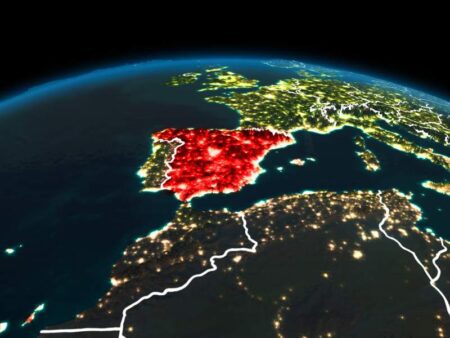

Space orbit view of Spain highlighted in red. Image courtesy 123rf.
The April blackout that hit the Iberian Peninsula was of an “exceptional character”, highlighting the need for improved grid resilience measures in case of cascading voltage increases, says Europe’s TSO association in the latest update of their investigation.
ENTSO-E’s expert panel, established after the blackout to investigate its causes, has released new insights into the blackout after receiving data from all relevant parties, including DSOs and generation companies.
According to ENTSO-E, the most probable cause of the blackout was the cascading series of generation disconnections and voltage increases.
According to the panel, the cascading voltage increases have never before been linked to a blackout in any part of the European power system.
If confirmed, this high voltage blackout mode will require a thorough analysis and investigation, says the Network.
Have you read:
Five seconds to failure: Iberia’s blackout and grid resilience in a high-renewables future
Jolt to the system: What the Iberian blackout says about grid investment
ENTSO-E lists two important lines to consider:
- Enhancing voltage control management procedures and capabilities of all active actors of the electricity system to prevent such major voltage-related incidents in the future;
- Assessing how the system defence plans can better protect the European power system against this new type of phenomena.
Additionally, on the potential of an atmospheric disturbance being the cause of the blackout, ENTSO-E cites the Spanish state meteorological agency AEMET, which indicated that no “exceptional weather events” were recorded in Spain at the time of the blackout.
ENTSO-E’s findings comes weeks after Redeia president Beatriz Corredor defended the actions of the Spanish grid operator during the April blackout “before, during, and after the incident”.
The company’s defensive stance followed a report released mid-June from Spain’s government, pointing the finger at Redeia for miscalculations.
In response, Red Eléctrica submitted its own report mid-June, attributing the causes to generation interruptions.
Both reports from Red Eléctrica and the Spanish government will be considered in ENTSO-E’s investigation, the Network says.
Also of note from ENTSO-E is a denial of the theory that the blackout was caused by an extreme atmospheric event.
According to the Network in their FAQs on the blackout, the theory seems to have been spread via a fake document on social media, wrongly attributed to the Portuguese TSO REN, which denied its validity.