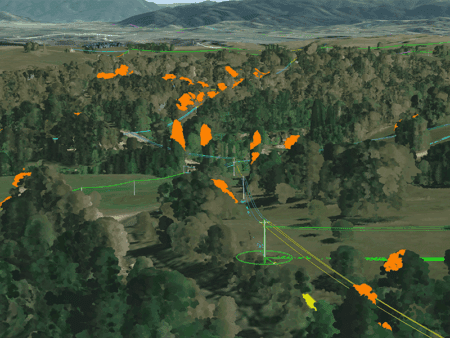

Source: Neara. A look inside Neara’s physics-enabled digital twin.
From blackouts during heatwaves to surging air conditioning demand that grids can’t support, energy systems stress is now a daily reality in Europe and demanding smarter planning, writes Taco Engelaar, SVP and Managing Director, Europe at Neara.
At the same time, the EU is working to reduce external energy dependency, accelerate the clean energy transition, and boost grid efficiency. This is no longer just a technical challenge. It’s about economic competitiveness, national security and climate resilience.
The European Commission calls for a pan-European digital twin of the power grid, designed to support observability, resilience and smarter planning. But for this vision to deliver real value, a digital twin must do more than visualize infrastructure. It must simulate how networks behave in real conditions and under future threats.
That’s where a physics-based approach comes in.
The challenge: uncertainty without insight
Most current grid models rely on outdated asset data, statistical assumptions and fragmented workflows. This makes it difficult to answer critical questions: Which assets will fail in a windstorm? How will increased demand from air conditioning affect network stability? What is the most cost-effective intervention for grid reinforcement?
Without detailed simulation, utilities are left to manage risk with limited context and make billion euro investment decisions without knowing which actions will deliver the most impact.
The solution: Neara’s physics-enabled digital twin
Neara’s physics-enabled digital twin creates structurally accurate models of infrastructure that behave as assets would in the physical world. It captures every pole, conductor, terrain feature and environmental variable in a single, engineering-grade model.
This allows utilities to test scenarios before investing, such as heat induced line sag, wind related pole stress, or the impact of adding rooftop solar at scale. Instead of relying on probability, they can model what will happen, when and why.
Because the platform is extensible, it supports a range of EU priorities – from DER integration and flexibility markets to resilience forecasting and cross-border grid coordination.
The opportunity: better planning, faster response
European grid operators are already using Neara to reduce risk and improve efficiency. What once took more than a year to assess – like system-wide pole inspections or route planning – can now be done in hours. This speed doesn’t just support better maintenance. It enables smarter capital allocation and faster adaptation to climate-related threats.
The energy transition will strain every part of Europe’s infrastructure. But smarter planning, built on real physics and real data, allows utilities to respond with confidence and precision.
About the author

Taco Engelaar is SVP at Neara, leading EMEA and LatAm growth. A seasoned energy expert, he helps utilities boost grid resilience with AI-powered modeling and has been featured by global media.
About Neara
Neara is the first physics-enabled digital twin that delivers engineering-grade analysis across entire utility networks. It helps asset owners simulate real-world risks, automate decisions and prioritize investments with confidence, speed and structural accuracy – transforming complex grid challenges into actionable insight. Trusted by leading utilities across four continents.