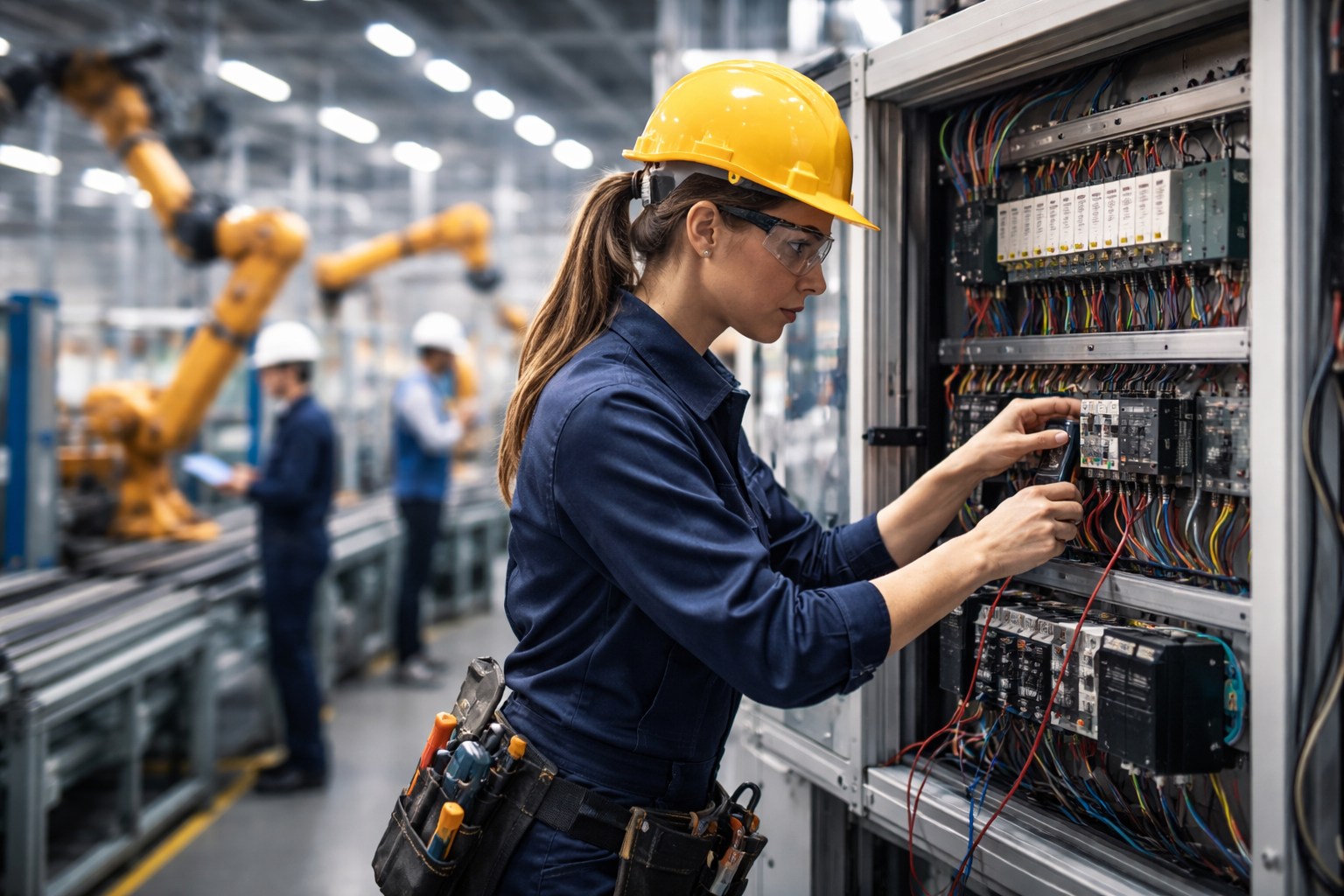
Engineering likes to tell itself it is a meritocracy. And, in purely technical terms, it is. A machine either meets tolerance or it does not. A cable assembly either passes testing, or it gets scrapped.
The trouble is, engineering careers are not closed-loop systems; they are leaky pipelines built out of recruitment, training routes, workplace culture, promotion gates, and — crucially — who gets believed when they say that they can do the work.
As International Women’s Day 2026 arrives, it comes — as it does every year — with a theme and a slogan: “Give To Gain”. But for the engineering sector, it’s time that companies shunned slogans in favour of the frank reality. The sector is staring down electrification, retrofit, grid reinforcement, automation, defence rearmament, and a long tail of industrial maintenance that does not politely wait for headcount plans.
If engineering keeps excluding women from the roles that physically build, install, and run the systems, it keeps choosing scarcity.
Wonky progress
At the top-line level, the trend is not flat. In the UK, EngineeringUK’s footprint of “engineering roles” shows women at 12.0% in 2015, rising to 16.5% by 2021, with the latest workforce snapshots (2025) putting women at 16.9% of engineering and technology roles. That is a gain of several percentage points in a decade — meaningful, but still a long way from normal.
And the devil is particularly present in the granular detail, where the story stops being celebratory. Skilled metal, electrical, and electronic trades remain stubbornly male-leaning. EngineeringUK’s footprint shows women rising from 1.7% in 2015 to 3.8% by 2021 in that trade grouping — an improvement, but still effectively a closed shop in cultural terms. You can double a number and still be left with a number too small to change what an apprentice sees on day one.
Europe offers a second, and far more uncomfortable, comparison. Eurostat data for 2024 put women at 40.5% of scientists and engineers across the EU, up from 29% in 2004. However, in manufacturing, women are only 22.4% of scientists and engineers. The continent’s headline numbers look better than the UK’s until you reach the industrial perimeter — and then the same old pattern reappears.
This is the context in which Scotland’s electrotechnical trade association SELECT is pushing a simple message: the sector can pay well, it is hard to automate away, and it sits at the centre of net zero delivery. It is also a sector where women are still treated as an exception.
SELECT points to the success of Ellis Stevenson, employed by Campbell & McHardy Ltd in Elgin, who won the SkillELECTRIC title after a three-day competition in December — the UK’s first female champion in the competition. That matters, not because trophies change structural barriers on their own, but because visibility changes what young people assume is possible.
Sharon Miller, Managing Director Designate at SELECT, makes the stakes similarly visible: “Attracting and retaining more women to our sector is vital to addressing the current skills gap. The electrotechnical sector is a haven for those seeking a well paid, AI-proof role which also supports the drive to net zero.”

The optimism is real, and the apprenticeships data suggests movement. SELECT says the number of young women choosing to train as an electrician in Scotland has doubled over the past decade. It also concedes the scale of the problem: female apprentices still account for around 2% of learners. That is the reality we still must grapple with.
Manufacturing is not one workforce, it’s several
One reason the debate keeps slipping into platitudes is that “engineering” and “manufacturing” get treated as single blocs. They are not. The UK’s manufacturing workforce is more gender-balanced than engineering, but it is segmented by job type.
Data from the University of Cambridge Institute for Manufacturing’s Women in UK Manufacturing 2025 report puts women at 28.4% of the UK manufacturing workforce in 2024. It also showed a split in where women are concentrated, with representation stronger in professional and associate professional roles, and materially weaker in skilled trades and machine operative work.
Manufacturing may no longer be defined by purely manual work, but the roles that carry physical authority — the jobs that set the pace of production — are still disproportionately male.
That segmentation influences retention. The same Cambridge report notes that, among respondents who had left manufacturing, 75% cited feeling undervalued, 58% pointed to limited career progression, and 42% referenced non-inclusive environments. Work–life balance, inflexible patterns, and poor management also feature heavily. These are not “women’s issues”; they are production issues, because churn destroys capability.
GTK, a UK-based manufacturer of cable assemblies, is using International Women’s Day to put its own leaders forward and talk about what it takes to build a career inside a factory-backed business. The three perspectives are useful precisely because they are not identical. Manufacturing is a chain of constraints; you do not improve it from one function alone.
Lucia Goncalves, Production Planner at GTK, describes a career built through operational work across the UK and Portugal. “I have over 20 years of experience in electronics manufacturing across the UK and Portugal. I began my career as a warehouse operator and quickly progressed into a team leader role,” she says, pointing to the moment she gained deeper systems exposure. “Later, becoming an SAP Key User expanded my technical and process knowledge, eventually opening the door to my transition into production planning.”

That route is a reminder that some of manufacturing’s best technical operators are built, not hired fully formed. Progression routes can start in roles that are often dismissed as non-technical.
Candice Robins, Finance and Far East Operations Director at GTK, frames influence in terms manufacturing engineers recognise immediately: controls and feedback. “I’ve been in finance for over 15 years, and in that time, I’ve always had a passion for using financial insight to solve problems and drive business performance,” she says.
It is easy to lightly mock finance in engineering circles for not being the preferred flavour of STEM. Easy, that is, until a business cannot fund capex and cannot back investment in new equipment. Ultimately, similar skills underpin both paths.
But, unfortunately, skills form only part of the challenge. As Leanne Matthew, HR Business Partner at GTK, identifies, a barrier that repeatedly shows up in retention data is authority, not ability. “It’s not just about being a woman; age plays an important factor as well,” she says. “A lot of the challenges I’ve faced in previous roles were in relation to not just being a woman, but being a younger woman in a leadership position.
“What’s supported me through this is being around strong female role models — that’s been invaluable to my career.”
That line is one that emerges time and time again. If women rarely see women promoted in technical and operational leadership, they correctly infer a ceiling. They leave, or they never enter, and the pipeline narrows further upstream. The sector then complains it cannot find talent, as if the labour market is a force of nature and not the culmination of our own natures.
The trades gate, and the culture behind it
The electrotechnical trade is a useful microcosm because it combines high skills demand with traditional gatekeeping. Catherine Gillon, Director of Employment Affairs at SELECT and Secretary of the Scottish Joint Industry Board (SJIB), argues employers are more open than the stereotype suggests: “Although it may be seen as a difficult environment for a female employee, we find that employers are very open to taking on young women and supporting them through what can be an extremely demanding training schedule.”
There is truth in that. There is also a catch: openness to recruiting a small number of women does not automatically translate into an environment that retains them, promotes them, and gives them equal access to the jobs that build competence.
GTK’s Leanne Matthew makes the visibility point directly, and it is one manufacturing still struggles to absorb. “Giving women in the sector a platform and showcasing role models helps promote engineering or manufacturing as a career path for women,” she says. “Young girls and women need to know that they can go into manufacturing, because it’s not just wearing a high vis and a hard hat, there’s lots of other doors that can open and lots of other benefits.”
That is correct, but it should not become a comfortable diversion. The goal is not to steer women away from frontline technical work into office-based functions because it feels more welcoming. The goal is to fix the frontline.

“Give To Gain” means changing who owns the work
All that said, we should revisit this year’s International Women’s Day theme and view it as a structural steer rather than a snappy slogan. Engineering’s next gains will come from two places: progression and ownership.
Progression is the near-term lever. The sector can choose to build credible pathways: apprenticeships that do not treat women as anomalies, return-to-work routes for experienced staff who step out, and flexibility that works alongside shift patterns, outages, and project delivery. These are management decisions, not cultural debates.
Ownership is the longer-term lever, and it is where Europe’s numbers ‘shine’ again. The European Patent Office reports women made up 13.8% of inventors in Europe in 2022, and only 13.5% of patenting startups include a woman founder. Even in 2024, only around a quarter of EPO applications named at least one woman inventor. If engineering wants women in leadership, it has to put women on the patent, on the programme, and on the P&L.
The industry does not need another round of awareness. It needs to act. The gain is as grounded and clear as it could possibly be. It is electricians on the tools, planners stabilising schedules, engineers commissioning systems, and leaders who look like the talent that the sector keeps saying it cannot find.