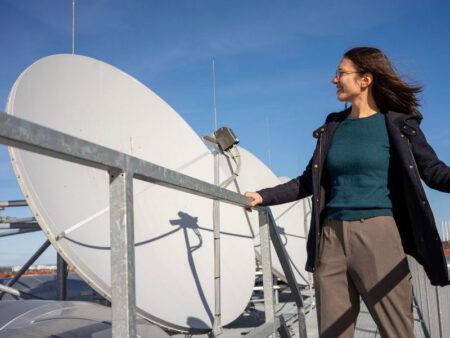

Researcher Irene Livia Kruse, who with colleagues will develop the solar forecasting, in front of DMI’s satellite image reception dishes. Image: DMI.
Danish TSO Energinet has entered into an agreement with the Danish Meteorological Institute (DMI) for satellite-based solar forecasting.
The service, which is due to start delivery in early 2026, is proposed to draw on satellite photos and AI to predict cloud cover over individual solar parks on a 10 minute basis and thus the electricity production.
With this, Energinet envisages being able to better balance the grid as renewable energy accounts for an increasing share of Denmark’s energy production and to provide better and cheaper electricity supply.
“For us, the collaboration is about looking ahead, and there we spot an electricity grid with greater risks of imbalances than what we see today,” commented Jesper Abildgaard Nielsen, director of Energinet‘s Digital Products and Business Development department.
“If we just let it go, it will become more expensive to balance the electricity grid and ultimately affect our high Danish security of electricity supply. Therefore, I am very much looking forward to working with DMI on more frequent and much more accurate solar forecasts.”
Have you read?
Europe’s Metop-SGA1 satellite launches to advance extreme weather forecasting
Europe Energy Briefs: Weather and climate and how they impact the energy system
Currently Energinet receives updated weather forecasts on a three hourly basis but the aim is to speed up the frequency to 10 minutes.
DMI Director Marianne Thyrring adds that the collaboration on making maximum use of solar energy is the result of DMI being both a weather authority and a research institute.
“We are pleased to be able to contribute to the green transition with more accurate weather data, and we predict that the need will only increase for other free green data.”
The initiative gets under way formally from 1 October 2025. The intention is that the satellite solar forecasting tool is open source and available to other users and companies across Europe.