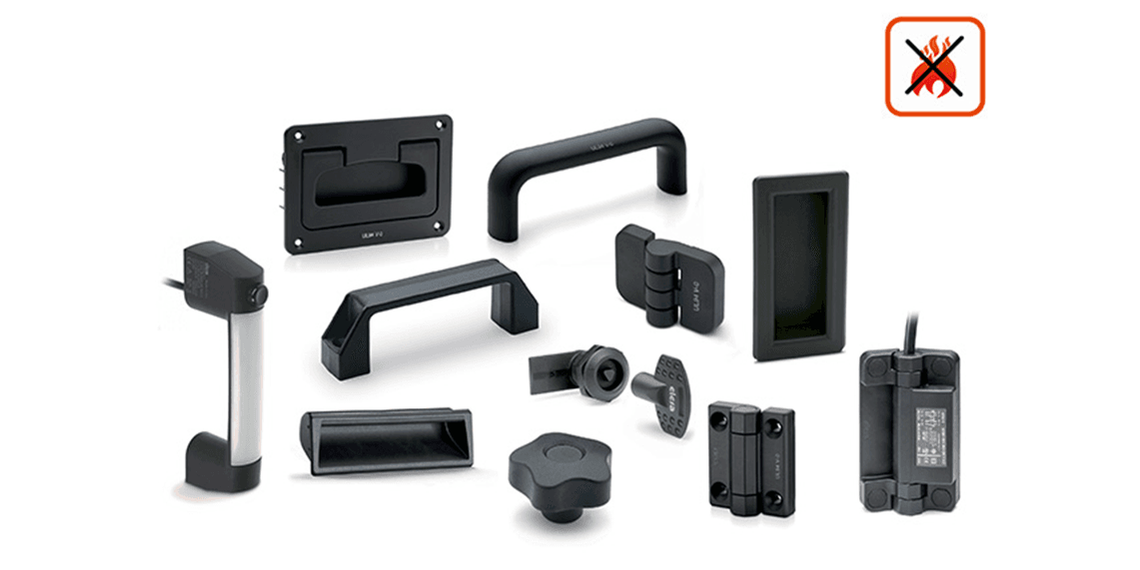
Elesa has expanded its AE-V0 range of machine components, extending the availability of self-extinguishing technopolymer hardware for applications where flame resistance is a core design requirement rather than a desirable extra. The enlarged line now covers lobed clamping knobs, bridge handles, recessed handles, hinges, electric hinges, and closures, giving machine builders a broader set of fire-rated specification options across the physical points that operators touch, open, fasten, and adjust.
The industrial significance sits in the classification. According to Elesa, the AE-V0 family uses a specially formulated technopolymer that meets UL 94 V-0 requirements. Under UL’s vertical burning test, that means each specimen must self-extinguish within 10 seconds after flame removal, while also avoiding flaming drips that could spread ignition to surrounding materials. Elesa says the material performance is backed by a UL Yellow Card, the third-party recognition record used across the plastics and components market to verify the safety characteristics of a given material.
That places the range above the more basic UL 94 HB horizontal burning benchmark still associated with many conventional polymers. In practical terms, the issue is not just whether a component burns, but how it behaves when exposed to flame in real equipment layouts where doors, guards, housings, access panels, and operator interfaces sit close to other combustible or electrically active parts. For machinery used in public environments, complex industrial plants, or increasingly automated installations, component-level fire behaviour can influence both machine design choices and approval pathways.
What Elesa is selling, then, is not a single specialist part but a wider degree of consistency. Instead of mixing standard and fire-rated materials across different component families, OEMs and panel builders can specify the same flame-performance standard across more of the machine envelope. That matters where enclosure hardware, hinges, safety-access points, and manual controls all need to meet the same risk assumptions without compromising ergonomics or installation flexibility.
The expansion also reflects a broader shift in industrial specification, where seemingly ordinary standard components are being asked to carry more of the compliance burden. In highly automated systems, hardware is no longer just hardware. It is part of a larger argument about safety, reliability, and how far designers can standardise around one material platform when fire performance becomes a non-negotiable requirement.