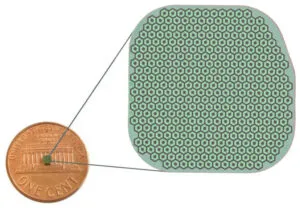
Science, a Californian company, has introduced an innovative implant designed to restore central vision in patients suffering from geographic atrophy due to dry age-related macular degeneration. The Prima implant, measuring 2 x 2mm and 30μm thick, comprises 378 closely-packed hexagonal pixels, each 100μm across. It is strategically positioned within the retina, beneath damaged rods and cones, but above intact electrically-sensitive bipolar cells, thus bypassing the damaged photoreceptors.
Each pixel within the implant is equipped with two series-connected photovoltaic cells powering a central electrode, while a counter-electrode encircles the hexagon’s perimeter. The implant operates in conjunction with custom augmented reality glasses that include a camera, an infrared image projector, and a belt-worn image processor capable of adding functionalities such as zoom. The projected infrared image is converted by the implant into an identical pattern of electrical stimulation, targeting the bipolar cells effectively.
A study published in the New England Journal of Medicine highlighted significant outcomes, with 84% of participants able to read letters, numbers, and words using the prosthetic vision provided by the Prima implant. Moorfields Eye Hospital, one of the participating institutions, noted that some participants could read, on average, five lines of a vision chart that were previously invisible to them.
Involving 38 participants across 17 institutions in five countries, the study underscores a pivotal moment in the history of artificial vision. “In the history of artificial vision, this represents a new era,” stated Mahi Muqit, a consultant at Moorfields Eye Hospital. “Blind patients are actually able to have meaningful central vision restoration, which has never been done before. Getting back the ability to read is a major improvement in their quality of life, lifts their mood, and helps to restore their confidence and independence.” The Prima chip operation can be safely performed by trained vitreo-retinal surgeons within two hours.
The introduction of the Prima implant marks a significant advancement in visual prosthetics, promising enhanced quality of life for individuals affected by severe vision impairment. As the technology continues to evolve, further developments in prosthetic vision are anticipated, offering hope to millions worldwide.