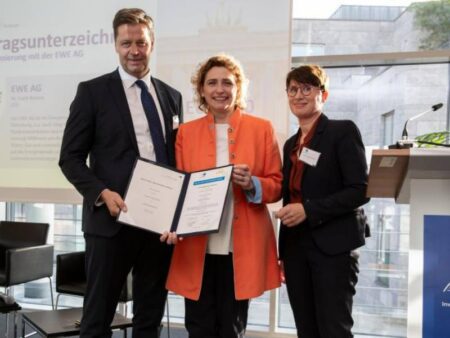

The long-term credit facility was finalised at an event attended by German federal government ministers, project partners and stakeholders. Image courtesy EIB.
The European Investment Bank (EIB) has loaned €450 million ($530 million) to Germany’s EWE to expand the power grid in Lower Saxony.
EWE, a German energy and infrastructure company, will use the financing to lay over 2,600km of new underground power lines and construct and modernise more than 1,100 substations.
According to the Bank, approximately 95% of the electricity fed into EWE’s power grid in Lower Saxony comes from renewable sources.
The investments will enable an additional 3GW of renewable generation capacity to be connected by 2028.
Commenting in a release was EWE chief financial officer Frank Reiners: “This financing will help supercharge our investments in grid expansion and digitalisation.
“This will enable us to rapidly and securely integrate more renewable energy into the power grid and strengthen the security of supply in our regions, thereby making them more attractive for new industrial developments.”
Have you read:
Germany’s special fund: A renewed bid to be energy transition’s champion
Germany’s 50Hertz plans three new underground electricity routes
EIB Vice-President Nicola Beer added: “What many people do not know is that the most important energy-transition investments are often right under our feet.
“With over 2,600 km of new underground power lines and more than 1,100 new and modernised substations, we are working with EWE to build a hidden backbone for a more secure energy supply and expanded use of renewable energy throughout northern Germany.”
Beer added that the financing is the largest-ever for EWE from the bank and remarked that 2024 was a record year for investments from the EIB into the power grid, “…this project shows how we are actively shaping Europe’s green future.”
According to the EIB, the EWE’s investment programme is fully aligned with Germany’s national energy and climate plan, which foresees an 80% share of renewable energy in electricity use by 2030.
It also supports the REPowerEU initiative by expanding clean-energy integration, cutting emissions and strengthening energy supply.