
Image: Trende
A commercial peer-to-peer (P2P) power trading project among agricultural cooperatives in Japan has been launched by the renewable energy company Trende Co.
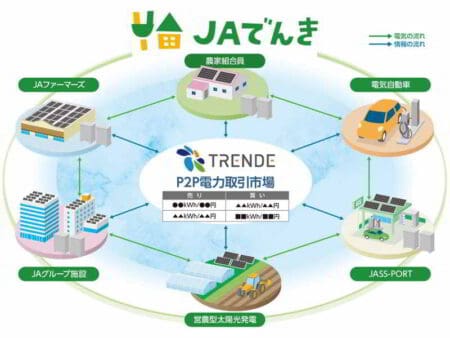
The blockchain-based service, which is being implemented through Japan’s National Federation of Agricultural Cooperatives, uses AI-based supply and demand forecasting to trade electricity between consumers supplied from local solar power and energy storage facilities.
In particular, consumers in Japan who have reached the end of the feed-in tariff period for their solar power generation should have more opportunities to sell and utilise their surplus electricity through P2P power trading.
The initiative had its origin in 2023, with a collaboration between Trende’s parent company Itochu and the cooperative Federation to realise a ‘smart agri community’, in effect an analogue of a smart city.
Have you read?
Scaling energy communities for a more optimal energy market design
Energy Transitions Podcast: Peer-to-peer empowerment
In March 2024, a pilot P2P power trading service was launched through the Federation’s electricity retailer subsidiary Zen-Noh Energy Co. in households and supermarkets where solar power generation systems are installed in the Gunma Prefecture.
The aim was to reduce the farming and living costs for the members of the Federation’s member associations.
Findings up to August 2024 are reported to have confirmed that all the participants have gained economic benefits and that the service is effective for “local production for local consumption of electricity that balances economic and environmental friendliness”.
The participants expect the economic benefits to grow as their number increases.
The plan also is to expand the trading service with other distributed resources such as EVs and to promote joint efforts, set out in the ‘smart agri community’ concept to “realise a comfortable and comfortable living environment”, “support agriculture and lifelines” and “realise a decarbonised society”.
With the service as a starting point, Itochu states also intending to promote the effective use of renewable energy in contributing to the prevention of global warming.