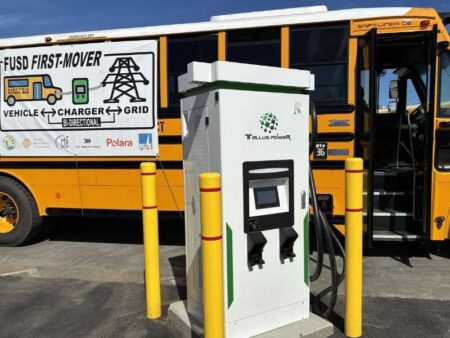

PG&E and The Mobility House have launched a groundbreaking vehicle-to-grid electric school bus fleet with Fremont Unified School District. Courtesy: Pacific Gas & Electric Company.
PG&E, The Mobility House (TMH) and Fremont Unified School District (FUSD) have commissioned one of California’s most advanced vehicle-to-grid (V2G) electric school bus fleets.
Sometimes, objects can be defined by the tasks they help us carry out. A washing machine is pretty useless if it doesn’t live up to its namesake. What is a stapler, if not a thing that staples?
But other times, standard nomenclature doesn’t begin to describe. A school bus, for example, can be much more than transportation to and from a learning institution; for students, for school systems, and for the local utility.
Clean rides, smart energy, resilient grid
California utility Pacific Gas and Electric Company (PG&E), in partnership with FUSD and TMH, recently commissioned one of California’s most advanced V2G electric school bus fleets. PG&E calls the August announcement a “major milestone” in clean transportation, grid resilience, and student health.
FUSD is now equipped to power and manage a growing fleet of 14 electric school buses, including four Thomas Built and 10 Blue Bird buses. PG&E and the Mobility House installed six high-power bidirectional V2G direct current (DC) fast chargers, and plan to put in two additional high-power unidirectional chargers in 2026, which will give the school district access to 22 electric vehicle (EV) chargers in all (six new ones, plus 14 previously-installed low-power chargers). This infrastructure will support the displacement of six internal combustion engine buses, with four new electric buses entering service this year and two more in 2026.
“This project is a shining example of how innovation creates a cleaner, smarter energy future,” said Mike Delaney, VP of utility partnership and innovation at PG&E. “We’re proud to support Fremont USD and school districts across California as they convert to better, electrified student transportation.”
Have you read:
Project details
The project, led by TMH under the California Energy Commission-funded Replicable Vehicle-to-X Deployment Study (RVXDS), will utilise TMH’s intelligent charge management platform, ChargePilot, to optimise both charging and discharging of the fleet using open standards.
“Electric school buses, with their large batteries and predictable schedules, have tremendous potential to support the electric grid with V2G,” said Gregor Hintler, North American CEO of The Mobility House. “We are proud to provide the technology that enables the district to drive clean and support community energy resilience.”
As an aggregator, ChargePilot will also enable FUSD’s participation in PG&E’s Emergency Load Reduction Program (ELRP) by responding to OpenADR signals, turning school buses into grid assets that can support reliability during peak demand. OpenADR is an open, secure, and two-way information exchange model for Demand Response (DR) and Distributed Energy Resources (DER).
To enable this transformation, PG&E upgraded the site’s electrical infrastructure, including:
- A new 480-volt 3-phase service entrance (upgraded from 208V)
- A 750 kVA transformer
- Facilitated installation of a 2,500-amp switchgear to meet current and future charging needs
PG&E expedited the energisation process through a streamlined Rule 15/16 service upgrade, ensuring the site could accommodate the full allocation of six V2G DC fast chargers. Rules 15 and 16 are electric utility rules in California that outline the requirements for service line extensions, which are lines that connect the distribution lines to the customers’ electric meters. The site is also interconnected via Rule 21, allowing energy export and additional revenue opportunities for the school. Electric Rule 21 describes the interconnection, operating, and metering requirements for generation facilities to be connected to an investor-owned utility’s (IOUs) distribution and transmission system.
Can we take this show on the road?
This marks the second school district participating in PG&E’s commercial fleet Vehicle-to-Everything (V2X) pilot, following the successful deployment with Zum and Oakland Unified School District in 2024.
Fremont USD’s participation in PG&E’s EV Fleet programme, which began in 2019, has supported 17 electric school buses and 13 electric medium-duty vehicles with incentives for infrastructure and charging equipment.
In addition to PG&E and TMH, the pioneering FUSD project was made possible through the collaboration of Polara, World Resources Institute, and the Center for Transportation and the Environment. Together, PG&E asserts, they are helping lead the charge toward a cleaner, more resilient future, one electric school bus, one bidirectional charger, and one transformer at a time.
“We’ve already seen how the electric buses can contribute to cleaner air for our community,” said Ernest Epley, FUSD’s Director of Transportation. “Now, we have the opportunity to use these buses to deliver clean and reliable energy too.”
Originally published by Paul Gerke on Factor This.