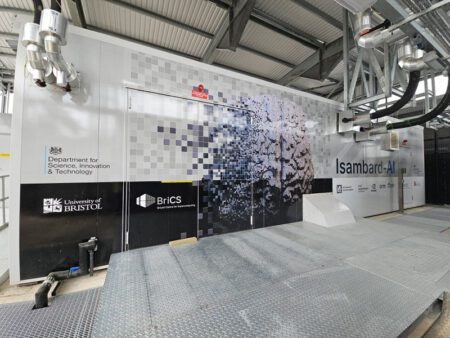

Image: University of Bristol
Britain’s most powerful supercomputer Isambard-AI has been brought online with a 5MW grid connection by National Grid Electricity Distribution (NGED).
The new network connection, which was installed in just three weeks, involved the laying of hundreds of metres of underground cable from a primary substation and a newly constructed HV substation, the distributor has reported.
Isambard-AI, built and run by the Bristol Centre for Supercomputing at the University of Bristol at a cost of £225 million ($302 million), requires power equivalent to that needed by 2,000 homes.
“Isambard-AI is a nationally important step forward in AI-research infrastructure and is the first supercomputer grid connection we have enabled in the region,” commented Stephen Blackwell, NGED’s Bristol head of operations.
“We have worked at pace to enable energisation, collaborating with the university, the Department for Science, Innovation and Technology and others to make this happen, and in the process helping to boost the country’s AI capabilities.”
Have you read?
Kestrel supercomputer to support renewable energy research in US
Europe Energy Briefs: Quantum set for mainstream in Europe
Isambard-AI – named after the 19th century engineer Isambard Kingdom Brunel, who is best remembered today for the Clifton suspension bridge in Bristol and for the ‘SS Great Britain’ in dry dock in the city – is more than ten times faster than the next fastest supercomputer in the UK and has been ranked as the 11th fastest supercomputer in the world.
Powered by over 5,000 NVIDIA GH200 Grace Hopper superchips delivering 21 exaflops of AI performance, Isambard-AI is designed to support research in areas from clean energy to medicine across academia, government and industry.
Using up to 4MW of power when running flat out, it also is energy efficient, reported to rank fourth globally for its energy efficiency.
Professor Simon McIntosh-Smith, director of the Bristol Centre for Supercomputing and co-founder of Isambard-AI, added that securing the grid connection was a critical step for the project.
“It enables us to launch Isambard-AI and open up its full potential of next-generation supercomputing, whilst paving the way for innovation, skills development and economic growth across the region and beyond.”
The story doesn’t end there and the Bristol Energy Network is currently working on a proposal, which has been given an initial nod by the South Gloucestershire Council, for two 4.26MW wind turbines at Pucklechurch just outside Bristol for local community power and perhaps direct connection to the Bristol and Bath Science Park, where Isambard-AI is located.
This would open the possibility of powering the supercomputer with clean power.
South Gloucestershire Council Cabinet Member with responsibility for climate and nature action, Louise Harris, said the project has such potential to help meet the goals to become carbon neutral.
“We need to wait for the details, but we look forward to seeing what comes forward once our communities have been able to engage with Bristol Energy Network.”