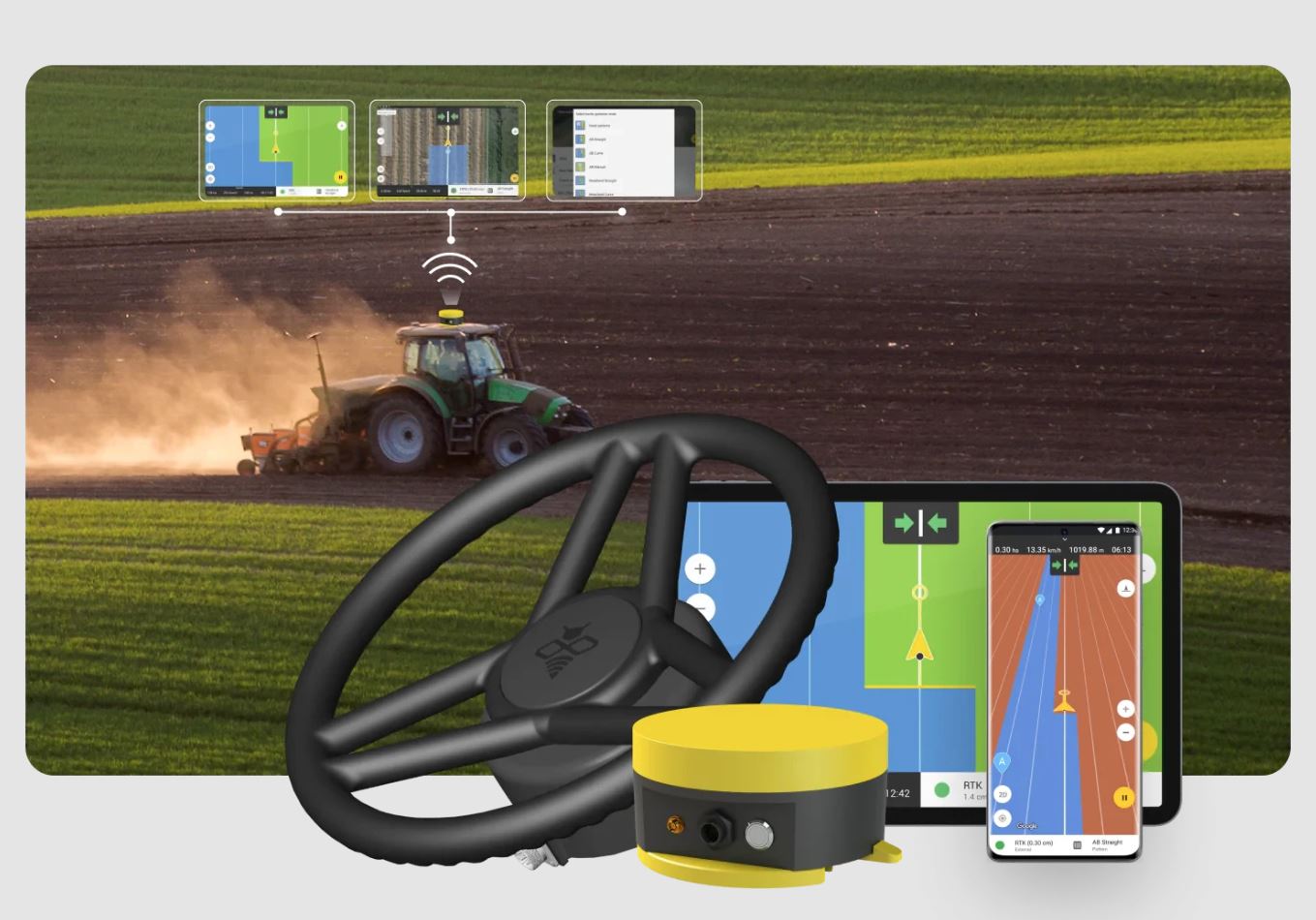
Precision in fieldwork is critical when it comes to maximizing yield and minimising waste – and that’s exactly where auto steering systems shine. These systems guide your machinery along perfectly straight or curved paths with minimal overlap or skip, improving efficiency across a wide range of field operations. While almost any crop can benefit from guidance, some respond especially well to the accuracy and repeatability that autosteering provides.
In this article, we’ll look at six types of crops where auto steering system like FieldBee Autosteer delivers the most noticeable advantages – from planting to harvest.
Row Crops
Auto steering is especially valuable for row crops, where precise spacing and straight-line accuracy directly impact yield and efficiency. Systems like FieldBee Autosteer help maintain consistent row alignment during planting, fertilizing, and harvesting – reducing overlaps, skips, and compaction. This is particularly useful in large fields, where even small deviations can result in significant losses over time. It also supports controlled traffic farming by keeping machinery on the same tracks season after season.
Cereal Crops
For cereal crops like wheat and barley, productivity hinges on speed, precision, and minimal input waste. Auto steering systems allow you to cover wide areas quickly while staying precisely aligned with previous passes. This ensures uniform seeding, accurate fertilizer application, and better use of field space. It’s especially helpful in low-visibility conditions – such as at night or in dusty weather – where manual driving would be less accurate and more tiring for the operator.
Vegetables
Vegetable production demands a high level of precision due to narrow row spacing and the delicate nature of the crops. Auto steering enables accurate bed shaping, planting, cultivation, and spraying – minimizing damage to plants and maintaining optimal field structure. This is particularly useful in repeated-pass operations, where exact machine guidance prevents accidental crop destruction and helps improve harvest quality across high-value vegetable fields.
Vineyards and Orchards
Perennial crops like grapes and fruit trees require extreme precision due to fixed row spacing and tight navigation paths. Auto steering systems help operators move between rows with millimeter-level accuracy, reducing the risk of plant damage and improving efficiency in tasks like spraying, mowing, and mulching. In sloped or uneven terrain, guidance systems also improve safety and machine stability, making work more predictable and less stressful.
Root Crops
When working with crops like potatoes, beets, or carrots, uniform spacing and consistent depth are essential for good yield and easy harvesting. Auto steering ensures accurate row placement and repeatable passes – which helps with crop development and reduces mechanical damage during harvest. It also simplifies operations in fields where previous rows must be followed exactly, such as during ridging or spraying.
Oilseeds
Crops like sunflowers and canola benefit from evenly spaced planting and precise coverage during fertilization and pest control. Autosteer helps maintain straight rows and consistent overlap during field operations, which is especially important for maximizing light exposure and plant uniformity. With fewer gaps and better timing, these crops develop more evenly and can be harvested more efficiently.