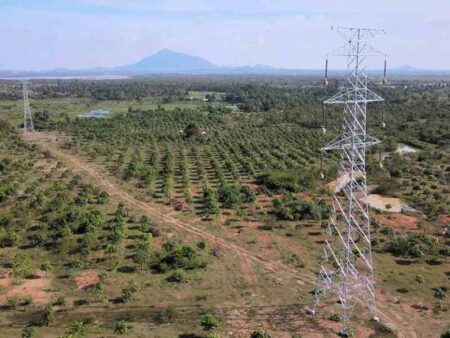

Cambodia province of Kampong Chnang. Image courtesy ADB
The Asian Development Bank (ADB) has approved a $52.72 million loan for the Grid Expansion Project in Cambodia.
The project will strengthen the country’s transmission network to integrate more renewable energy into the national grid and help meet rising electricity demand.
Cambodia’s grid was built for conventional power and now needs expansion to handle growing solar and wind. The project will build 55km of 230kv transmission lines between Pursat and Kampong Chhnang, and upgrade nine substations across the country.
These investments will strengthen transmission capacity to deliver renewable energy to demand centres nationwide, improve reliability, and encourage greater private investment.
Cambodia power infrastructure
According to the ADB in a release, Cambodia has expanded its domestic electricity generation rapidly, doubling output from 8.68TWh in 2020 to 17.85TWh in 2024. Over the same period, reliance on imported electricity dropped from 3.06 to 1.57TWh. This progress, says the ADB, reflects the country’s growing energy self-reliance and the potential of renewable sources to support its development goals.
Additionally, strong economic growth in the country over the past decade has resulted in immense power demand growth.
Cambodia’s medium demand growth case is projected to reach 36TWh by 2030, 50TWh by 2035, and 66TWh by 2040. However, Cambodia’s existing transmission infrastructure is reaching its capacity while power demand grows fast.
Phnom Penh and Kampong Chhnang provinces are overloaded, resulting in transmission constraints and disproportional transmission losses (2.3%). Pursat province is also expected to face similar challenges due to quickly growing power demand and supply.
To address such challenges, Cambodia has a comprehensive development plan for the national grid.
The government aims to scale up renewable energy in the generation capacity mix to total 6,326MW by 2040, which will account for 59% in total generation under the reference scenario of the Power Development Master Plan, 2022-2040.
Have you read:
Energy Vault and Astor Enerji sign global BESS and transformer supply chain agreement
How etrucks are driving decarbonisation of mining in China
The project area of Pursat province and Kampong Chhnang province has the most abundant solar resources, which has strong potential for solar parks.
Commenting in a release was ADB country director for Cambodia, Jyotsana Varma: “Reliable and affordable electricity is the backbone of Cambodia’s growth story.
“This project is about more than building transmission lines—it is about connecting people, schools, hospitals, and businesses to a cleaner and more resilient energy future. By bringing more renewable energy into the grid, Cambodia can power opportunities for its people while protecting the environment for generations to come.”
Aligned with Cambodia’s Power Development Master Plan (2022–2040) and the National Energy Efficiency Policy (2022–2030), the project will help reduce transmission losses, and enhance energy security.