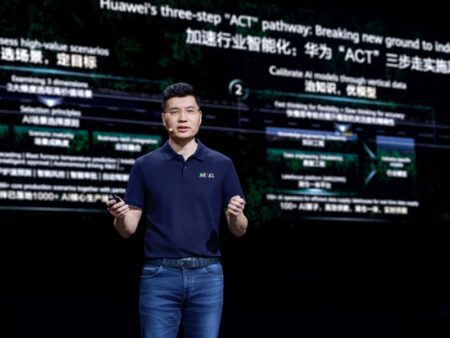

Leo Chen, Senior Vice President and President of Enterprise Sales at Huawei
Huawei has unveiled its three-step ‘ACT’ (Assess, Calibrate and Transform) pathway as a new approach to intelligent transformation in energy and other industrial sectors.
The rapid emergence of advanced AI is raising new questions in industrial sectors such as how can AI create value in my industry, how can I make the most of my data while remaining competitive, and what about large scale application?
Leo Chen, Senior Vice President and President of Enterprise Sales at Huawei, responds: “In Chinese, we have the saying ‘real knowledge comes from practice’,” he says, pointing to its underpinning of a new approach to industrial transformation that the company is introducing.
Designed, along with solutions for individual industries, on cases advanced in several sectors, including banking, healthcare and utilities, he adds: “Our collective response to the changes brought by AI will determine whether it can truly deliver its ‘last mile’ value, and transform technology breakthroughs into real-world benefits.”
Managing data in the power industry
The utility case from China Southern Power Grid is focused on the vast volume of data being managed.
One of its critical challenges is figuring out how to leverage this data to identify defects in power transmission lines.
China Southern Power Grid’s approach was to develop a large model for the power sector, called MegaWatt, building it on the Ascend computing platform and MindSpore AI framework. To prepare the data for AI training, an end-to-end data governance to clean, process, label and optimise was implemented, with Huawei’s optimised operators used to speed up training and greatly improve accuracy.
Following its deployment, MegaWatt was found to have boosted defect recognition efficiency by five times, raised the accuracy to over 90%.
Moreover, the solution has boosted the per-card throughput by 3.3 times compared to traditional solutions and greatly reduced the inference latency.
However, the case also indicated that general purpose models can’t directly solve industry-specific problems and that enterprises need to fine-tune models with their own quality data.
This allows them to train custom models that solve business challenges and create lasting advantages.
‘ACT’ for industrial intelligence
For Huawei, five key learnings emerged from many customers like the China Southern Power Grid case.
1. Choosing the right scenarios is critical as the true value of AI isn’t just efficiency; it needs to be integrated with core production scenarios
2. General purpose models are not enough with out-of-the-box offerings; generic models need to be fine-tuned on high quality enterprise data
3. AI agents are scaling fast as industries fuel demand for large-scale inference
4. Human-AI collaboration will become a new organisational paradigm as AI systems evolve from personal assistants to true partners
5. Systematic governance and risk management are critical to mitigating AI agent risks like out-of-control autonomy and lack of traceability
These then form the basis for Huawei’s three step ‘ACT’ pathway for large-scale AI adoption – Assess, Calibrate and Transform.
“Let’s start with the first step – assessing high-value scenarios,” says Chen, continuing: “Huawei has a robust AI scenario assessment framework that evaluates business value, scenario maturity and business–technology integration and which has already helped customers identify and implement more than 1,000 core AI production scenarios.
“Once the right scenarios are identified, the second step is calibration or building industry models with vertical data. Huawei provides a full toolchain to help enterprises transform raw data into knowledge and knowledge into models.”
As an example, he cites Huawei’s unified Lakehouse platform, which enables enterprises to stream massive amounts of raw data into a data lake, then convert it into structured data warehouse assets, i.e. transform idle data into ready-to-use data.
Another is Huawei’s end-to-end AI security protection system, which works on multiple layers, from cloud, network, edge and device to models and applications, to help guarantee secure and trustworthy AI applications.
“The third step is transforming business operations with AI agents. Enterprise processes are complex, with many scenarios and heavy workloads. Huawei’s one-stop Versatile platform can automatically generate agents, as well as workflows with more than 100 steps and this makes agent deployment much faster.”
Additionally, Huawei has developed an AI talent enablement programme, designed to help business professionals to effectively develop, deploy and operate AI agents.
Realising the ACT pathway
Alongside the ACT pathway, Huawei is promoting a three-step approach to delivery for enterprises with an AI-oriented ICT infrastructure covering the entire process from data preparation and storage through data movement and the high-speed computing interconnect to model training and inference.
Features include Huawei’s Unified Cache Manager plugins, which enables large models to move from minute-level to long-term memory, the 800GE high speed networking solutions, which supports clusters four times larger than the industry standard, and the Ascend AI SuperPoD offering a high-performance solution that can support training and inference for multi-trillion-parameter models and multi-modality.
Chen says that its solution is aimed at breaking through common bottlenecks, but that true industry intelligence can’t be achieved without partners and that the partners ecosystem continues to be strengthened.
“First, we embrace open source then we empower our partners with platforms and tools, and we enable rapid replication through industry expertise.
“Huawei has worked closely with our partners on joint development and marketing for more than 200 industry solutions, helping these partners speed up replication and delivery,” Chen concludes.
Alongside the ACT pathway, the nine solutions for industrial intelligence are:
- City AI Centre & Foundation Model solution;
- Intelligent Computing Labs solution;
- Medical Technology Digital and Intelligence 2.0 solution;
- Banking AI and Foundation Model solution;
- Intelligent Manufacturing R&D solution;
- SMART Logistics & Warehousing solution;
- Intelligent Distribution solution;
- Intelligent Exploration and Development for Oil and Gas solution; and
- Steel Blast Furnace Temperature Prediction solution.
You might be interested in:
How etrucks are driving decarbonisation of mining in China
About Huawei
Huawei is committed to becoming a partner of choice for the digital transformation of the global power industry. Huawei focuses on finding technologies for scenarios and works with various partners to create value for customers, helping them achieve secure, efficient, green and innovative transformation.