Trackside working on electrified railways demands meticulous isolation procedures – these are vital, yet invariably time-consuming. Siemens Mobility, however, is piloting a new technology that promises to streamline the isolation process, affording trackside teams significantly more time to carry out essential works during possessions.
The Siemens Remote Securing solution has been designed to satisfy the need for Network Rail to comply with Electricity at Work Regulations (EaWR) which require an isolation be secured. This translates to an isolation being in the control of a Nominated Person (NP) trackside, rather than an Electrical Control Operator (ECO) in a distant control room. Remote Securing prevents an ECO or remote substation maintenance staff inadvertently energising an electrical section, putting the safety of the operatives in the hands of those closest to them.
The impact of isolation time on productivity
Network Rail takes more than 35,000 isolations per year, approximately two thirds of which are on 25kV Overhead Line Equipment (OLE), with the remaining third on the direct current (DC) third rail network. The OLE isolations, which are the subject of this feature, take on average 48 minutes according to a recent Network Rail electrical safety challenge statement.
On short overnight possessions, this results in a significant loss of productivity.

The OLE isolations are taken by an NP in the vicinity of the trackside work site. They communicate with the ECO who remotely operates and monitors the electrical switchgear. The switchgear used to isolate a section of track can be distributed across several kilometres of track.
This makes it difficult to comply with the EaWR which define an isolation as “the disconnection and separation of the electrical equipment from every source of electrical energy in such a way that this disconnection and separation is secure.” For legacy infrastructure, Network Rail has therefore allowed derogation from the regulations and does not apply inhibits to switchgear under isolation.
In CP5, Network Rail introduced the Supplementary Isolation Process (SIP) for new OLE electrification which ensured compliance with the EaWR. SIP increases isolation time, as it requires the NP to manually apply a padlock to every item of switchgear.
Trialling a safe and fast way to do isolations
In order to address this challenge, Siemens Mobility has been collaborating with Network Rail to define and develop the Remote Securing Trapped Key solution since 2015. Siemens created and demonstrated a proof of concept in 2020 and, in March this year, has deployed the system onto the Shotts Line in Scotland for operational trial.
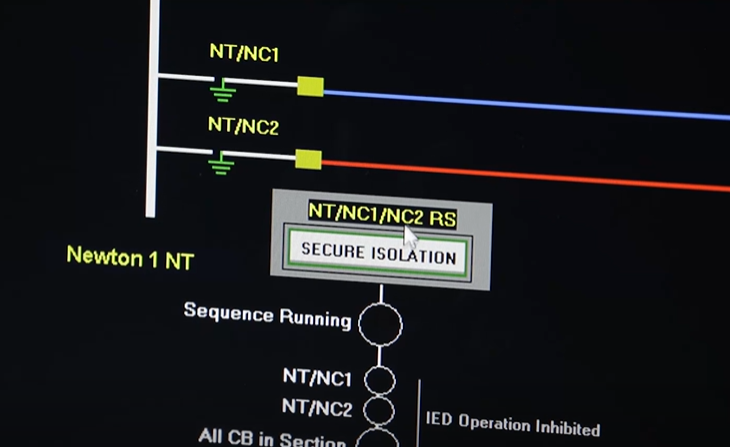
This was the UK’s first deployment of a remote securing solution, enabling the NP to lock all associated switchgear in a safe position with a single key via the Supervisory Control and Data Acquisition (SCADA) system, eliminating the need for multiple padlocks. This works in the following way:
When the isolation is requested, the ECO will isolate the section of track by setting switches in the correct position ready for the planned work.
The ECO instructs the system to commence the Remote Securing sequence at which point the substation Remote Terminal Unit (RTU) checks the status of all relevant switchgear and sends commands to inhibit each device – either through Disconnect Locking Relays or software inhibits. The RTU does this for the devices within its substation as well as the devices at the opposite end of the isolated section via the associated RTU.
At this point, the NP can then remove the key from the Traction Isolation Control Key (TICK) box which prevents the switchgear inhibits from being removed, securing the isolation. Multiple TICK boxes can be deployed on an electrical section (such as at substations or access points) and keys can be removed from any of them.
The ECO then confirms to the NP that the isolation has been secured and authorises issue of a Form B to the NP who then tests that the line is not energised and arranges for earths to be placed before issuing Form Cs.
When the isolation is no longer required, earths have been removed, and Form Cs returned, the NP(s) will re-insert the key(s) which removes the inhibits and allows the ECO to energise the OLE. Up until this point, the ability to operate switchgear, either locally or from the Electrical Control Room (ECR), has been removed.
This quick process thus gives the NP control of the isolated switchgear and disconnectors that both ensures compliance with EaWR and offers significant productivity benefits by reducing the time to apply and remove isolations.

The Shotts line trial by Network Rail maintainers has progressed well and Siemens Mobility is now working with Network Rail to make refinements to the solution based on feedback. As a result of its success, all new electrification in Scotland is being procured with the Trapped Key Remote Securing Solution.
This new technology will enable Network Rail to deliver far more work than it would typically have been able to during possessions and will help boost productivity in the future. All while returning to within the ORR mandated EaWR compliance.
Further enhancements – mobile apps and configurable keys
Siemens Mobility has also been working on alternative Remote Securing solutions to provide different functionality for different scenarios. One such solution is an app-based eKey which has been demonstrated to provide the same level of robust securing as the Trapped Key option.
This solution uses the transfer of electronic tokens between the ECR and NP to secure the isolation and can be deployed as an alternative or in addition to the physical Trapped Key solution. It also allows the NP to view the live status of Substation and Trackside devices to see the progress of the isolation while it is being applied.
Another variant of Remote Securing is under development with GWML where the securing logic is located in the ECR’s Master Station. This allows the Trapped Keys to be configurable so that they can be used for securing different sections of track on different shifts. Initial design has also begun for a solution tailored towards the isolation of depots as well as other Rail environments outside of Network Rail infrastructure.
Unlocking greater possession efficiency
The successful trial in Scotland has the potential to unlock huge time savings and higher possession productivity on projects across the rail network. Across the UK, the time savings on OLE railway could be up to 18,000 hours per year. Thus, remote securing is a good example of the safety and efficiency benefits from considering the whole possession process and applying modern technology to it.