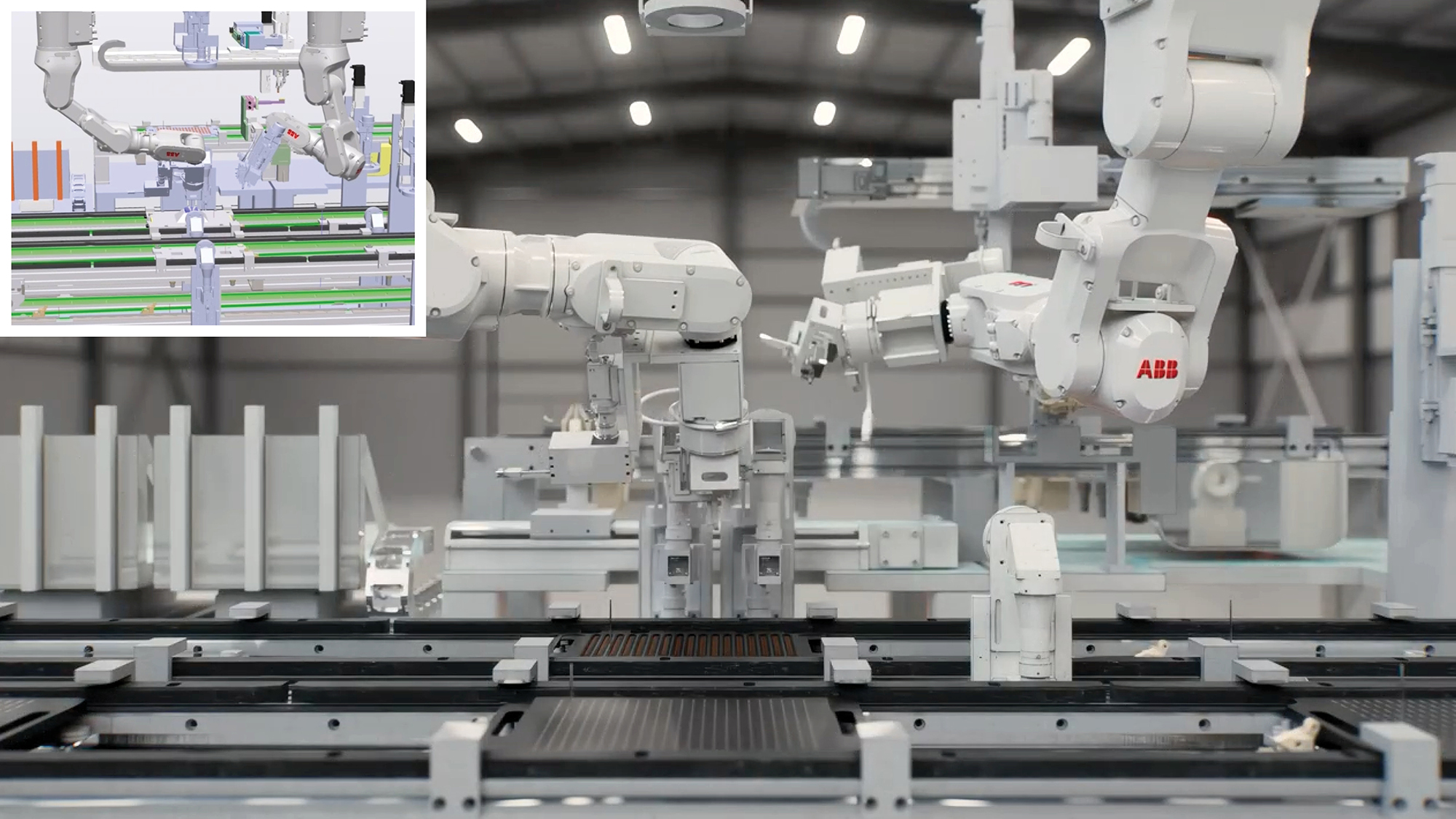
ABB Robotics is integrating NVIDIA Omniverse libraries into RobotStudio in a move designed to help manufacturers deploy physical AI in real-world robotics applications and narrow the long-standing gap between simulation and production.
The collaboration will combine ABB’s programming, design and simulation suite with NVIDIA’s physically accurate simulation technology to create RobotStudio HyperReality, a new capability due for release in the second half of 2026. ABB said the platform will allow developers to simulate robots in digital twins and generate synthetic data to train AI models before deployment on the factory floor.
Marc Segura, President of ABB Robotics, said the announcement marked a step towards making industrial and physical AI practical at scale. He said the integration of NVIDIA accelerated computing and simulation technologies into RobotStudio had removed the last barriers to closing the ‘sim-to-real’ gap for industrial robotics.
ABB said RobotStudio HyperReality will allow manufacturers to design, test and optimise production lines virtually, cutting setup and commissioning times by up to 80%, reducing costs by up to 40% by eliminating the need for physical prototypes, and accelerating time-to-market for complex products by 50%. The company added that the system could achieve up to 99% accuracy between virtual training and real-world deployment.
The supplier said this is supported by its virtual controller, which runs the same firmware as the physical robot hardware, and by its Absolute Accuracy technology, which it said reduces positioning errors from 8–15mm to around 0.5mm. Together, ABB argues, these tools make physically accurate simulation suitable for industrial-grade, high-precision applications.
Foxconn is piloting the first joint use case in consumer electronics assembly, where multiple product variants and delicate components make precise pick-and-place and assembly tasks difficult to scale. ABB said Foxconn is using synthetic data and virtual training to prepare assembly robots for a range of scenarios before moving them to production with close correlation to real-world performance.
Deepu Talla, vice president of robotics and edge AI at NVIDIA, said the industrial sector needs physically accurate simulation to bridge the gap between virtual training and real-world deployment of AI-driven robotics at scale. He said integrating Omniverse libraries into RobotStudio would bring advanced simulation and accelerated computing to ABB’s virtual controller technology.
ABB is also assessing the potential to integrate the NVIDIA Jetson edge computing platform into its Omnicore controller for real-time AI inference at the edge across its robot portfolio. The company said the latest announcement builds on earlier work with NVIDIA, including Jetson integration into ABB Robotics’ VSLAM autonomous mobile robots.
In a further commercial example, California-based robotic workforce company WORKR will demonstrate AI-powered robotic systems built on ABB technology at NVIDIA GTC 2026 in San Jose on 16–19 March. According to ABB, the systems are trained with synthetic data using NVIDIA Omniverse libraries and are intended to help manufacturers address labour shortages without requiring specialist robot programming skills on site.