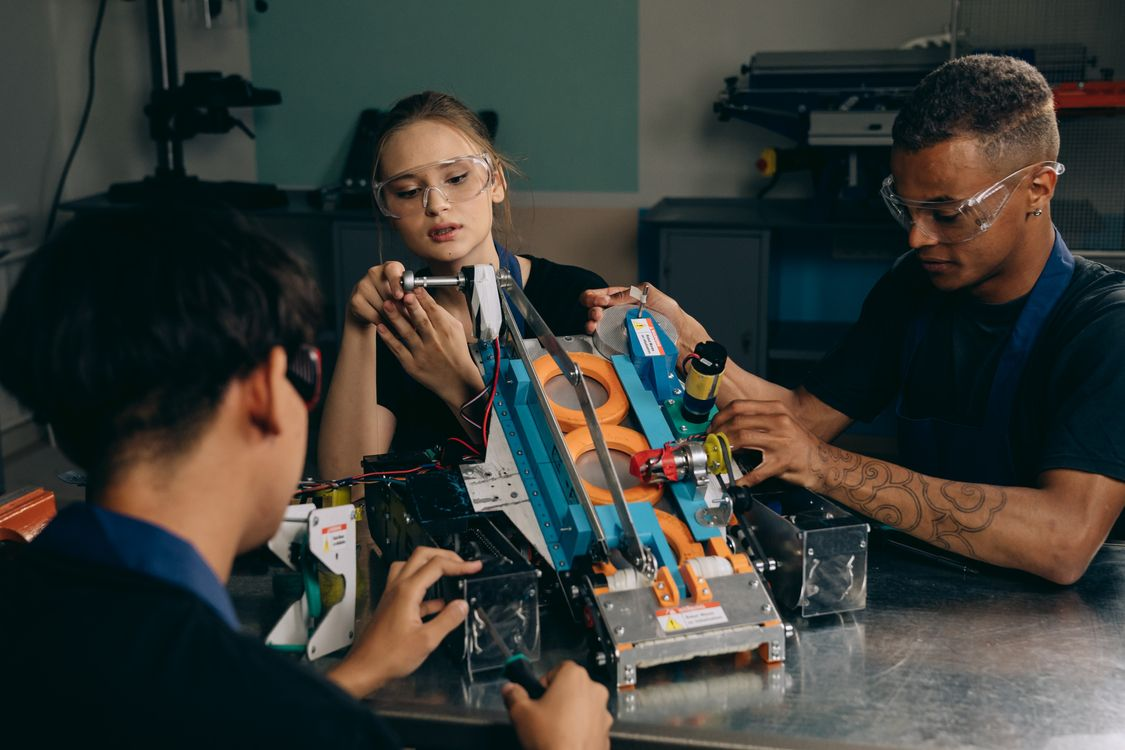
Students from Middlesex University have won gold, silver, and bronze in the industrial robotics category at the WorldSkills UK National Finals, where competitors apply practical engineering skills to automated manufacturing equipment.
Second-year BEng Mechatronics and Robotics students Dwij Sampat and Neel Vashi took gold. Denis Kerxhaliu and Dogu Muhurdaroglu won silver, with Jay Nii-Addy and Peter Zekry completing the university’s sweep of the medals. Middlesex reported the results on 23 November following the conclusion of the finals in Newport, Wales.
Students Nick Makatsaria and Santiago Strajijar also won silver in the separate automation competition while representing London Design and Engineering UTC. The two competitions assess complementary skills in industrial equipment configuration, programming, and integration.
WorldSkills UK’s industrial robotics competition is organised around teams of two. Participants progress through qualifying stages before the national finals, which involve completing a simulated manufacturing process using a FANUC educational robot cell. Training through FANUC Academy supports competitors’ preparation, including the use of robot simulation software.
The competition combines software programming with mechanical and electrical engineering because a robot’s ability to execute a sequence depends on its relationship with other components in the cell. Accurate positioning alone is insufficient if the tooling does not hold the workpiece correctly or the machine receiving it has not reached the appropriate operating state.
Establishing a robot programme requires engineers to define the positions and orientations used during each stage of the manufacturing process. The robot’s coordinate system needs to be related to the workpiece, fixtures, and tools, so that movements can be calculated in accordance with the physical layout of the installation.
Changing an end effector can alter its dimensions, payload characteristics, and the position of the point through which a manufacturing operation is performed. A programme developed for one tool may therefore require modification before it can be used with another.
A machine tending operation may require the robot to receive a signal confirming that the machine is ready before transferring a component. The machine must then be able to determine when the robot has withdrawn and the next manufacturing operation can begin.
Engineers establishing such sequences need to account for interruptions as well as normal operation. If a workpiece is unavailable or an expected signal is not received, the programme must respond in a manner appropriate to the equipment and the process. Fault finding consequently requires an understanding of both the software and the physical equipment producing the relevant signals.
WorldSkills UK’s training requirements include access to FANUC ROBOGUIDE, which allows participants to develop and test robot programmes within a virtual model of the equipment. Offline programming is an established industrial engineering technique, enabling potential movements to be assessed without continuously occupying the physical production cell.
Simulation can identify whether a robot can reach a proposed position and whether planned movements could interfere with surrounding equipment. Its accuracy depends on the quality of the model, particularly the dimensions and locations of the equipment represented within it. Physical validation remains necessary to establish that the programmed sequence works with the actual installation.
The educational combination of software modelling and physical equipment operation reflects changes in industrial production. Manufacturers are introducing cells capable of handling several product variants, where adjustments to tooling and robot paths can allow a single installation to accommodate different production requirements.
A cell supporting multiple variants must retain appropriate operating sequences for each configuration and receive information identifying the correct programme. Maintenance and production engineers must also be able to diagnose problems without unnecessarily interrupting operations elsewhere in the facility.
Developing these capabilities through practical engineering education can help prepare students for commissioning and supporting automation equipment. Middlesex’s mechatronics and robotics programmes combine academic engineering study with work involving physical systems, and its lecturer Karla Kosch is also a WorldSkills UK training manager in robot systems integration.
The industrial robotics competition is open to eligible apprentices and students undertaking engineering qualifications at Level 3 or above, subject to its experience requirements. Competitors who meet the relevant performance and eligibility criteria may subsequently be considered for Squad UK development for the 2028 international competition cycle, if the skill is included in that programme.
The national results conclude this year’s competition, in which Middlesex’s teams progressed through the qualifying stages and applied their programming and integration skills to the physical equipment used at the finals.