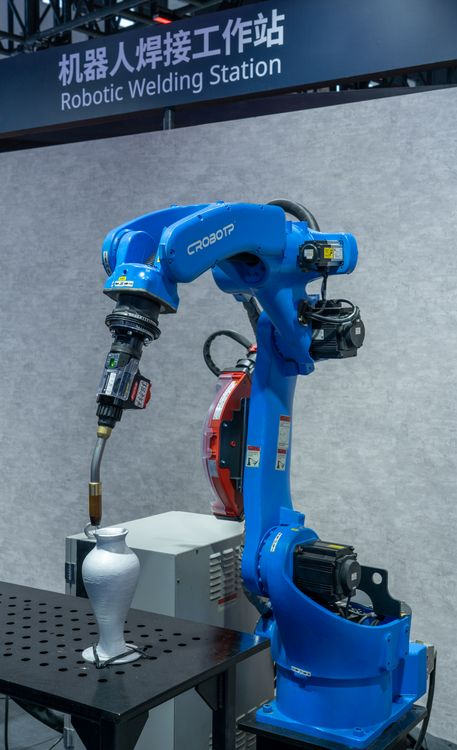
Path Robotics has raised $300 million in Series E financing to expand its industrial automation business, supporting further development of AI-driven robotic welding and new applications across manufacturing.
The funding round was led by Georgian and values the Columbus, Ohio-based company at $2.45 billion after the investment. Existing investors Addition, Drive Capital, IronArc Ventures, Tiger Global and Yamaha Motor Ventures participated, alongside new investors D. E. Shaw Ventures and NAVER Ventures.
Emily Walsh, a partner at Georgian, will join Path Robotics' board of directors. The investment brings the company's total capital raised since its founding in 2018 to more than $610 million.
The financing follows substantial expansion of the company's industrial customer base. Path Robotics reports that its annual recurring revenue increased seventeenfold during the preceding eighteen months, although it has not disclosed the starting or ending revenue values.
The company's principal technology is Obsidian, an AI model developed to control robotic welding in manufacturing processes where the position and geometry of components can vary.
Path Robotics has deployed autonomous welding systems in industrial fabrication, with applications associated with shipbuilding, heavy equipment and other manufacturing activities involving complex metal assemblies.
Conventional robotic welding commonly relies on programmed movement paths developed around a defined workpiece and its expected position. The robot moves the welding equipment along the specified route while the process applies heat and filler material to form the joint.
These arrangements can perform effectively when components are presented consistently and their dimensions remain within the limits established for the automated process.
Greater variation creates additional requirements. Fabricated components may differ slightly from their nominal geometry because of manufacturing tolerances, assembly conditions or distortion introduced during earlier processing stages.
The location and dimensions of a joint can therefore vary between workpieces, even when the same product is being manufactured. A robot following an unchanged programme may not always position its welding equipment correctly against the actual joint.
Path Robotics developed Obsidian to use sensor information when determining the location of weld seams and selecting the movement needed to complete an operation.
The system incorporates optical and laser-based measurement technology to examine the joint. The resulting information is processed to establish a welding path appropriate to the geometry detected on the workpiece.
Its model combines machine learning, computer vision and welding process information to support decisions about the movement of the robot and the operation of its welding equipment.
During welding, the system continues to monitor the joint and adjusts its movement in response to changing conditions. This is intended to accommodate variation that would otherwise require additional programming or intervention.
Thermal distortion is one source of change during the welding process. Concentrated heating causes material to expand, while cooling introduces contraction that can alter the shape or position of the surrounding structure.
These movements can influence the alignment of the joint as welding progresses. A system capable of measuring the changing position of the workpiece may be able to adjust its movement rather than relying entirely on the geometry established before the operation began.
Obsidian has been trained using extensive welding information collected through the company's development and manufacturing activities. Path Robotics says its training data include tens of millions of inches of welded material.
The model is intended to use that experience to interpret joint geometry and operating conditions. Its performance still depends on whether the available measurements and learned behaviour are suitable for the particular material, joint and welding process.
Different welding applications impose different requirements. Material thickness, joint preparation, access and the surrounding assembly can influence the process parameters and equipment needed to complete a weld.
Optical measurement also encounters challenges in a welding environment. The process generates intense light and changing surface conditions, which can affect the information collected by sensors.
The system must distinguish useful geometric measurements from interference while maintaining suitable coordination between sensing, robot movement and welding equipment.
Path Robotics has developed its technology principally through fixed robotic welding cells, where components are presented within a defined working area.
The latest financing will support continued deployment of these systems and development of additional robotic configurations, including the company's Rove mobile welding platform.
Introduced in April 2026, Rove combines Obsidian with a four-legged robotic platform, allowing welding equipment to move towards a large assembly rather than requiring the workpiece to be transferred into a fixed cell.
The arrangement is being developed for applications such as shipbuilding, heavy fabrication and construction, where moving a large structure may be difficult or where work must be carried out at several locations around an assembly.
Rove is designed to move to a defined working location, scan the weld seam and perform the operation using information collected from the workpiece.
Mobility introduces engineering requirements beyond those of a fixed welding cell. The robotic platform must position its equipment correctly, maintain suitable stability during the operation and work within the physical constraints of the surrounding structure.
The welding process also requires appropriate management of heat, electrical equipment, fumes and access to the operating area. A mobile platform does not remove the safety and engineering controls required for industrial welding.
Saronic Technologies is among the first manufacturers participating in the Rove early adopter programme. The maritime technology business is evaluating the system for manufacturing activities associated with its shipbuilding operations in Louisiana.
Rove remains at an earlier commercial stage than Path Robotics' established welding cells. The company's announcement does not establish that the mobile system has reached large-scale industrial deployment.
Path Robotics is also working with major industrial businesses including HII and Lockheed Martin. Its broader customer relationships cover manufacturing applications in which complex fabrication work can create constraints on production capacity.
Shipbuilding presents particular challenges because large metal structures require substantial quantities of welding, often in locations that are difficult to access using conventional fixed automation.
Automating selected operations can introduce additional capacity where the technology is suitable, but sustained manufacturing performance depends on the complete process surrounding the robotic equipment.
Workpiece preparation, material handling, welding consumables and inspection all influence the number of acceptable components that can be completed during a production period.
Quality assurance remains necessary after an automated welding operation. The completed joint must meet the requirements applicable to its intended use, with the inspection method and acceptance criteria determined by the manufacturing specification.
An adaptive control system can assist with maintaining the welding process, but the presence of AI does not independently establish that every joint will satisfy the required standard.
Path Robotics intends to invest further in computing infrastructure, data collection and model training. These capabilities will support development of its existing welding systems and potential expansion into other manufacturing tasks.
The company has identified operations before and after welding as areas for future automation development. It has not announced commercial product specifications or deployment schedules for a complete range of non-welding applications.
The additional funding will also support expansion into new industries and robotic configurations. Transferring technology between applications requires assessment of the equipment, materials and operating conditions involved rather than assuming that performance in welding will translate directly to another process.
Path Robotics reports strong growth in recurring revenue, but the seventeenfold increase is based on figures that have not been disclosed publicly. It does not establish the company's current revenue, profitability or number of installed systems.
The $300 million investment provides capital for further development of its autonomous welding technology and additional industrial applications. Commercial expansion will depend on the ability of its robotic systems to achieve reliable performance within manufacturing processes and the production requirements of individual customers.