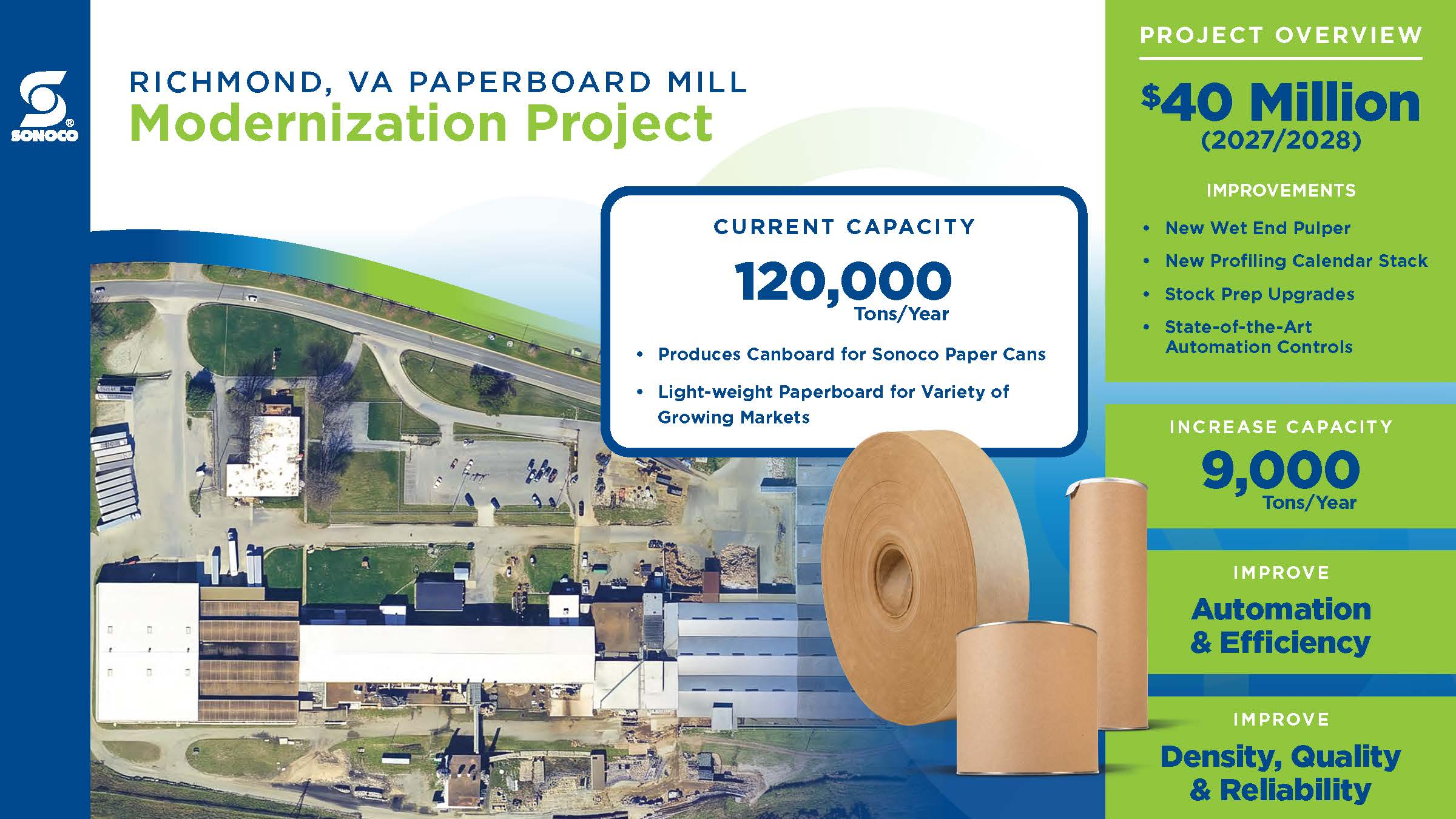
Sonoco plans to invest $40m in modernising and expanding its uncoated recycled paperboard mill in Richmond, Virginia, over the next two years. The programme is intended to increase annual production capacity by approximately 9,000 tons while improving sheet quality and operating efficiency. Construction is scheduled to begin in early 2027, with a second phase targeted for completion by the end of 2028. Sonoco expects the mill to continue producing during the work rather than undergo a prolonged shutdown.
The Richmond plant currently produces approximately 120,000 tons annually, according to Sonoco’s US reporting figures. Its output serves the company’s paper can packaging operations and external customers buying lightweight tan bending chip grades. The facility is part of an integrated North American network supplying recycled paperboard to consumer and industrial packaging markets. Improving the consistency and specification of paperboard at an existing mill can affect subsequent converting operations, where the material must behave predictably during winding, forming, printing and other manufacturing processes.
The first phase will concentrate on sheet formation, profile control, density and cleanliness. Paperboard begins as a dilute suspension of recovered fibres that is deposited onto a moving forming surface and progressively dewatered. Fibre distribution, web formation and the removal of water affect the sheet’s basis weight and thickness. Variations across the machine width can carry through to subsequent winding and conversion, so controlling the formation stage is a practical way to improve consistency while raising production capacity.
Profile control extends beyond nominal sheet weight. A continuous paper machine must maintain the required characteristics along and across the web as furnish composition, stock flow and operating conditions vary. Density affects the balance between thickness, stiffness and forming behaviour, with different packaging grades requiring different combinations of these properties. The Richmond work is therefore directed towards the consistency of saleable board as well as the volume the line can produce, because the two are linked by the amount of material that meets specification.
Recovered paperboard feedstock also makes cleanliness a manufacturing parameter. Adhesives, coatings and other residues can accompany reclaimed fibres through preparation, and unwanted material can affect sheet appearance or the performance of converting equipment. Screening, cleaning and process controls are used across recycled fibre operations to manage that variability. Sonoco has identified cleanliness among Richmond’s initial improvement priorities, alongside the physical properties established during sheet formation; the detailed equipment specification will determine how those objectives are delivered on the existing machine.
The second phase brings the investment further upstream into pulping and water systems, while adding automation and improvements to employee facilities. Pulping prepares recovered fibre for the paper machine, and water carries stock between process stages before much of it is removed again. Consistent pulp preparation and water management support the formation improvements planned earlier in the programme. Changes to these connected operations also require coordinated controls and commissioning, since instability in the furnish supplied to the machine can undermine consistency further down the line.
Automation joins the later pulping and water-system upgrades, linking process equipment changes with the control of production conditions. Instruments and feedback control in paper production can be used to monitor and adjust variables such as stock delivery, web properties and process conditions; the particular functions installed at Richmond will depend on the final engineering scope. Linking equipment changes with operating procedures and maintenance arrangements will be necessary during commissioning, especially where existing production equipment remains in use throughout the upgrade.
Construction is planned to start in early 2027 while the mill continues operating. A staged programme allows the company to coordinate installation work with a live production environment, where access to machinery, isolation of services and equipment commissioning need to be managed without unnecessarily interrupting output. Sonoco’s stated objective is minimal disruption to current production. That constraint will influence the sequencing of works across the paper machine, supporting utilities and later automation installations as the project progresses into 2028.
The mill supplies paperboard for Sonoco’s own paper can packaging operations and sells lightweight tan bending chip grades to external customers. Those outlets place different demands on sheet appearance, stiffness, density and handling characteristics, making stable production properties valuable to subsequent converting lines. A planned capacity increment of approximately 9,000 tons a year creates additional potential supply, while the formation and cleanliness work is intended to make that supply more consistent. The company has not divided the new capacity between individual grades or customer groups.
Richmond operates within Sonoco’s North American uncoated recycled paperboard network, which comprises ten mills and 16 paper machines across the United States and Canada. The company can therefore draw on established papermaking and converting operations while upgrading an existing site. Its mill output feeds industrial and consumer packaging uses, linking production conditions in Virginia to the material quality available further along the manufacturing chain. The investment expands one part of that network rather than creating a new greenfield production location.
The work is scheduled in two connected packages: improvements to the formed sheet and its properties first, followed by pulping, water systems and automation, with the latter phase targeted for completion by the end of 2028. Sonoco expects to maintain existing output through construction, so sequencing and commissioning will be as important to delivery as the additional paperboard capacity itself. The first engineering milestone is the start of site work in early 2027, ahead of the staged installation programme at the operating Richmond mill.