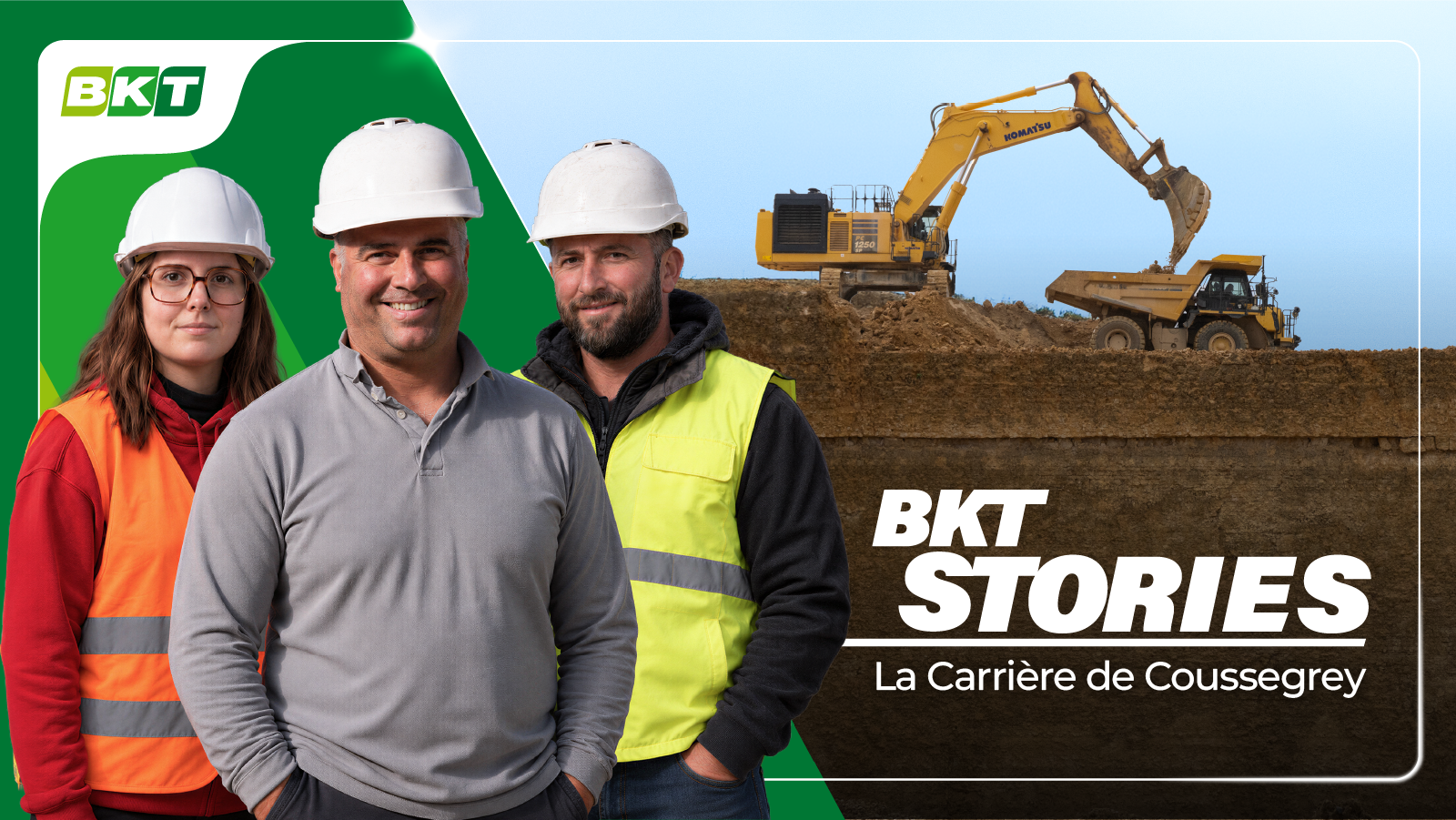
BKT has detailed the use of its EARTHMAX off-highway tyres at a limestone quarry in France, where rigid dump trucks and loading equipment work across abrasive, uneven surfaces while supporting a production operation of approximately 250,000 tonnes of aggregates annually.
Société Nouvelle des Carrières de Coussegrey, known as SNCC, operates in the Aube department and supplies aggregates, gravel and sand to construction companies and concrete producers. Its machinery moves extracted limestone to processing equipment before the finished material is loaded for customers.
The quarry uses EARTHMAX SR 47 and SR 41 tyres in different operating applications. SR 47 is used for haulage, while SR 41 serves loading equipment working on hard, uneven ground. The two specifications meet different operating demands and are not interchangeable simply because they belong to the same product family.
The manufacturer says its products were selected for traction, resistance to cuts, durability and operator comfort. The company also attributes reductions in downtime and improvements in fuel efficiency to the operating experience of the quarry, but has not published a controlled comparison, tyre-life records or a measured percentage improvement.
The tyre fitment date has not been disclosed. The account concerns established quarry operations rather than a newly completed fleet conversion or the launch of a new tyre model.
Haulage tyres at a hard-rock quarry must support substantial loads and repeated movement over surfaces exposed to loose stone, changes in gradient and potentially sharp fragments. The forces experienced during an uphill loaded journey differ from those involved in braking, manoeuvring near a crusher or travelling without a load.
Tyre construction, tread depth and compound selection are relevant to each duty. A tread designed for rocky surfaces must resist cuts and impact damage while providing sufficient contact with the ground to transmit driving and braking forces.
BKT describes the EARTHMAX SR 47 as an all-steel radial tyre for rigid haul trucks. Its E-4 tread classification and compound options are intended to address rock cuts, punctures and wear during heavy-duty haulage. Those are product design claims, with actual durability dependent on the application and maintenance arrangements.
The SR 41 is used in a different part of the quarry’s operation. BKT associates the tyre with traction and versatility on uneven surfaces, where loading equipment frequently turns, accelerates and changes direction during the movement of material.
Loading cycles impose different demands from long-distance haulage. A machine may repeatedly enter a pile, reverse, steer and travel a short distance to a receiving point. Tyre deformation and the quality of contact with the ground influence traction and the way shocks are transmitted to the operator.
Underinflation, overloading and inappropriate operating speeds can increase stress and heat within an off-highway tyre. Excessive inflation relative to the duty can also affect the contact area and ride behaviour. Pressure settings must be selected according to the manufacturer’s technical guidance and the loads and speeds actually encountered.
SNCC production manager Julien De Bruin describes the need to maintain stability and traction across varied operating conditions. Before the tyres were installed, BKT personnel assessed loads on the quarry’s machines and recommended specifications for individual applications.
That assessment is an important part of fitting tyres to an industrial fleet. The machine manufacturer’s load limits, axle loading, duty cycle, working surface and operating speed all influence the suitable size and specification. A tyre designed for rigid dump trucks is not automatically suitable for every item of loading or earthmoving equipment.
The company says BKT products currently equip about half of the quarry’s six-machine fleet, with the remaining vehicles being evaluated. This is a company-reported fleet position rather than an independently audited inventory or a commitment to replace every remaining tyre.
The quarry’s management has identified tyre service life as a significant maintenance concern because replacement takes machinery out of operation. A machine that is unavailable for hauling can reduce the delivery of extracted material to crushing and screening equipment, potentially interrupting the wider production sequence.
Tyre inspections can help identify cuts, abnormal wear, embedded objects and inflation problems before more serious damage develops. Their effectiveness depends on suitable operating procedures, maintenance access and the prompt investigation of defects.
Haul road conditions also influence tyre performance. Loose sharp material, ruts and standing water can affect traction and increase the likelihood of damage. Repairing working surfaces and controlling drainage may therefore contribute to equipment availability alongside tyre specification.
The operator reports that it wants to reduce fuel consumption and improve the overall efficiency of its machinery. Those objectives cannot be attributed to tyre selection alone: route length, vehicle loading, operating speed, machine condition and driving practice also affect diesel use.
A tyre’s rolling resistance contributes to the energy required to move a vehicle, but any effect on total fuel use must be assessed in the context of the complete haul cycle. A manufacturer-reported improvement in handling or ride comfort is not a quantified fuel saving.
BKT’s case study also identifies a wider investment in a new maintenance facility with photovoltaic panels. That project is distinct from the tyre applications and has not been accompanied by verified figures for electricity generation or changes in the quarry’s energy consumption.
Equipment selection at Coussegrey illustrates the relationship between maintenance and production continuity in aggregates extraction. The site processes around 250,000 tonnes annually, but BKT has not reported an increase in output attributable to its tyres or supplied a comparison of operating costs before and after the product selection.
The measurable next steps would be fleet-level records showing tyre operating hours, replacement frequency, unplanned downtime and fuel consumption under comparable loads and routes. Until those figures are available, the operational account supports a description of the quarry’s equipment choices and reported experience, rather than independently established performance gains.