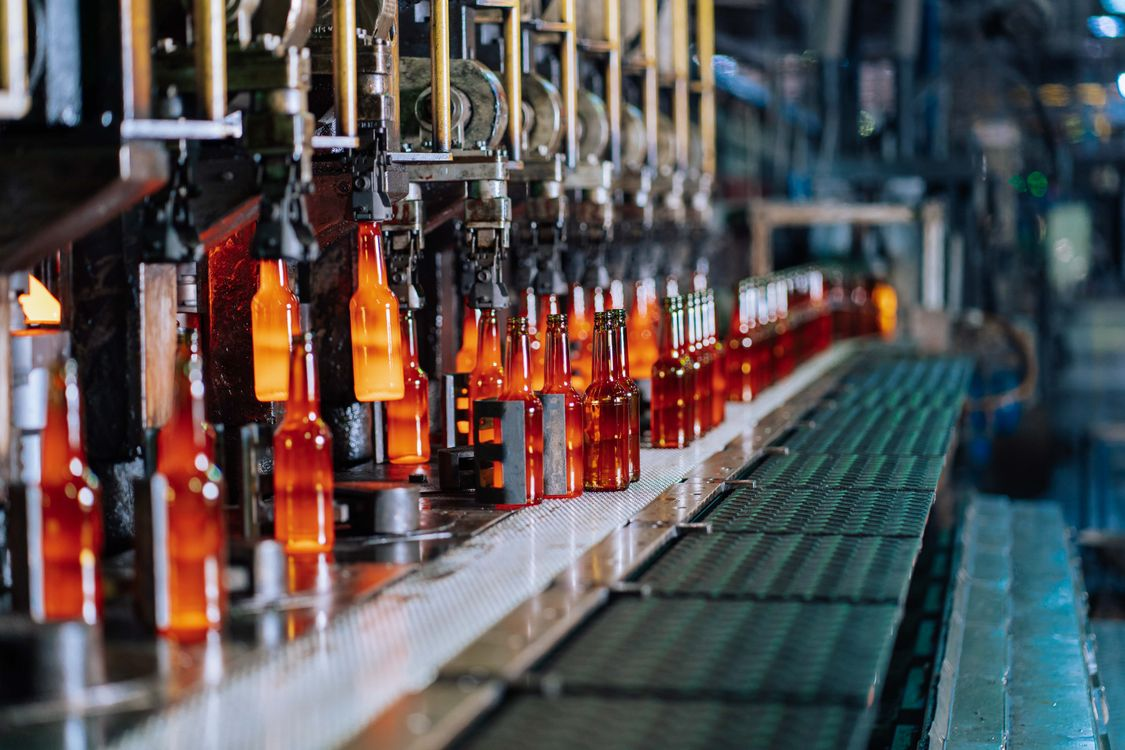
Visy has produced its first glass bottles at the company’s A$500 million recycling and manufacturing complex at Yatala in Queensland, following the start of commissioning of the first of two oxygen-fuelled furnaces.
The bottles mark a transition from construction into initial manufacturing activity after nearly four years of project development. They do not indicate that the complete factory is commissioned or operating at its planned annual capacity of up to one billion glass containers.
When fully operational, the complex is intended to manufacture bottles and jars with an average recycled glass content of approximately 70%. Visy expects to process as much as 200,000 tonnes of recovered Queensland glass each year, combining sorting, melting, forming and finished-product logistics at the site south of Brisbane.
Construction supported more than 600 jobs, while the company expects approximately 200 permanent operational roles following full commissioning. It has not disclosed the production rate achieved during the first bottle run or a date on which both furnaces are expected to reach their intended output.
The manufacturing investment sits alongside existing Visy cardboard box and beverage can operations, creating a cluster of packaging production facilities. Although these plants serve some of the same customers, glass making has distinct raw material, energy and process control requirements.
Recovered bottles and jars must first be prepared as cullet suitable for furnace feed. Collection streams can contain ceramics, stones, metals, unsuitable glass and other contaminants. Some impurities can cause visible or structural defects in finished containers, while inappropriate material can interfere with the melting process.
The project includes optical sorting equipment designed to process recovered glass to small particle sizes, reported by Visy as approximately 3mm. Sorting and material preparation help establish the feedstock consistency needed for repeated production runs, although actual acceptable contamination levels depend on the furnace and product specification.
Cullet replaces part of the virgin mineral input used in conventional glass batches. Because it has already been melted and formed, suitable recovered glass can reduce the energy needed to produce a homogeneous melt. The achievable proportion depends on availability, colour, chemical composition and the quality requirements of the finished packaging.
Visy’s 70% recycled-content figure is a target for the fully operating facility, not a measured average for the initial bottles. It also does not establish that every container produced at Yatala will contain precisely that proportion of recycled glass.
The new plant uses oxygen-fuelled melting technology. Conventional air-fuel furnaces introduce nitrogen alongside the oxygen used for combustion. A more concentrated oxygen supply reduces the nitrogen carried through the process, changing the volume and composition of the exhaust stream and potentially improving heat transfer.
The complete energy balance still includes production or supply of oxygen, the furnace operating regime and the performance of heat recovery equipment. The combustion arrangement on its own is not a measured guarantee of a particular reduction in energy use or carbon emissions.
Visy has also installed cullet preheating technology. Raising the temperature of incoming recycled glass before it reaches the principal melting zone reduces the temperature increase required inside the furnace. Its contribution to efficiency depends on heat recovery, material flow and process integration.
After melting and refining, glass must reach forming equipment at a temperature and viscosity suitable for shaping. Controlled portions of molten glass are delivered to machinery that forms the required bottles and jars, with dimensional and wall-thickness requirements set by the product design.
Cooling then needs to be managed through annealing to reduce residual stresses that could compromise strength or resistance to handling. Inspection systems assess finished containers before release, with suitable checks depending on the product and its customer specifications.
Industrial production therefore depends on more than successful furnace ignition. Consistent operation requires coordination of raw material preparation, melt quality, forming, cooling, inspection and packing. A problem in one stage can affect the amount of saleable packaging produced by the entire line.
The Yatala site’s planned logistics facilities will provide storage and distribution capacity for completed containers. These activities are important because high-volume glass manufacturing is typically organised around sustained furnace operation while customer orders vary in size and container specification.
Visy’s project is supported by a long-term relationship with Asahi Beverages and agreements involving Lion, Bundaberg and Coca-Cola. Production and distribution planning will have to accommodate the specifications and delivery requirements of those customers as commissioning progresses.
The company has previously said that greater local recycling and manufacture could avoid transporting around 40,000 tonnes of glass into Queensland. That is a project ambition associated with regional supply flows, not an independently verified saving already achieved during commissioning.
The same distinction applies to energy and emissions performance. Oxygen-fuelled furnaces and cullet preheating are technically relevant measures, but Visy has not published sustained operating data demonstrating the completed plant’s consumption or emissions per tonne of glass.
The initial bottles confirm that part of the manufacturing system can now produce finished containers. The next milestones will be commissioning of the remaining furnace and associated equipment, followed by stable production demonstrating the project’s intended capacity, recycled content and operating performance.