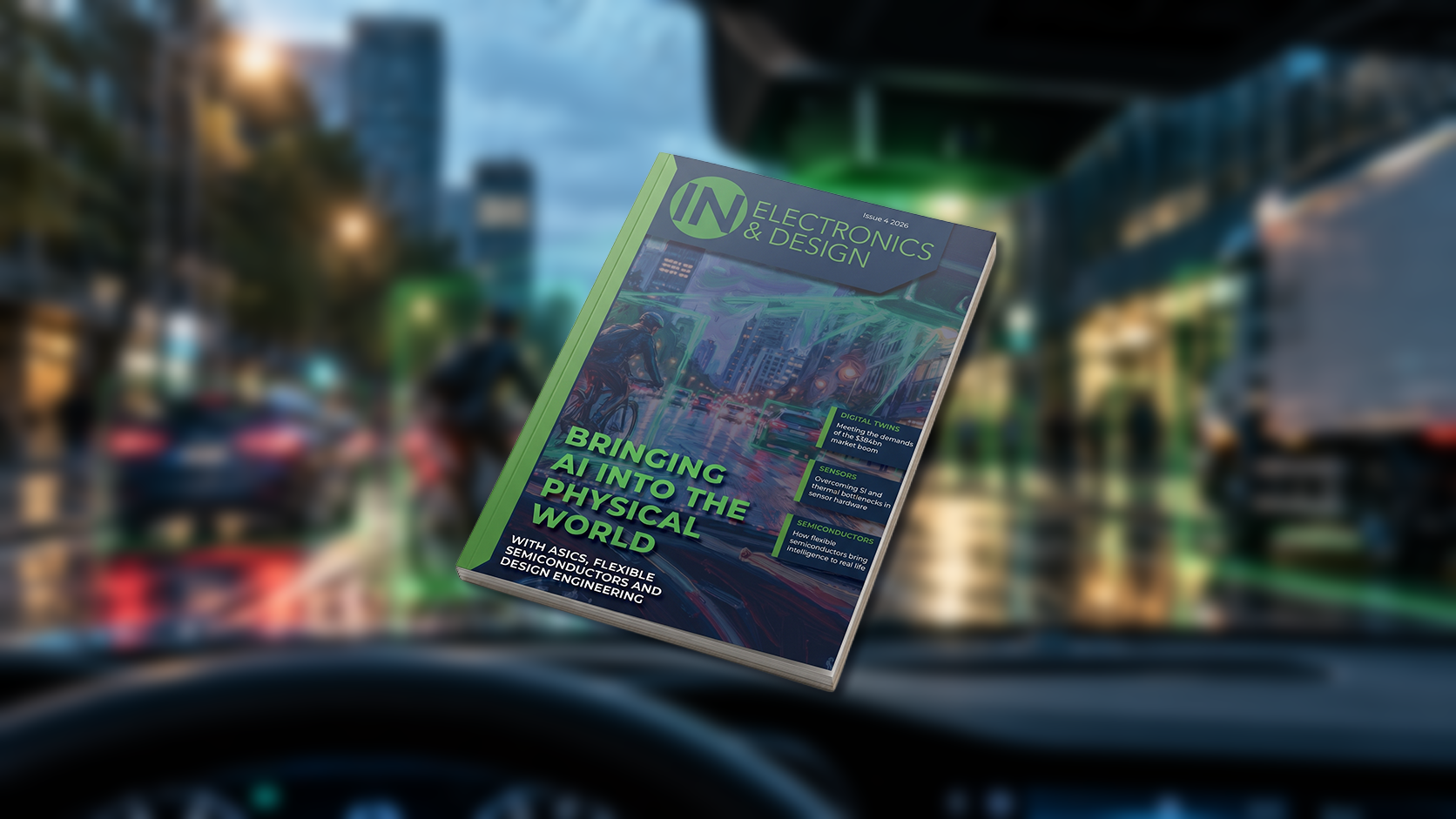
IN Electronics & Design has released its October 2026 edition, focusing on the engineering behind AI that operates in products, machines, and sensors. Bringing inference closer to where information is generated can cut latency, although tight power budgets, fluctuating processor loads, and thermal limits complicate the hardware that must support it.
Capturing useful physical data presents its own questions of cost and scale. Catherine Ramsdale of Pragmatic Semiconductor considers how flexible, low-cost chips incorporated into individual packages could provide visibility beyond pallet-level tracking. Once collected, information has to arrive in time to support decisions. Wireless Logic examines the connectivity needed to keep industrial digital twins aligned with their physical counterparts, in a market forecast to exceed $384 billion by 2034.
Processing that information locally requires a deliberate choice of architecture. Swindon Silicon Systems examines ASICs optimised for defined inference tasks, while Efinix discusses the reconfigurability of FPGAs when models and sensor workloads are expected to change. That choice affects efficiency, development cost, and how readily a product can accommodate future requirements.
Even an appropriate processor can undermine the performance of nearby components. Grid AI’s illustrative thermal model places a 3 W neural processing unit inside a sealed sensor enclosure and finds that an accelerometer can exceed its bias error budget regardless of its position on the PCB. Heat spreading and signal integrity also compete for copper and board space, creating trade-offs that component placement alone cannot resolve.
The same engineering discipline extends into development and deployment. Keysight’s agentic RF design software allows AI assistants to generate and optimise circuits while simulation validates the results. ByteSnap Design, meanwhile, explains how carefully prioritised software, signed boot images, and streamlined startup sequences can bring automotive camera feeds online within seconds. In each case, the performance of the complete system remains the final test of the design.
Subscribe to IN Electronics & Design to read the full October magazine here.