Choosing between manual and powered lifting equipment starts with the work itself. A maintenance team making occasional lifts in a restricted plant room has different requirements from a production site moving loads throughout a shift. Load weight matters, but so do lift height, available power, frequency of use, headroom and the space around the lifting point.
The wrong choice can leave operators working harder than necessary or result in equipment that is more complex and costly to maintain than the task requires. A useful comparison looks beyond whether a hoist has a motor and considers how the equipment will be used over its working life.
Where manual lifting equipment works well
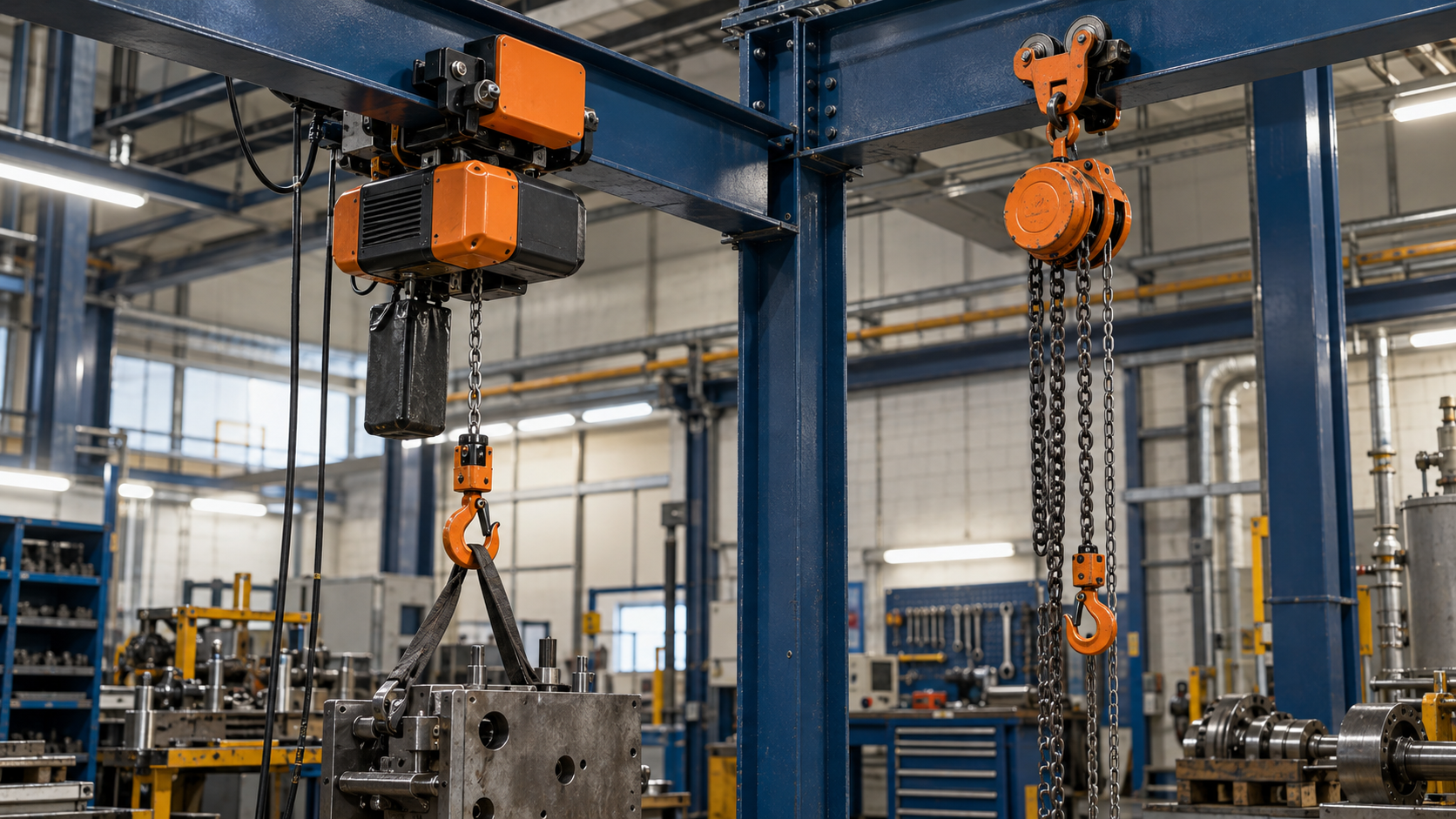
Manual chain blocks and lever hoists use mechanical advantage to raise, lower or position a load without an electric or pneumatic drive. Their relatively simple construction makes them useful for occasional lifting, maintenance work and locations where a permanent power supply is unavailable.
They can also suit restricted spaces. A compact manual hoist may be easier to position where headroom is limited or where equipment needs to be moved between lifting points. For temporary work, shutdown maintenance or infrequent component changes, adding a powered system may offer little operational benefit.
Manual does not mean unrestricted, though. The rated capacity, lifting height, attachment point and operating environment still need to match the task. Where the work also involves lifting, lowering or carrying loads by hand, a manual handling assessment can help identify higher-risk parts of the task.
When powered lifting becomes more practical
Electric and air-powered hoists reduce the physical effort needed to move loads and can be better suited to tasks where lifting forms a regular part of production or maintenance. The benefit becomes clearer when the same movement is repeated throughout a shift or when operators need controlled lifting over a greater height.
The available power source changes the choice. Electric hoists suit many fixed industrial installations, while pneumatic equipment can be useful where compressed air is already available or where the working environment makes another drive system more appropriate.
Once load capacity, lift height, duty cycle and available power have been established, a lifting equipment supplier in the UK, like Lifting Hoist Direct, can match those requirements to a suitable manual, electric or air-powered hoist, along with the lifting accessories needed for the job. Two hoists with similar capacities can still differ considerably in lifting speed, headroom, control method and suitability for the surrounding environment.
Duty cycle matters as much as load capacity
Rated capacity is an obvious starting point, but it does not describe how frequently a hoist is expected to work. Two sites may lift the same load while placing completely different demands on the equipment.
An occasional maintenance lift may involve only a few operating cycles before the hoist is stored again. A production process may repeat the same movement throughout the working day. In the second case, lifting speed, motor duty, heat build-up, controls and servicing requirements become part of the specification.
This is why fixed rules based on load weight alone are unreliable. Equipment selection should reflect the manufacturer’s rated limits and the actual operating pattern rather than assuming that a particular weight automatically requires manual or powered lifting.
Site conditions can narrow the choice quickly
The surrounding environment often removes options before purchase price enters the discussion. A hoist may need to operate in a low-headroom area, outdoors, around dust or moisture, or in a hazardous zone where the equipment specification has to reflect the conditions.
The supporting structure also matters. A chain block, powered hoist or trolley needs an appropriate suspension point, runway beam or lifting structure capable of supporting the intended load. Available travel distance and site access for installation, inspection and maintenance should be considered at the same stage.
For portable work, weight and ease of installation may favour manual equipment. For a fixed workstation where the same lift occurs repeatedly, powered lifting can reduce the amount of manual effort involved and make cycle times more consistent.
Safety duties apply to both types
Manual lifting equipment does not sit outside workplace lifting rules because it lacks a motor. Where LOLER applies, lifting operations need to be planned and carried out safely, while equipment must remain suitable for the task and be examined at the required intervals.
PUWER also applies to work equipment and covers matters such as suitability, maintenance and adequate training. The training required should reflect the equipment and the risks involved rather than relying on the assumption that manual equipment is simple enough to use without instruction.
A thorough examination is separate from routine maintenance. Where lifting equipment is exposed to conditions that can cause deterioration liable to result in danger, LOLER requires thorough examination at appropriate intervals by a competent person.
Purchase price is only part of the cost
Manual equipment normally has fewer powered components to maintain and does not require batteries, electrical supply or compressed air. That can make it economical where lifting is infrequent, and the operating effort remains reasonable.
Powered equipment introduces additional maintenance and energy requirements, but those costs need to be considered against the work being performed. On a busy production line, faster repeated lifts or reduced physical effort may matter more than the difference in initial purchase price.
Maintenance requirements also deserve attention. Equipment that is difficult to inspect or maintain in its installed position can create disruption later, even if the original purchase appeared economical.
Match the equipment to the lifting task
There is no single point at which manual lifting equipment becomes the wrong choice and powered equipment becomes the right one. Load, lift height, frequency, working environment, available power and operator involvement all affect which option fits the task.
Manual hoists remain useful for portable or occasional work and in locations without a suitable power supply. Powered systems make more sense where lifting is frequent, cycle time matters, or physical effort needs to be reduced. The final choice should reflect how and where the equipment will actually be used, not simply its rated lifting capacity.