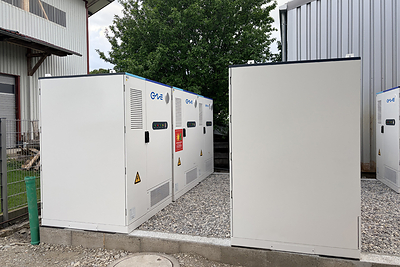
CNTE has deployed a 700kW/1,624kWh battery energy storage system at an industrial facility in Schwabmünchen, Germany, integrating it with the site’s existing solar array, diesel backup generator, and grid connection.
The installation uses seven liquid-cooled STAR-H battery units rated at 100kW/232kWh each. A central energy-management system coordinates the storage with 440kWp of photovoltaic generation, a 500kW diesel generator, grid supply, and changing factory demand.
The project is intended to improve the use of electricity already generated on site without requiring the factory to replace functioning backup equipment. The battery instead adds another controllable layer between generation and production loads.
Surplus photovoltaic output can be stored rather than exported or curtailed, then discharged later when factory consumption rises or electricity from the grid is more expensive.
That is a familiar commercial-storage application, but integrating the existing diesel generator creates a second duty. Standby generators provide dependable power during an outage, yet diesel engines are generally inefficient when running well below their designed operating load or repeatedly starting for short interruptions.
A battery can respond immediately to smaller or rapidly changing loads while the generator is held back or operated closer to a more efficient point. The precise strategy depends on how the factory prioritises resilience, fuel savings, battery state of charge, and electricity tariffs.
CNTE says the installation was designed around several practical problems at the site, including limited use of surplus solar generation, inefficient low-load diesel operation, fuel and maintenance costs, and the need to maintain continuity of power for production.
That last requirement separates an industrial storage system from a straightforward electricity-price exercise. A factory can lose considerably more through an interrupted process than it saves through marginal tariff optimisation, so the control system has to preserve enough energy for resilience where continuity is a priority.
The battery’s 700kW power rating determines the maximum instantaneous output, while its 1,624kWh energy capacity determines how long that output can be maintained. At nominal full power, the stored energy equates to a little over two hours before allowing for operating limits and conversion losses.
The seven-unit architecture gives the project modularity. Capacity is distributed across multiple enclosures rather than one large battery block, which can simplify transport, installation, thermal management, and some maintenance operations.
Liquid cooling is used to manage cell temperature. Temperature control influences battery efficiency, available power, ageing, and the consistency of cells operating across a pack, making thermal design particularly important for systems expected to cycle regularly.
The energy-management software is the layer that turns the collection of equipment into a hybrid system. Without coordinated control, solar inverters, batteries, a diesel generator, and the grid simply remain four independent electricity sources.
The controller has to decide when to charge or discharge, when to preserve battery capacity for a possible interruption, and when starting the generator provides a better operating outcome than continuing to draw from storage.
Industrial loads make those decisions less predictable than household demand. Motors, compressors, heating equipment, refrigeration, pumps, process machinery, and production start-ups can create large short-duration peaks, while a shutdown or shift change may reduce demand abruptly.
Peak shaving is therefore another potential function. The battery can absorb part of a brief demand spike instead of allowing the factory’s grid import to rise to the same level, although the economic value depends on the site’s tariff structure and the frequency of those events.
CNTE has published modelled savings for the project, including reduced diesel consumption during a representative two-hour outage and potential wider energy-cost savings. Those figures depend on assumptions around fuel prices, outage duration, operating strategy, solar generation, and electricity tariffs, so they should not be treated as guaranteed annual performance.
The more useful long-term evidence will come from actual factory operation. Energy-management logs will show how often the battery prevents generator starts, how much additional solar electricity is consumed on site, how frequently the system is cycled, and whether stored energy remains available when an outage occurs.
The installation also illustrates why industrial batteries are increasingly being retrofitted around existing infrastructure rather than introduced only as part of new factories. Many plants added solar panels, backup generation, and electrical upgrades at different points in their development, leaving technically capable assets that were never designed to operate as one system.
Storage can provide the missing link without discarding that investment. For operating factories, this is often more realistic than a complete electrical redesign that would require long shutdowns or replacement of serviceable equipment.
CNTE works across utility-scale and commercial energy storage and has investment backing from CATL. The Schwabmünchen system is modest beside grid-scale projects, but its engineering relevance lies in direct integration with a working production site rather than its headline megawatt-hour capacity.
The real test will be whether the battery reduces energy and fuel use without complicating production reliability. If the control system can manage those competing objectives, the project provides a model for factories seeking to add storage around solar and diesel assets they already own rather than starting again with a blank electrical system.