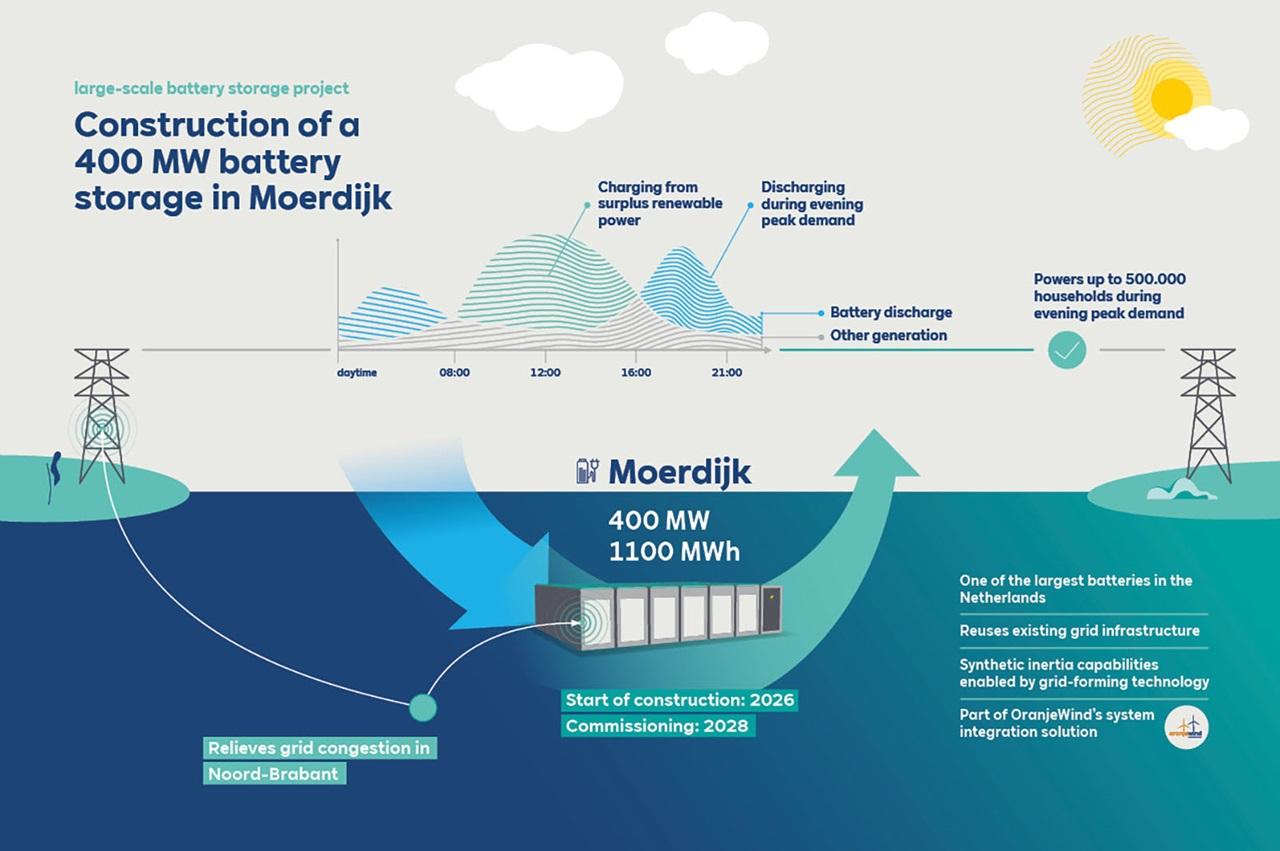
RWE has taken a final investment decision on a 400MW/1,100MWh battery storage system at its Moerdijk power station in the Netherlands, combining multi-hour energy storage with congestion management and advanced grid-support functions.
The installation will use 208 lithium-ion battery containers and is designed to deliver its full rated output for almost three hours. Construction is due to begin shortly, with commissioning scheduled for the second quarter of 2028.
Rather than requiring an entirely new transmission connection, the battery will use existing infrastructure at the Moerdijk power station and connect through the site’s established substation. That reuse of high-voltage assets is important in a Dutch market where available grid capacity has become increasingly difficult to secure.
RWE will operate the system under capacity-steering arrangements with transmission system operator TenneT. The battery can be scheduled to avoid worsening congestion during constrained periods and discharge when additional power is useful, potentially releasing capacity for other users waiting to connect or increase electricity consumption.
TenneT and regional network operator Enexis will assess the effect as part of a congestion-management review due in December 2026. The project therefore combines a commercial storage asset with a practical test of whether batteries can alter local power flows enough to create useful network headroom.
The system will also be equipped for advanced grid services including instantaneous reserve, or inertia support. Conventional generating units naturally contribute rotational inertia through large spinning machinery, helping slow sudden frequency changes after a fault or loss of generation.
As more electricity is supplied through inverter-connected wind, solar, and batteries, system operators increasingly need power electronics and control software to reproduce some of that stabilising response without relying on a synchronous generator.
Moerdijk already provides RWE with operating experience in this area. The site hosts a 7.5MW/11MWh synthetic-inertia battery, described by the company as the first system of its type connected to the continental European grid.
The new project is two orders of magnitude larger in energy capacity. It moves the site from a specialist grid-support demonstration towards a storage asset capable of affecting regional supply and demand over several hours.
That longer duration matters for congestion management. A short-duration battery can respond extremely quickly to frequency events but may have limited influence over a bottleneck that persists throughout an evening demand peak or several hours of high renewable output.
At 1.1GWh, the Moerdijk project can shift significantly more energy between periods. RWE says the system could supply electricity equivalent to the evening peak demand of around 500,000 households for almost three hours, although its actual operating pattern will be dictated by market conditions and grid requirements rather than a single household-supply duty.
The project will also support integration of the 795MW OranjeWind offshore wind farm being developed by RWE and TotalEnergies. OranjeWind is being paired with several forms of onshore flexibility, including storage and controllable electrical loads, in an effort to align variable wind generation more closely with demand.
A battery cannot create additional transmission capacity in the same way as another circuit or transformer. It can, however, change when the existing network is loaded, which is increasingly valuable where infrastructure has enough aggregate annual capacity but becomes constrained during specific combinations of generation and demand.
Using a power-station site provides more than a grid connection. Roads, electrical compounds, operating expertise, security, communications, and utility interfaces are already present, reducing some of the enabling works required for a greenfield storage project.
Across Europe, former and changing thermal-generation sites are becoming attractive locations for batteries for precisely that reason. In many cases the transmission connection and surrounding electrical infrastructure are more difficult to reproduce than the land required for containerised storage.
The containerised architecture also shifts a significant proportion of manufacturing away from site. Battery racks, thermal-management equipment, controls, and much of the associated electrical hardware can be assembled before delivery, leaving the project team to integrate hundreds of enclosures through transformers, switchgear, cabling, protection, fire systems, communications, and the site-level energy-management platform.
RWE currently operates around 1.7GW of battery storage globally, with another 3GW under construction. Its Dutch portfolio also includes a 35MW/41MWh installation at Eemshaven alongside the existing Moerdijk inertia battery.
The 400MW project is therefore not an experimental entry into storage. Its significance lies in scale and operating duty: a multi-hour system being built specifically to combine renewable integration, commercial flexibility, congestion relief, and power-system stability through one grid connection.
With commissioning still around 18 months away, detailed engineering, procurement, civil work, electrical integration, software configuration, and qualification remain to be completed. The final investment decision nevertheless moves Moerdijk into delivery, where the value of the project will depend as much on how intelligently it is dispatched as on the number of battery containers installed.