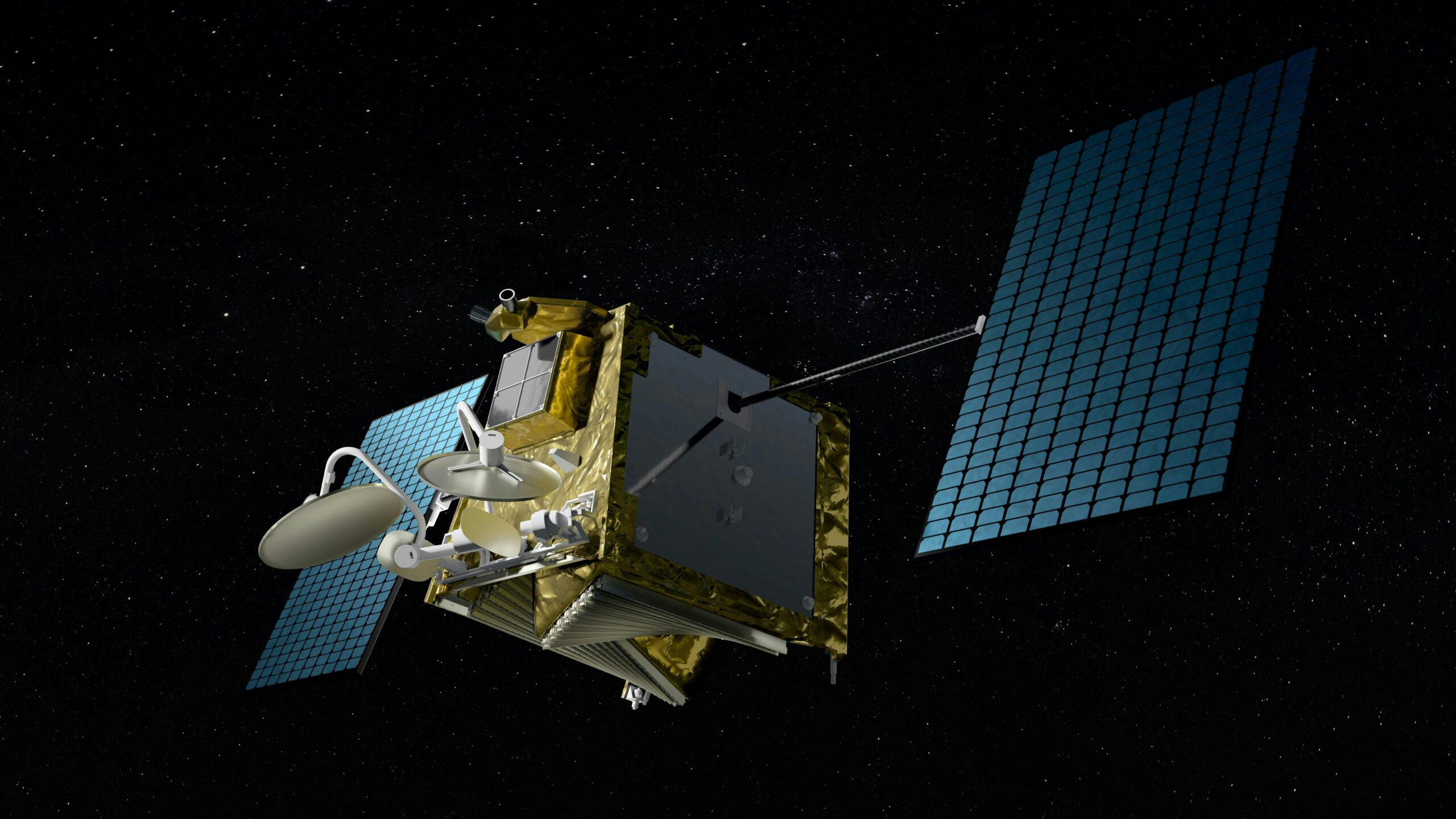
Airbus has begun initial industrial work on 229 additional OneWeb satellites after Eutelsat issued an Authorisation to Proceed, potentially extending the current replenishment programme to 669 spacecraft manufactured by Airbus.
The new tranche would sit alongside 440 replacement satellites already procured from Airbus, with those earlier batches due for delivery and launch as Eutelsat replaces ageing spacecraft in the existing OneWeb low-Earth-orbit constellation.
The terminology matters. Eutelsat has issued an Authorisation to Proceed covering initial industrial activities for the 229 satellites; Airbus has not described the latest step as a fully executed production contract for every phase of the additional batch.
An ATP nevertheless allows work to start before the remainder of the contractual programme is completed. For a satellite factory, that can protect continuity across engineering, procurement, supplier activity, tooling, integration, and test rather than allowing a gap to emerge between production lots.
The additional spacecraft are planned for manufacture at Airbus Defence and Space’s Toulouse facility, which is already delivering previous OneWeb batches. Airbus says keeping the work at the same site should support a rapid and consistent production rate.
That continuity matters more in a constellation programme than in conventional satellite manufacturing. Low-Earth-orbit networks depend on hundreds of broadly standardised spacecraft, so manufacturing resembles serial industrial production more closely than the traditional model of building a small number of highly bespoke satellites.
Repeatability therefore becomes central to the economics. Common platforms, standard interfaces, controlled bills of materials, repeatable integration, automated testing, supplier cadence, and configuration management all matter when the same basic spacecraft has to be produced hundreds of times.
OneWeb currently operates more than 600 satellites across 12 synchronised orbital planes at roughly 1,200 kilometres altitude, providing high-speed, low-latency communications. Replenishment is required because satellites have finite operating lives and constellation coverage depends on replacing units before retirements begin to reduce service resilience.
The next 229 spacecraft are expected to incorporate further capability developed through the programme, including advanced digital channelisers intended to improve onboard processing flexibility and efficiency. Airbus also says the satellites can accommodate hosted payloads alongside the core OneWeb communications mission.
Hosted-payload capability can create more value from a standard bus, but it also makes industrial integration harder. Additional payloads introduce their own requirements for electrical power, thermal control, data interfaces, software, structural mounting, electromagnetic compatibility, and verification.
Those changes have to be absorbed without undermining the cadence that makes constellation manufacturing viable. A high-rate production line gains its advantage from stable processes; every additional customer-specific integration has to be controlled carefully enough that one spacecraft does not quietly turn back into a bespoke project.
Airbus’s Toulouse operation is also involved in Europe’s IRIS² sovereign-connectivity programme, giving the site another future source of low-Earth-orbit satellite work. The two programmes remain commercially and technically distinct: OneWeb is Eutelsat’s established global network, while IRIS² is an EU-backed system with its own procurement and mission requirements.
The common industrial theme is utilisation. Satellite manufacturing infrastructure carries high fixed costs in cleanrooms, environmental test systems, integration equipment, specialist engineering, quality assurance, and supplier qualification. Sustained serial production across several programmes can retain skilled teams and spread those costs across more spacecraft.
The corresponding risk is congestion. Payload delays, semiconductor shortages, propulsion hardware, solar arrays, radio-frequency components, or software changes in one programme can affect factory resources required elsewhere. High-rate satellite manufacturing still depends on a supply chain whose individual components can have much longer lead times than the final assembly process.
Eutelsat’s need for replacement spacecraft also makes this programme fundamentally different from a one-off launch campaign. A large constellation creates a recurring industrial cycle because satellites already operating in orbit begin ageing while their replacements are still moving through engineering and production.
Airbus has accumulated experience in that model through earlier OneWeb manufacturing programmes and is now using Toulouse to maintain the replacement pipeline. The 229-satellite ATP gives the factory authority to begin the next phase rather than wait until all subsequent commercial steps are complete.
The next meaningful milestone will be progression beyond initial industrial activities into the full production programme. If the additional batch advances as planned, Airbus will be responsible for 669 new OneWeb satellites in the current replenishment cycle — enough volume to keep serial satellite manufacturing firmly in the realm of industrial production rather than occasional spacecraft craftsmanship.