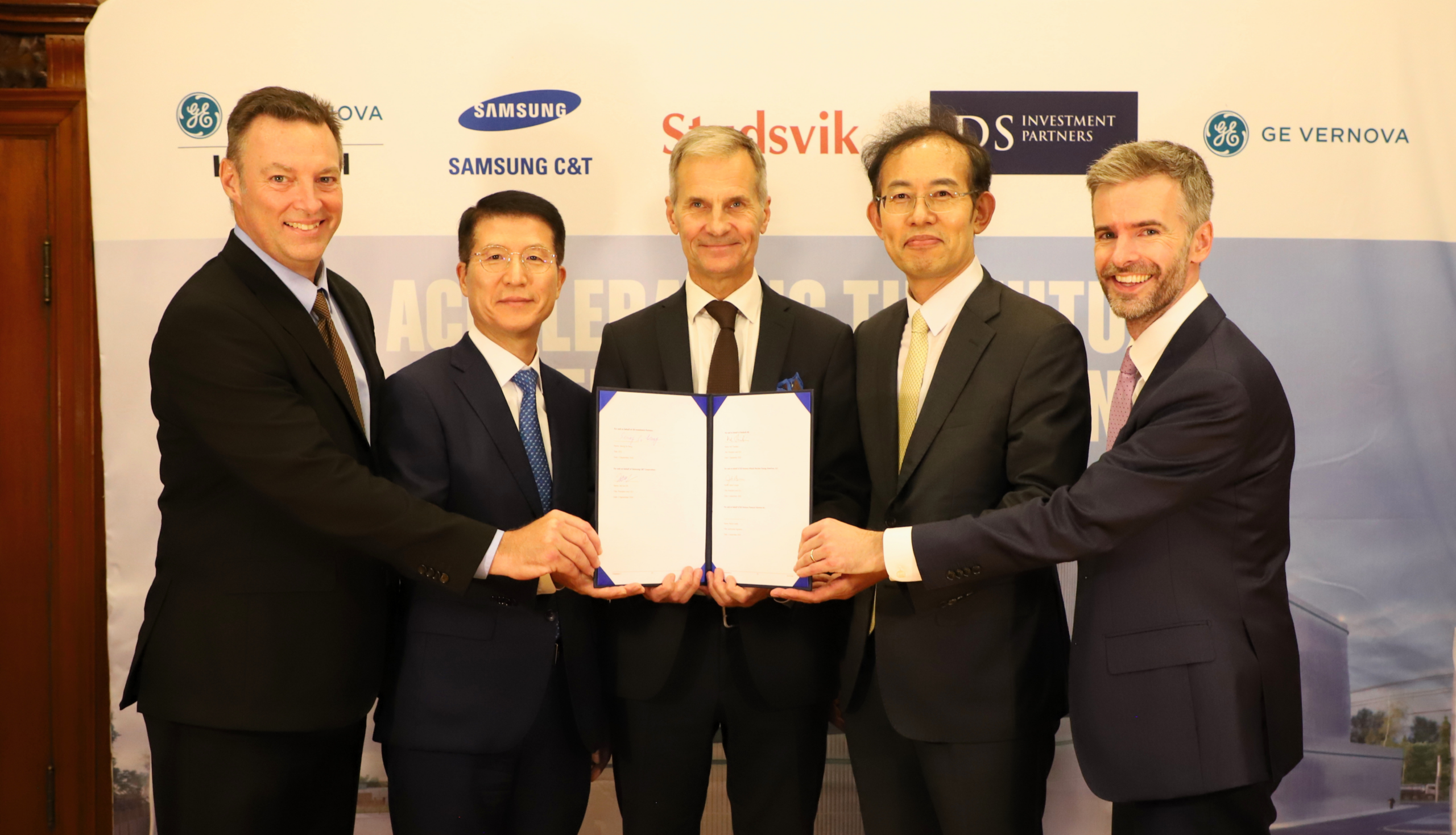
Studsvik has selected GE Vernova Hitachi Nuclear Energy and Samsung C&T as strategic partners for an initial four-reactor nuclear project in Sweden with planned generating capacity of around 1.2GW.
The first ReFirm development would use four BWRX-300 small modular reactors at either Studsvik’s existing licensed nuclear site in Nyköping or the Målma site in Valdemarsvik. The first unit is targeted to enter operation in the mid-2030s, although the site will be selected during development work and the agreement does not constitute a final investment decision or authorisation to construct.
GE Vernova Financial Services and South Korean investment company DS Investment Partners are also participating. The consortium has entered an exclusive agreement for a fixed period, during which commercial, technical, regulatory, financing, and project-delivery work will continue.
A joint project company is planned to support development, financing, construction, ownership, and operation, with its final structure still subject to definitive agreements. That gives the programme a defined development organisation without implying that construction is committed.
Studsvik will lead permitting, environmental-impact assessment, site rights, community engagement, and discussions with the Swedish state. GE Vernova Hitachi will lead reactor engineering, licensing support, and cost estimation as design authority, while it and Samsung C&T will form the principal execution team.
ReFirm entered the Studsvik group through its acquisition of Kärnfull Next earlier in 2026. Kärnfull Next had worked with GE Vernova Hitachi on BWRX-300 deployment in Sweden since 2022 and had already established a strategic relationship with Samsung C&T, giving the consortium a development history that predates the latest agreement.
The two candidate locations have different starting positions. Studsvik already operates a licensed nuclear facility at Nyköping, while an application for the Valdemarsvik site was submitted in March 2026 under Sweden’s newer legislation governing approval of new nuclear facilities.
The BWRX-300 is a roughly 300MWe boiling-water reactor designed around natural circulation and passive safety functions. Four units would provide approximately 1,200MWe while allowing the programme to repeat the same reactor configuration rather than treat each plant as an unrelated engineering project.
Replication is central to the proposed delivery model. Engineering work, procurement packages, construction methods, commissioning procedures, and workforce experience from an earlier unit can be applied to later reactors if the design remains sufficiently standardised.
Karl Thedéen, president and chief executive officer of Studsvik, said: “One reactor is a project. Four is the start of an industry.”
The distinction is particularly relevant to nuclear supply chains, where manufacturers can face substantial qualification costs before supplying safety-classified components. A sequence of similar units gives equipment suppliers and contractors a stronger basis for investment in tooling, documentation, skills, inspection capability, and production capacity than a single isolated order.
Studsvik also wants greater Swedish industrial participation across engineering, procurement, construction, and long-term operations. The programme is intended to create a supply base capable of supporting the first project and, potentially, later deployments elsewhere in Sweden and Europe.
Achieving that will require more than identifying companies capable of manufacturing broadly suitable equipment. Nuclear components, materials, software, welding procedures, inspection methods, and production records can all be subject to demanding safety classification, traceability, and quality-assurance requirements.
The multi-unit structure can spread those qualification and mobilisation costs across a larger programme, although repeated design changes would erode the advantage. A supplier that has to revise tooling, calculations, documentation, or licensing evidence for each subsequent unit gains far less from standardisation.
The BWRX-300 already has a wider deployment pipeline. Construction of the first unit is under way at Ontario Power Generation’s Darlington site in Canada, while the technology is also being evaluated or developed for projects elsewhere in Europe and North America.
That provides the Swedish consortium with engineering and construction experience from outside the country, but it does not remove local licensing, financing, siting, or supply-chain work. Reactor designs can be standardised more readily than national regulatory frameworks, grid connections, ground conditions, civil works, and project-finance structures.
Sweden has changed its nuclear policy framework to permit development beyond the country’s established reactor sites and has introduced state-backed financing mechanisms. Individual projects still require government approval, leaving the ReFirm consortium with several substantial gates before procurement can progress into construction.
The current agreement fixes important parts of the industrial structure: the reactor technology, strategic engineering and construction partners, investment participants, candidate sites, and initial fleet size. It does not settle project cost, final financing, site selection, or construction authorisation.
The next milestones will consequently be more useful than the partnership announcement itself. Site selection, environmental and nuclear approvals, financing arrangements, formation of the project company, supply-chain qualification, and a final investment decision will determine whether the proposed 1.2GW programme becomes a four-unit construction sequence.
Until then, ReFirm is an increasingly organised development programme rather than a committed power station. The mid-2030s operating target leaves time for those decisions, but nuclear schedules have a habit of consuming apparently generous margins long before concrete is poured.