GE Vernova has introduced a medium-voltage uninterruptible power supply for AI data centres and other energy-intensive facilities, moving power protection further upstream than the low-voltage UPS arrangements conventionally used around computing loads.
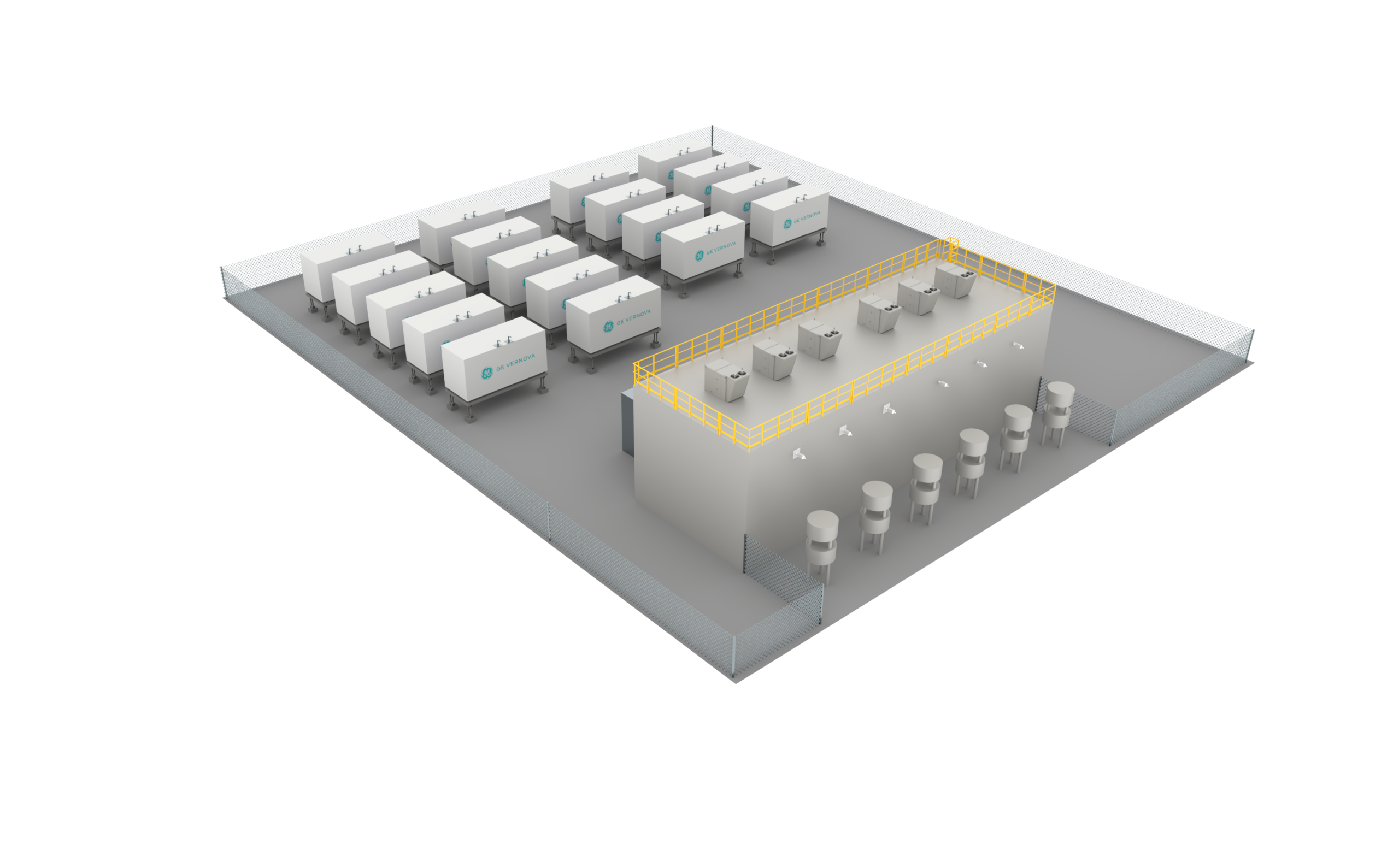
The MV-UPS is installed between a facility’s power supply and its critical loads on the medium-voltage network. It combines power-conversion equipment, advanced controls, and integrated energy storage to maintain voltage and frequency through disturbances while buffering rapid changes in demand.
The architecture addresses two related problems. A data centre has to protect computing equipment from poor power quality or an interrupted supply, but very large AI facilities can themselves create difficult load behaviour for the grid or onsite generators feeding them.
AI processors can move rapidly between different levels of utilisation as workloads change. When thousands of accelerators behave in parallel, the resulting step in electrical demand can become significant at facility scale. Generators, transformers, switchgear, and grid connections have to accommodate those changes even though the computing workload can alter much faster than large electrical or mechanical systems respond.
Conventional UPS protection is generally installed after incoming electricity has been stepped down to low voltage, dividing protection across smaller sections of the facility. GE Vernova’s system shifts that stabilising function to medium voltage so a larger block of load can be managed by one coordinated installation.
The company describes the system as a stability block between the power source and the facility. Supply-side disturbances can be prevented from reaching critical equipment, while rapid changes in facility demand can be buffered before they propagate back towards the grid or local generation.
Integrated energy storage is central to that behaviour. Batteries respond more rapidly than most generating plant, allowing power electronics to inject or absorb energy while slower systems adjust. The same storage can potentially support peak shaving, load shifting, and other energy-management functions when it is not responding to a disturbance.
Medium-voltage placement also changes the physical layout of a project. Protecting larger blocks of load upstream can reduce the amount of low-voltage UPS equipment, cabling, and associated electrical infrastructure required further downstream, although the actual savings will depend on the facility architecture and redundancy standard.
Those decisions have to be made early. Transformer ratings, protection coordination, switchgear, cable routes, battery capacity, fault levels, and generator behaviour are interconnected, so replacing a conventional UPS layout is not a component substitution that can be left until the building is substantially designed.
The development reflects the changing scale of data-centre electrical engineering. Individual AI campuses are reaching loads comparable with heavy industrial installations, while developers are increasingly considering dedicated gas generation, microgrids, battery systems, and complex grid connections to secure sufficient capacity.
That makes the boundary between utility infrastructure and facility infrastructure less distinct. A large load can affect network voltage and frequency behaviour, while restrictions imposed by the network can determine how rapidly a data-centre campus is able to expand.
GE Vernova is addressing that market across a much wider electrical portfolio. It supplies gas turbines, substations, high- and medium-voltage transformers, switchgear, energy-management systems, and power-conversion equipment, allowing the MV-UPS to sit inside what the company describes as a power-to-rack architecture.
The business is also developing solid-state transformer technology intended to move more efficient and compact power conversion closer to computing racks. Together, the technologies indicate an effort to treat AI data-centre power as one coordinated system rather than a succession of independent electrical products.
That approach is becoming necessary because efficiency losses accumulate through every conversion stage between the grid and a processor. At conventional data-centre loads, incremental improvements can reduce operating cost. At AI-factory scale, the same percentages translate into much larger amounts of electricity and heat that have to be generated, distributed, and removed.
A medium-voltage UPS does not solve the underlying problem of securing enough generation and grid capacity. It instead addresses what happens once a large facility is connected: keeping sensitive loads stable and preventing their fast-changing behaviour from becoming another source of electrical disturbance.
GE Vernova expects the first MV-UPS systems to ship in mid-2027, with its first project scheduled for energisation later that year. Those installations will provide the practical evidence for claims around reduced footprint, simplified architecture, and connection performance.
The concept is technically straightforward in purpose even if implementation is not: deal with large-scale power quality before electricity is broken into hundreds of smaller low-voltage branches. With AI computing pushing individual facilities towards industrial-scale electrical demand, medium-voltage protection is moving from the edge of the data centre much closer to its core design.