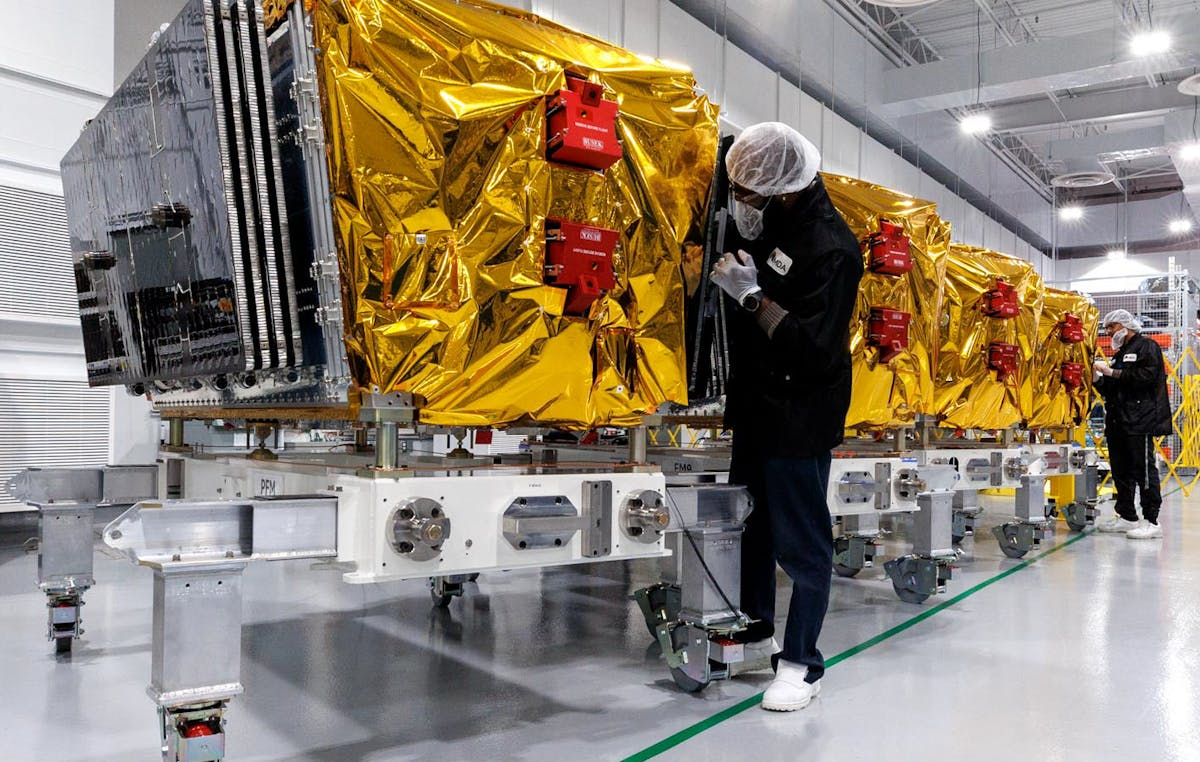
MDA Space has deployed the first eight Globalstar 2-R replenishment satellites into low Earth orbit, taking its first commercial communications constellation delivery as prime contractor from the factory floor into on-orbit commissioning.
The spacecraft launched aboard a SpaceX Falcon 9 from Cape Canaveral at 9:12pm ET on 15 August. MDA says the satellites were developed, fully integrated, and tested in Montréal and will now undergo a series of in-orbit checks before entering service in Globalstar’s existing constellation.
Nine further satellites from the 17-unit order remain in the final stages of integration at MDA. Once operational, the replenishment fleet is intended to extend the life of Globalstar’s low Earth orbit network, which supports mobile satellite, Internet of Things, and direct-to-device services.
The programme originates in a US$327 million prime contract awarded to MDA in 2022 covering design, manufacture, assembly, and test of 17 satellites. Rocket Lab was selected to provide the spacecraft bus, while MDA retained the prime role and responsibility for payload development and integration.
That division gives the launch an industrial significance beyond the spacecraft count. Acting as prime contractor requires MDA to coordinate the bus, payload, suppliers, integration, verification, documentation, delivery, and programme schedule rather than supplying an individual antenna or electronic subsystem to another spacecraft manufacturer.
The 17-satellite order was also tied to MDA’s move towards higher-volume production in Montréal. Constellation programmes change the manufacturing problem because customers require multiple spacecraft in closely controlled configurations rather than a small number of heavily bespoke satellites assembled over several years.
Repeatability therefore matters as much as individual spacecraft performance. Work instructions, component availability, test sequences, production data, supplier quality, and configuration management need to function across a series rather than being rebuilt around each unit.
The first eight reaching orbit demonstrate that the production flow has progressed beyond factory preparation and qualification. They have passed through integration and ground testing, been transported to the launch site, survived Falcon 9 ascent, and separated into orbit.
Deployment is not the end of acceptance. Commissioning now has to confirm power, communications, attitude control, thermal behaviour, payload performance, and the links between each spacecraft and Globalstar’s ground network before the satellites can be placed into routine service.
The remaining nine spacecraft provide another measure of production performance. MDA says they are in the final stages of integration, so the programme still has to complete ground testing, delivery, launch, and commissioning across the balance of the order.
Globalstar’s requirement is fundamentally one of infrastructure renewal. Low Earth orbit communications networks depend on having enough healthy spacecraft positioned across the constellation, making replenishment a continuing operational requirement rather than a one-off technology demonstration.
That has consequences for manufacturing strategy. A constellation operator needs replacement satellites at predictable intervals, while the manufacturer benefits when designs, tooling, and test equipment can be reused across enough units to reduce engineering effort per spacecraft.
MDA has since expanded its high-volume satellite ambitions beyond the original Globalstar order. Its Montréal manufacturing operation is now supporting other commercial constellation programmes, making production rate and factory utilisation increasingly important measures of its satellite business.
The Globalstar programme remains distinct from MDA’s more recent work for Telesat Lightspeed, which has already appeared in recent Industrial News coverage. The current development concerns a separate customer and spacecraft programme reaching launch and commissioning, rather than another announcement about Montréal factory capacity.
That distinction is worth retaining because high-volume satellite manufacturing produces several different kinds of milestone. A new order demonstrates demand, factory expansion demonstrates intended capacity, completed spacecraft demonstrate production, and successful deployment demonstrates that finished hardware has survived the transition from manufacturing to orbit.
The first eight Globalstar satellites have now crossed that latter threshold. MDA still has nine spacecraft to complete and the launched batch remains subject to commissioning, so the programme should not yet be described as finished.
Even so, the launch gives the Montréal operation a tangible production reference. MDA is no longer simply preparing to manufacture a commercial communications constellation as prime contractor; eight examples have left the factory and reached orbit, with the rest of the order following behind them.
That commissioning sequence will also test whether batch-produced spacecraft retain the consistency expected from a higher-volume manufacturing system once they are operating in orbit.