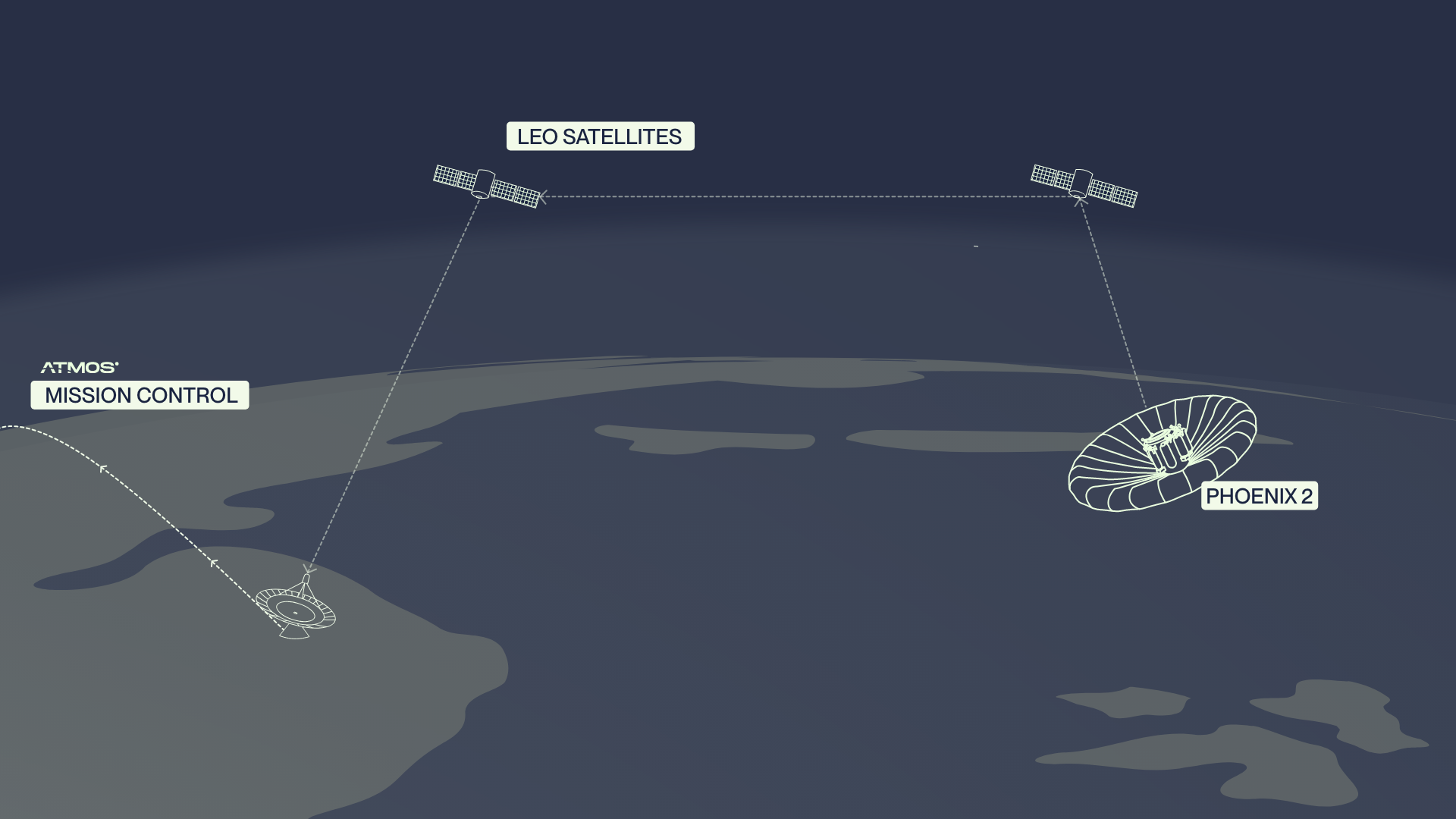
Astrolight and ATMOS Space Cargo have signed a memorandum of understanding for a 2027 flight demonstration intended to establish an optical communications link between a re-entry vehicle and an orbiting satellite, with the companies targeting real-time transfer of system, mission and payload data during orbital operations and atmospheric return.
Astrolight plans to install its ATLAS-X laser communication terminals on both ATMOS Space Cargo’s PHOENIX re-entry vehicle and the satellite involved in the demonstration. The planned spacecraft-to-satellite link is designed for data rates of up to 2.5 Gbps, giving the mission a route to transmit information directly through an orbiting relay rather than depending only on conventional radio-frequency telemetry.
The companies describe the proposed test as the first in-flight optical communications link between a re-entry spacecraft and an orbiting satellite. That claim remains to be demonstrated in flight, but the engineering objective is clear: maintain a high-speed optical connection while the return vehicle moves through changing orbital geometry and then enters the atmosphere.
For ATMOS, the communications work is being integrated into the PHOENIX architecture rather than treated as a separate payload experiment. The company is developing PHOENIX for cargo-return missions carrying scientific samples, in-orbit manufactured products and other hardware back from low Earth orbit. Real-time connectivity would give mission control earlier access to vehicle health, guidance, de-orbit performance and payload data before the spacecraft is physically recovered.
That matters as return missions become more autonomous. A reusable or repeatable cargo service has to manage the complete sequence from orbital operation through de-orbit, atmospheric entry and recovery, and communications become more valuable when operators are making decisions before the vehicle is back on the ground. The partners also see potential applications in defence, Earth observation, disaster response and wider in-space logistics.
Astrolight’s ATLAS-X terminal has been designed as a compact, low-SWaP system, reducing the size, weight and power demanded by optical communications equipment. Those constraints are especially important on a re-entry vehicle, where communications hardware competes with payload, guidance, thermal protection and other spacecraft systems for limited mass, volume and electrical power.
Laser communications offer a different balance of capability from conventional radio-frequency links. Astrolight says optical systems can support substantially higher data rates while using narrow, directional beams that are more difficult to jam, intercept or detect. The same narrow beam also makes accurate acquisition, pointing and tracking central to the system, because the terminals must remain aligned closely enough for the link to survive relative motion between two spacecraft.
Laurynas Mačiulis, CEO of Astrolight, said the programme is intended to move re-entry laser communications beyond ground-based laboratory work and into a flight environment. He said the longer-term objective is to allow re-entry vehicles to connect directly with satellites and eventually constellations, giving operators access to more mission data in real time while making communications harder to interfere with or intercept.
ATMOS chief executive Sebastian Klaus said the company is working towards independent and routine European access to return from space, with real-time connectivity becoming more important as cargo missions become more autonomous and data intensive. The planned laser link is intended to support payload monitoring, autonomous de-orbit and re-entry operations as part of the PHOENIX mission architecture.
The European industrial context gives the project a broader relevance. Europe still depends significantly on international partners for cargo transport to and from low Earth orbit, while programmes intended to strengthen European return capability are creating a market for spacecraft, payload services and supporting infrastructure. The Astrolight and ATMOS partnership does not by itself solve that logistics gap, but it addresses one of the enabling systems that a repeatable commercial return service would need.
Optical communications could also change when payload customers receive useful information. A returned scientific experiment or in-space manufactured product may contain data that can be transmitted before the physical payload is recovered, allowing operators and researchers to evaluate mission performance earlier. For high-value or time-sensitive cargo, that can make the communications system part of the service proposition rather than a background spacecraft subsystem.
The 2027 demonstration still has several steps to clear. The terminals must be integrated with the PHOENIX vehicle and the satellite selected for the test, the pointing and tracking system must operate through the mission geometry, and the partners must show that useful data can be transferred during the more dynamic phases of flight. The companies have announced an objective, not a completed capability.
That distinction matters because optical links are often discussed in terms of headline bandwidth. For a re-entry application, reliability and continuity will determine whether the link is operationally useful. A 2.5 Gbps design rate is valuable only if the terminals can acquire each other, hold the link and move meaningful mission data while the vehicle is changing position and heading towards recovery.
Astrolight and ATMOS are therefore using a communications demonstration to tackle a wider logistics problem. If PHOENIX can maintain an optical connection with an orbiting satellite during return, Europe would gain another building block for autonomous cargo missions. The test planned for 2027 will show whether that link can survive outside the laboratory, where bandwidth figures have to contend with moving spacecraft, constrained hardware and an atmosphere that is rather less accommodating than a presentation slide.