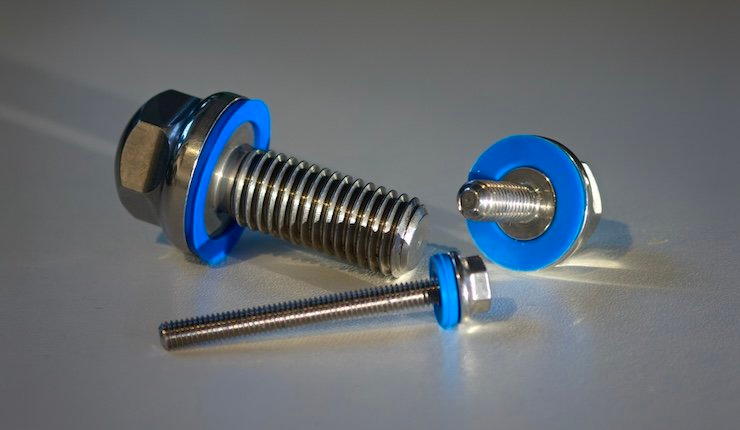
Accu has introduced an expanded range of hygienic bolts intended to reduce contamination traps across pharmaceutical, food, biotechnology, and other washdown production equipment.
The fasteners combine polished stainless steel bodies with integrated sealing elements that close the interface around the bolt head. Available variants use 304 or 316 stainless steel with EPDM or silicone seals selected according to the operating environment.
Metric sizes extend from M4 to M20, providing options for machine guards, enclosures, processing equipment, access panels, frames, and other assemblies requiring regular cleaning. Accu states that selected products are manufactured to recognised hygienic design requirements, including 3-A Sanitary Standards.
Surface finish and geometry are central to the design because conventional fasteners can include recesses, exposed threads, abrupt changes in section, and gaps around the head where water, product residue, cleaning chemicals, or microorganisms can collect.
Smooth external profiles and seals reduce those retention points while making visual inspection and cleaning easier. Fewer inaccessible surfaces remain around the completed joint, provided the fastener is installed correctly and the surrounding equipment has also been designed for hygienic service.
Material selection varies within the range. Type 304 stainless steel provides corrosion resistance for many general washdown duties, while 316 grades offer greater resistance in aggressive chemical or chloride bearing environments.
The appropriate grade depends on cleaning agents, temperature, exposure time, product chemistry, and the consequences of corrosion. A material suitable for intermittent washdown may not perform in continuous contact with a concentrated chemical or hot process fluid.
Elastomer selection requires the same discipline. EPDM performs well across many hot water, steam, and cleaning applications, while silicone can provide a wider high temperature range in suitable duties. Neither material is compatible with every oil, solvent, disinfectant, or product.
Published data for individual variants shows operating ranges extending from sub zero temperatures to well above 100°C, depending on the seal and metal combination. Those limits describe the component rather than approving it automatically for a complete process, where pressure, chemical concentration, and repeated cycling can change performance.
Accu has also stated that the products are not supplied as cleanroom certified fasteners. Hygienic design can support cleaning and contamination control, but it does not by itself establish suitability for a classified cleanroom, sterile boundary, or validated pharmaceutical process.
Small components are often specified late in equipment design, even where vessels, pipework, valves, drives, sensors, and guarding have been selected carefully. Conventional fasteners can then introduce crevices or materials that complicate cleaning across an otherwise well designed machine.
Fasteners can also become a maintenance problem when seals degrade or non standard designs are difficult to replace. A rapid component replacement in pharmaceutical production showed how a relatively small mechanical item can determine whether an entire line remains available.
Good hygienic design therefore includes access, inspection, replacement, and documentation as well as initial cleanability. Maintenance teams need to identify the installed material, seal type, torque requirement, and approved replacement without relying on visual similarity.
Repeated exposure to heat, pressure washing, foam, disinfectants, alkaline or acidic chemicals, and mechanical handling can alter seals and surface condition. An elastomer may harden, swell, crack, or lose compression over time, turning a previously sound joint into a contamination risk.
The joint design must also prevent the seal from becoming an uncontrolled dead space. Excessive tightening can damage the elastomer, while insufficient tightening may leave a gap, so equipment manufacturers need defined installation procedures and torque controls where the application demands them.
Pharmaceutical and food manufacturers are placing greater emphasis on contamination control strategies that consider complete systems rather than only major components. Annex 1 expectations in sterile manufacturing, together with established hygienic design principles in food production, encourage the removal of avoidable surfaces that are difficult to clean or inspect.
Documentation must follow the physical design. Material certificates, seal specifications, installation records, inspection intervals, and replacement history allow quality and maintenance teams to demonstrate that the joint remains suitable throughout service rather than only at commissioning.
Fasteners cannot compensate for poor equipment layout, unsuitable materials, inaccessible pipework, or inadequate cleaning validation. They can remove a common design weakness at comparatively low cost when incorporated early enough.
Accu’s expanded range gives equipment builders a broader catalogue option for those duties. Final selection will still depend on process conditions, certification requirements, seal compatibility, cleaning validation, and the quality system governing the finished machine.